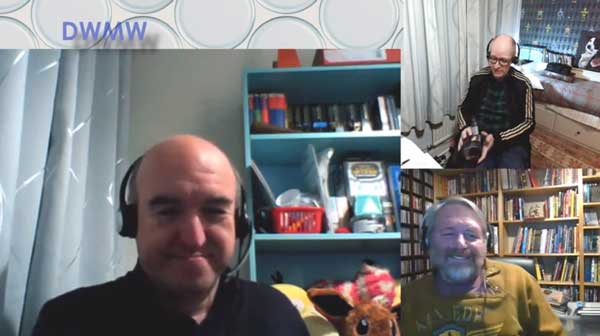
Shortly before I started out making my own podcast series, I took part in Nigel J Anderson’s own video podcast Doctor Who Most Wanted, alongside Brian M Clarke. The same line-up would meet again online a couple of weeks later to record the first episode of Very British Futures.
, Nigel
Now that podcast is available on Youtube and I urge you to watch, especially if you have been enjoying Very British Futures. The focus of this episode is on reconstructions of missing episodes, both official and fan-made. I knew Nigel had ambitious ideas but I’ve been taken aback with how polished and visually entertaining the episode has turned out, thanks to the many hours he has put into it, to turn a Skype chat into a proper half hour episode.
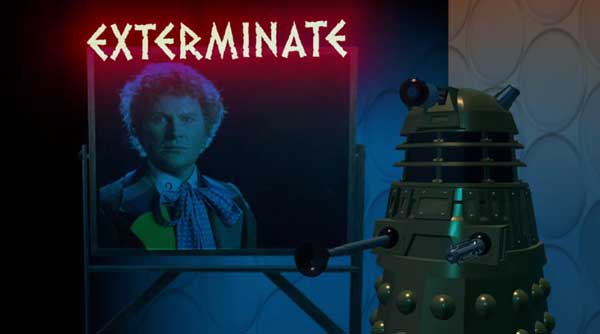
Where possible the Skype footage is enlivened with CGI illustrations, alongside an animated clip of the unmade William Hartnell story Masters of Luxor, a clip from Nigel’s live action recreation of the opening chapters of Doctor Who in an Exciting Adventure with the Daleks, plus other animations.
We cover quite a range of topics in course of the episode, including a look back at The Stranger series starring Colin Baker, the recent animated Troughton stories, and what stories we would especially like to be returned to the BBC archive.
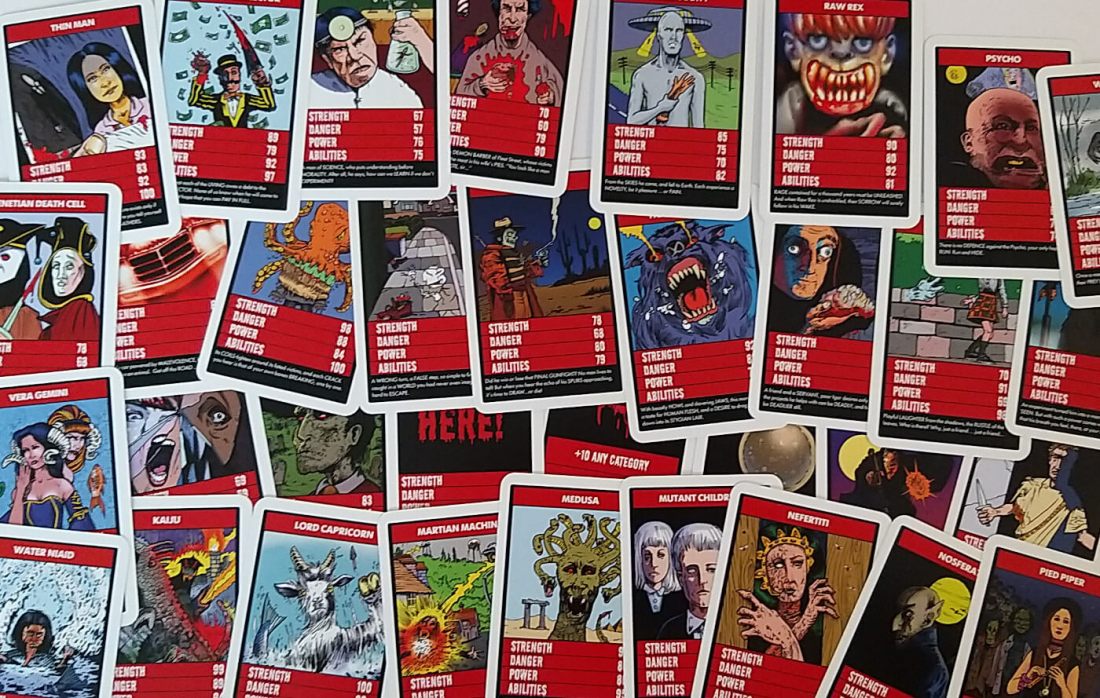
In other news, there is still a little time to take part in Rik Hoskin’s Terror Trumps Kickstarter campaign and get a copy of his marvelous 70’s retro horror card game. If you want to learn more, take a look at their Kickstarter page http://kck.st/3bLx6zm
The Nineties were a busy time for SF television, just not for British voices. Whilst the success in syndication of Star Trek: The Next Generation ushered in a purple patch for US television – The X-Files, Deep Space Nine, Stargate SG1 and countless short-lived shows with a range of quality, it seemed to me that the UK lost confidence in the genre once Doctor Who was cancelled (bar the one-off 1996 TV Movie). It’s noticeable that a lot of what was produced by TV companies in this decade for peaktime audiences put the emphasis on their ‘realism’ or carried assurances that they were not ‘science fiction’ but drama. Star Cops, Bugs, Space Island One. ITV’s The Uninvited is an interesting example of that. It’s an alien invasion story dressed up as A Ruth Rendell Mystery.
I enjoyed rewatching The Uninvited recently and I equally enjoyed talking with my friends John Isles and Nicky Smalley about it a few weeks ago for the next edition of Very British Futures. Turns out like me, John kept it on VHS tape for a long time, simply because it was British SF TV at a time of relative scarcity. I don’t think I quite managed to fit in my appreciation of Leslie Grantham as one of the chief alien bad guys, all intense stares and cool demeanor. This episode might feel a little different to the preceeding ones because I was testing the water by having a more wide-ranging conversation about the Nineties and novelisations too. Here’s some more details about the show for the record.
Principle Cast Douglas Hodge – Steve Blake Leslie Grantham – Chief Supt. Philip Gates Lia Williams – Melissa Gates Sylvestra Le Touzel – Joanna Ball David Allister – James Wilson Caroline Lee-Johnson – Sarah Armstrong
Writer – Peter Broker Music – Martin Kizsko, Toby Gilks Cinematography – Doug Hallows Editor – Colin Goudie Producers – Ruth Boswell, Leslie Grantham, Laura Julian, Archie Tait Director – Norman Stone
I’ve been adding the RSS feed for the podcast to more online directories. You can find it at: Anchor, Spotify, Google Podcasts, Apple Podcasts, RadioPublic, Breaker, Pocket Casts, Spreaker, Blubrry, and Digital Podcasts.
However you can still listen or download the show from the link below too.
Grisly, lurid artwork. An array of horror fiends, both classic and original. Yes it is the return of Rik Hoskin, Tim Brown and Chatri Ahpornsiri’s labour of love Terror Trumps a card game which is also a homage to the classic Seventies Top Trumps Horror packs. I wrote about this project a few months ago. Now I’m the proud possessor (ho ho) of the enhanced version 2.0. Not only do many of the cards feature fresh characters and new art, but each carries a witty description by Rik too. Plus they’ve introduced more power-up cards too.
If you would learn more, take a look at their Kickstarter page http://kck.st/3bLx6zm
I really hope this imaginative project gets the support it deserves.
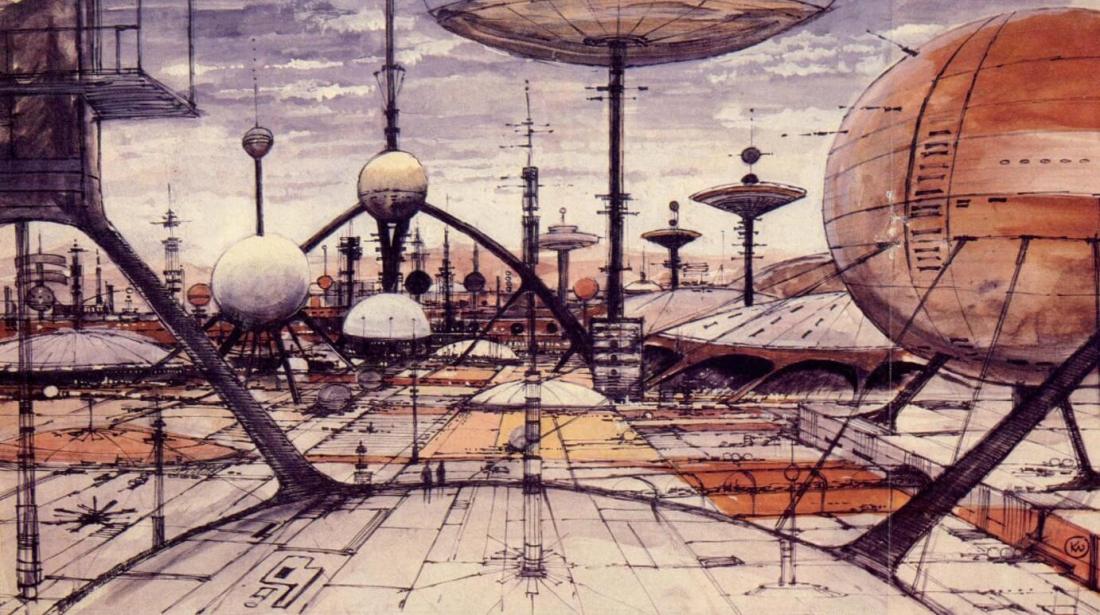
Star Maidens is exactly the kind of show I originally set this podcast up for. Not quite a lost show, but certainly an obscure one, at a time when there was not that much SF on mainstream television that was not Doctor Who or from the Gerry Anderson stable. A British-German co-production, it’s certainly got a lot of problems in both concept and execution, but there’s some interesting ideas in there and for a relatively low-budget production, the world of Medusa is quite impressive thanks to Keith Wilson’s production design skills. (see one of his design drawings above for the Medusian city). Wilson also was the lead designer on Space 1999 and the two shows share a certain look. Although the more location bound episodes set on Earth do look cheap and ugly in that special Seventies way.
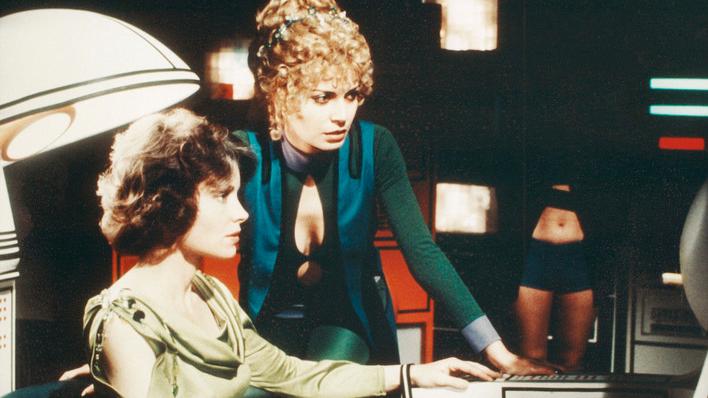
Liz is interrogated by Octavia
It’s also intriguing to think that this show was shown a year before Star Wars was released and rewrote the SF landscape for ever. Nevertheless the disco futurism look of SF, typified by Star Maidens would persist for a while yet. Buck Rogers in the 25th Century would be a key example. Despite the opportunities for kinky dominatrix and lesbian subtexts, and the fact that it has a plethora of beautiful women in its cast, it does not feel like a particularly sexy show, or at least no more than Space 1999 or UFO did.
We got so busy talking about the gender politics and the characters with my guests Dr Rebecca Wray and Kevin Hiley that we left out some basic details about the show. So here are the essentials you might like to have whilst listening.
Cast
Lisa Harrow – Liz
Christian Quadflieg – Rudi
Christiane Krüger – Octavia
Judy Geeson – Fulvia
Gareth Thomas – Shem
Pierre Brice – Adam
Derek Farr – Dr Evans
Dawn Addams – President Clara
Directors
Freddie Francis, Wolfgang Storch, James Gatward, Hans Heinrich
Writers
Eric Paice, Ian Stuart Black, John Lucarotti, Otto Strang
Producer
James Gatward
Very British Futures episode 4 – Star Maidens is available on all the major podcast platforms, or you can listen and download an MP3 copy below.
Very British Futures – Star Maidens
In the end, I’m glad I’ve finally got around to seeing this show, which for years I only remembered for the sticker colouring book which my grandparents bought for me back in 1976. Thanks for your continued listening and support.
One of the benefits of inviting different combinations of guests on to each episode is that you get a variety of tones. It keeps it fresh and surprising. This episode, covering the BBC Eighties series The Tripods, for example welcomes Andrew Roe-Crines to the guest sofa, along with regular contributor Kevin Hiley. Andrew is a senior university academic and he brings a certain thoughtfulness and rigor to his answers. Combined with Kevin’s great enthusiasm for this programme, it results in our deepest and most analytical hour so far, and one that has made me look at this drama series with fresh eyes. I hope it does for you too.
The Tripods was an unusual commission for the BBC, who have tended to regard Doctor Who as fulfilling their annual family science fiction needs. There hadn’t been an example of two major SF series on BBC1 since Blake’s 7 had appeared 1978 on mid-week evenings during the Star Wars boom. Based on the popular children’s novels by John Christopher, it followed the adventures of teenagers Will, Henry and Jean-Paul (nicknamed Beanpole) as they go on the run across Europe and eventually join the human resistance against the Tripods, gigantic machines which rule the human race through “capping”, a metal circuit fused to the skull. The cap makes the wearer an obedient drone. Ultimately the resistance discover that the Tripods are in fact vehicles for an amphibious alien race known only as the Masters.
Co-funded by the Australian channel WGB, this was an epic production, with lots of location filming and impressive effects. Unfortunately that epicness also led to a leisurely pace, especially in the first season. Viewers were frustrated by the lack of Tripods in many episodes, often only appearing for a moment, striding by. But when the action came it was excellent and the second season was much livelier than the first. But it was too late and the audience never returned in large enough numbers. Unlike the current BBC/HBO adaptation of His Dark Materials, which publicly committed itself to making the whole trilogy from the start, the BBC were making decisions on a season by season basis and fresh productions from new producers were lobbying for its budget. So The Tripods became a trilogy of only two parts.
In the subsequent years there have been rumours of a Hollywood movie but nothing has come of that. Personally I think the series, with a bit rewriting, especially to boost the female participation, would be a great fit for a streaming service. You can learn more about the series by listening to the podcast, which is available on Anchor and Spotify amongst other platforms. You can also listen or download a copy below.
Very British Futures – The Tripods
Future programmes coming up on Very British Futures podcast include: Star Maidens, The Uninvited, Max Headroom, Out of the Unknown, Star Cops and The Nightmare Man. If there are any British SF shows you would cover in the future, why not drop me a line or leave a comment? All the best.
Response to the first episode of Very British Futures was very warm, and now I am keen to push on and get several more recorded between now and September, when my workload will increase. Next out of the gate is Knights of God, the ITV 1987 family adventure series set in the then future year of 2020. Now 2020 was not a bundle of fun for most of us, but at least the country had not collapsed into ruins and being ruled by a jackbooted religious order. It’s an impressively mounted television series that recalls ITV’s ambitious children’s series from the Seventies such as Sky and Children of the Stones in its scope and grittiness.
I was glad to be joined over Skype by my old Westlake Films muckers Kevin Hiley and Dr Rebecca Wray to remember the show and discuss its themes. They were worried they wouldn’t have enough to say but as you’ll hear we filled an hour nicely.
You can listen to the podcast at Anchor or on one of these platforms: Spotify, Google Podcasts, Breaker, RadioPublic, Acast or PocketCasts. Whilst I’d encourage you to use one of those, to build up my figures, if you need a copy for your MP3 player, you can download it below.
Very British Futures – Knights of God
Thanks for your support and join me next time, as we continue the theme of life under occupation and young resistance fighters with The Tripods.
For the last few months I have had a project secretly coming together, something to look forward to as I laboured on the third year of my degree apprenticeship. I have enjoyed being a guest on other people’s podcasts but it has left me with a desire to do more. So it was only natural to start thinking about my own podcast series. Now episode one has been released on the Anchor platform and Spotify, and hopefully will gradually be made available on other sources too soon.
Very British Futures is a celebration of lesser known science fiction television series which Britain has produced over the years. I felt that there already enough excellent series and websites covering Doctor Who, Blake’s 7, Red Dwarf, The Prisoner, Quatermass and Supermarionation but there was a niche for talking about some of the less well-remembered productions. So each episode, some special guests and myself will be looking back at a different show, critiquing it and putting it into context of the history of SF. There’ll certainly be humour but the emphasis will be on appreciation rather than mockery.
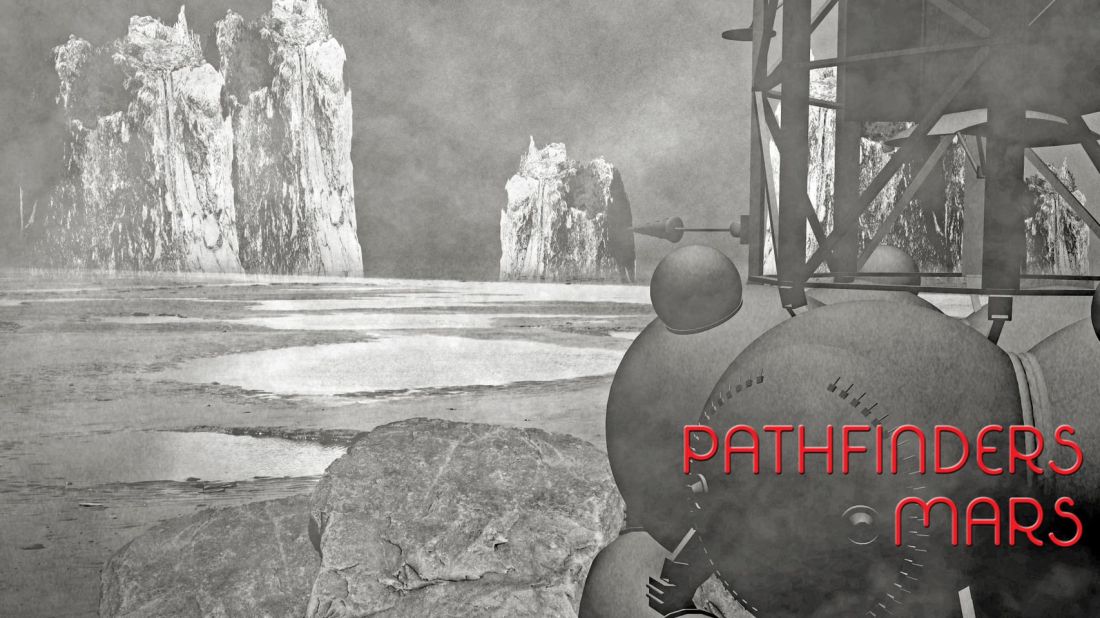
1961’s Pathfinders in Space trilogy seemed a great place to start. It’s not the first British SF series by any means but it feels like the beginning of a new era of modern television. Its place as the precursor of Doctor Who means it is influential but at the same time it is not nearly as well known as it should be. Plus I knew from conversation that Nigel Anderson and Brian Clarke would be happy to talk about it and both were at ease in front of a microphone. We had already recorded several podcasts about missing Doctor Who episodes, for Nigel, and I also appeared in a video discussing the Daleks which Nigel had produced. Whilst being together in a room to record would have been pleasant, Skype’s audio quality was acceptable for a simple conversation.
It’s been good to go back to a little light audio production. Making a podcast is a lot simpler than an audio drama. Most of the work is editing the original Skype recording, applying some noise reduction, getting rid of mistakes or sections where the conversation went too far off-topic, then bookending it with music. My biggest problem has been learning to use a headset properly, being more use to a microphone on a stand or a dictaphone. I turned to my friend Chatri Ahpornsiri, who I’ve worked with on previous audio dramas, to provide the theme music and he generously provided four versions to choose from. You can hear more of his marvellous work at chatriart.bandcamp.com. There are several free to use platforms for hosting podcasts. I felt Anchor was the easiest to use and I was attracted by the way it automated posting my series on most of the major podcast outlets.
There is now a home for the podcast on the web, with more information and links to sources mentioned in the show. You can listen to the series at https://anchor.fm/gareth-preston but unfortunately you cannot download the episode easily from there. Whilst I’d prefer it if people streamed it from here or one of the other platforms for the sake of the show’s stats, I appreciate that some people would like the option to download the MP3 file for portable listening. So you can find episode one below:
Very British Futures – Pathfinders in Space
At the moment I am editing the second episode, in which Rebecca Wray, Kevin Hiley and myself talk about Knights of God. After that there are plans to make episodes about: The Tripods, Star Maidens, The Uninvited and after that I have a long list of possible candidates, and plenty of guests I am hoping to record with. Would love you to have a listen and hear back from you, what you think and what shows you would like to be covered.
Lockdown has not been kind to theatres or indeed creative groups of any discipline. Overcoming restrictions however can be its own kind of inspiration and this month saw the release online of my most ambitious video in quite a while.
To give credit where it is due, Stages in Waiting (working title – BLT Lockdown Podcast) was initially conceived and written by Peter Scofield, the actor and director who I’ve worked with quite a bit over the years, both as a co-star and behind the scenes. When ideas were being thrown around the committee for what kind of videos Bolton Little Theatre could make, monologues were the obvious answer and the Life Bites series grew from that. However from the beginning Peter liked the idea of performing something bigger. He written quite a lot of humorous poetry over the years and he had the idea of a short video anthology, filmed on location in the environs of Bolton Little Theatre. As well as Peter’s words, there would be a bit of Shakespeare and some public domain songs too. Initially there was talk of a live streaming broadcast followed by an edited version on demand. Ultimately, the project was scaled back to an on demand video, due to the complexities, challenging enough under normal conditions.
The idea of filming actors separately was always there, to make it easier to film in restricted C19 conditions, but originally the cast would gather together on stage for the final number. We had an initial meeting and set a recording date in late August. Then Bolton entered a local lockdown and the general feeling among the participants was it was too risky. Government advice waxed and waned, I was preoccupied by my house move, and suddenly we were halfway through October. Peter, Sandra and I had the feeling that if the film wasn’t made soon it might never be, now that winter was setting in, Christmas was on peoples’ minds and the theatre hoping to re-open in the New Year. So a revised production was put into action, now wholly made up of single performers who would only meet in Adobe Premiere. We agreed new dates and Sandra Leatherbarrow organised the rota of actors who would come to the theatre over two evenings. Then in the preceding weekend, Boris announced Lockdown 2, beginning right in the middle of our schedule! Nevertheless we decided to push ahead, even though this meant some last minute cast changes. Including a surprise cameo from myself.
If that wasn’t enough, I also decided to make this film with a new kind of camera I had only recently obtained – a DSLR (Canon EOS60D to be precise). I had seen that many other filmmaking acquaintances of mine had been using DSLR cameras instead of camcorders for years, now that they could record HD video. DSLR’s offer the benefits of customisation, better lenses and a socket for an external microphone, something basic that nevertheless a lot of camcorders in model’s price range seemed to lack. My first attempts at filming were somewhat blurry but I had learnt more and now was fairly confident I could get some decent material. I think the results speak for themselves. I’ve still more to learn, but Stages in Waiting is my best looking personal film yet. Rich colours, and between my two lenses, some depth of field shots I’ve never tried before. I’m now fully converted to the DSLR cause, at least as far as tripod filming is concerned. My camcorder is still superior for moving hand held shots.
My direction was light, confined to just encouraging one or two to be a bit ‘bigger’ in their delivery. My cast were all experienced performers so I could concentrate on the shots and just listen out for fluffs. Considering nobody acted with anyone else, their performances meshed together magically well in the digital cutting room. Released on Saturday 21st November on Bolton Little Theatre’s YouTube channel, the response so far has been gratifying positive. I’m proud of Life Bites too, but Stages in Waiting is just a bit more unique than I’ve seen any other local group do. I hope you enjoy it too if you watch it.
A few months ago you may have read here that I guest edited an online issue of Worktown Words for my old friends over at Live from Worktown. It was a new experience for me, curating a month of poetry submissions, all on my chosen theme of Celebration. The standard of entries was genuinely high. My thanks to editor Paul Blackburn for inviting me and his help.
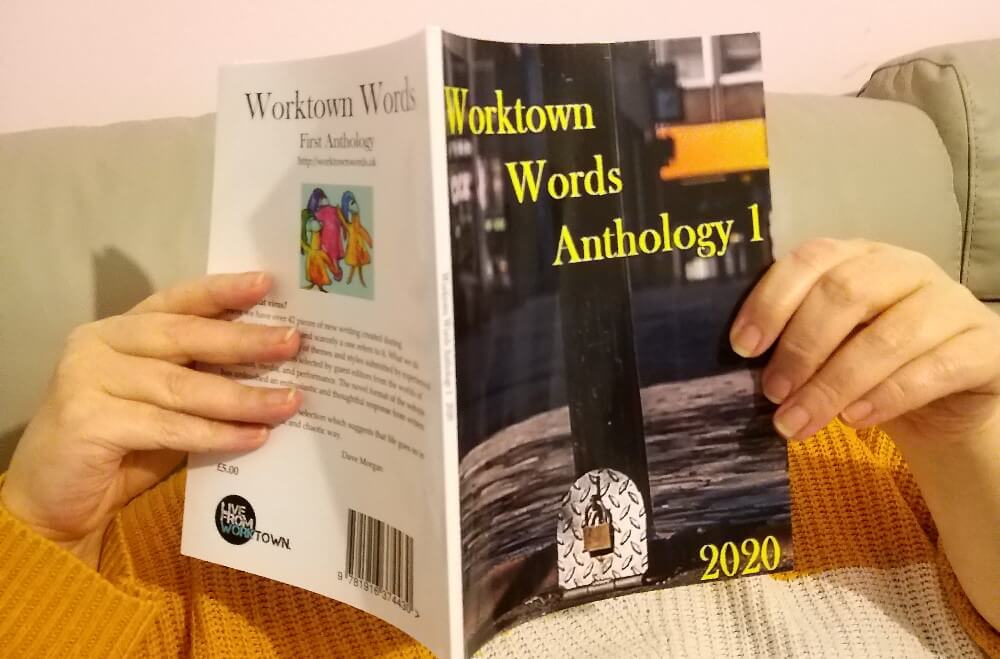
Tina enjoying the new anthology
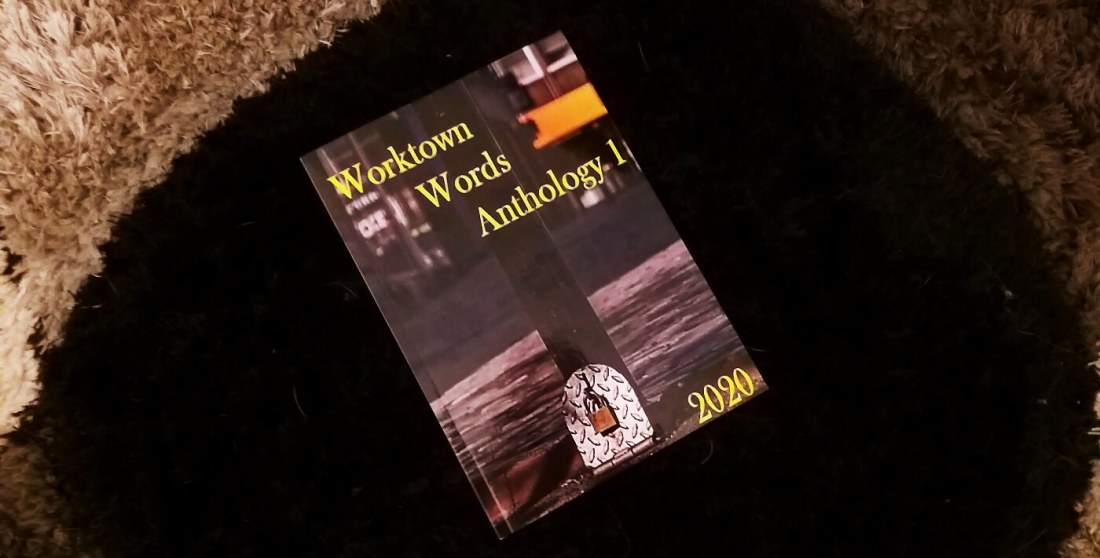
Now a selection of the best of the first ten issues has been released in paperback form and I received my contributors copy a couple of days ago. Two poems come from my issue and they are both stormers – Magician on the Podium by Rosie Adamson-Clark, and My Human Brain by David Bateman. Dipping into it I’m impressed once again by the quality of the pieces. It’s full of emotion and ingenuity. Other highlights I have discovered include No Shock by Shaun Fellows about a notorious political figure and Freedom by Donna Hughes, a tale of meeting a Scottish salmon. The other themes during this first ‘season’ of books have been: Spring, Joker, Horizon, Escape, Shock, Silence, Stranger, Heritage and Tear.
Keep looking for opportunities they say. With no chance of Bolton Little Theater or indeed anyone else’s theaters opening for business anytime soon, creatives are turning to the internet to tell stories and keep connected with their audience. Quite a few local theaters and film-making groups have ventured into monologues, with their obvious advantage of combining lockdown friendly simplicity with potentially great acting and writing. After all, Alan Bennett’s Talking Heads is considered a drama benchmark. Not that I am presenting BLT’s own contribution to the genre as anything like on that level, but it is a versatile format and I hope our Life Bites are going to exploit it.
I was first approached in August with the idea of making short videos for Bolton Little Theater by Carol Butler, who has joined me as producer on this series. She had noticed several of our rivals were already producing them and felt our group was getting left behind. So we proposed the idea to the committee and it was accepted, along with plans for a larger group video filmed at the theater called Stages in Waiting and a short excerpt from ‘Allo ‘Allo, the play we would have been producing in September. Sandra Leatherbarrow suggested the title of Life Bites and it felt right immediately to me. My next act was to set up a dedicated YouTube account and create an animated ident out of the theatre’s logo. A simple coming together of the front symbol and the background coloured square.
Like me, Carol is a writer and performer and had recently been compiling her stories and poems into a forthcoming anthology. She drew on one of these comic stories for the first instalment and recorded it on her smartphone in an impressive feat of learning unknown technology. All I had to do was create the title sequence. I was influenced by the old BBC Play for Today credits from the Seventies. Since these monologues are likely to be all close-ups of performers, I did my best to find photos from old BLT productions which were a good close up of an interesting face and it was actually quite hard to find suitable images in my library. However I persevered and found enough to make the right length of montage, shuffling the actors around to find the best mix. The music was from YouTube’s copyright free music library. Why invite trouble?
Carol’s Pink Fluffy Handcuffs went down really well and has easily been the most successful episode so far. It was followed by Gig 13, Dean Lane’s comic tale of a nightmare gig, not drawn from his own musical career but inspired by it. Dean is an excellent storyteller as well as songwriter. Then there was lull.
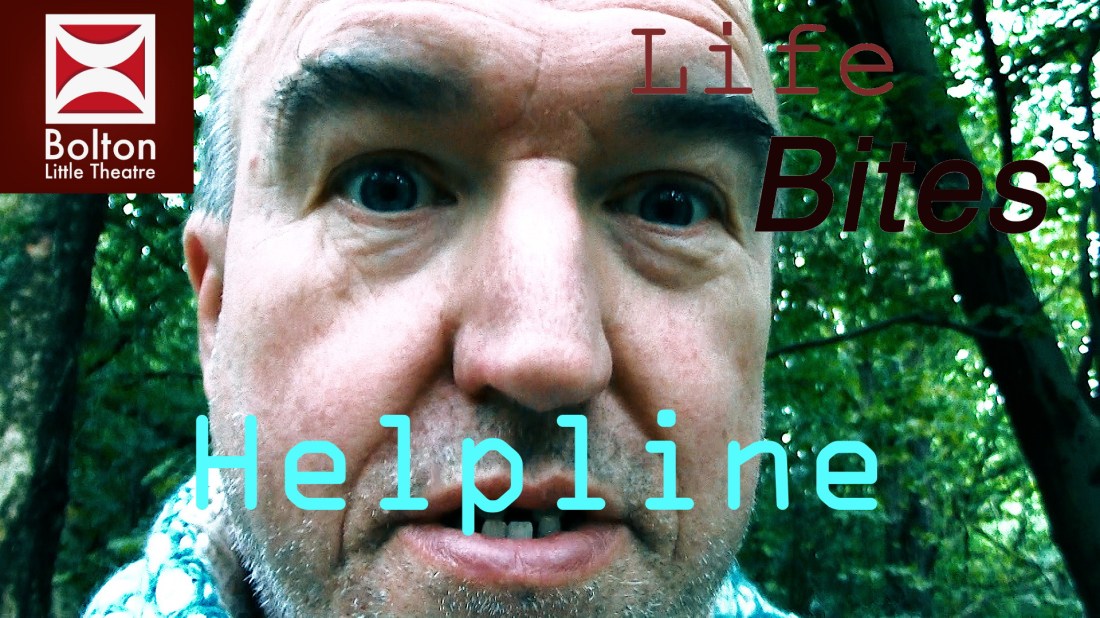
After several busy weekends, I finally had time to venture into the local parkland and find a secluded spot to record my entry Helpline. I originally wrote this for the Octagon Theater’s 2014 Best of Bolton evening for local writers, where it was performed by Hylton Collins, before he became a regular on Emmerdale as Tubby Dingle. The idea was one of those that just came into my head and doesn’t have a defined origin. I was just trying to think of a quick story that would fit on a single page. For this video I revised it a bit further, making it a little punchier and adding a contemporary joke. In the end the version I filmed was a little improvised, using the script as a guide because I had not given myself enough time to learn it word perfect. I quite enjoyed editing it, adding a blue filter, some digital distortion, creating an animated message card and filtering the dialogue to give it that monitor quality. Now its out there and I would love you take a look at one of first bits of personal filmmaking I have done in quite a while.




 The Phantom Frame