Doctor Who The Aztecs Special Edition DVD

Before we begin this revisit to another of my old ciao.co.uk reviews, a quick note that the latest edition of the Talking Pictures TV podcast is now out. Hosted by Scott Phipps, it features a contribution by myself on the 1979 Quatermass series by Thames. Plus lots of interesting reviews about old British gems like Hobson’s Choice and The Snorkel. Listen to it now at Spotify, iTunes etc or its website. Thank you, now back to the marvellous Hartnell era of Doctor Who.

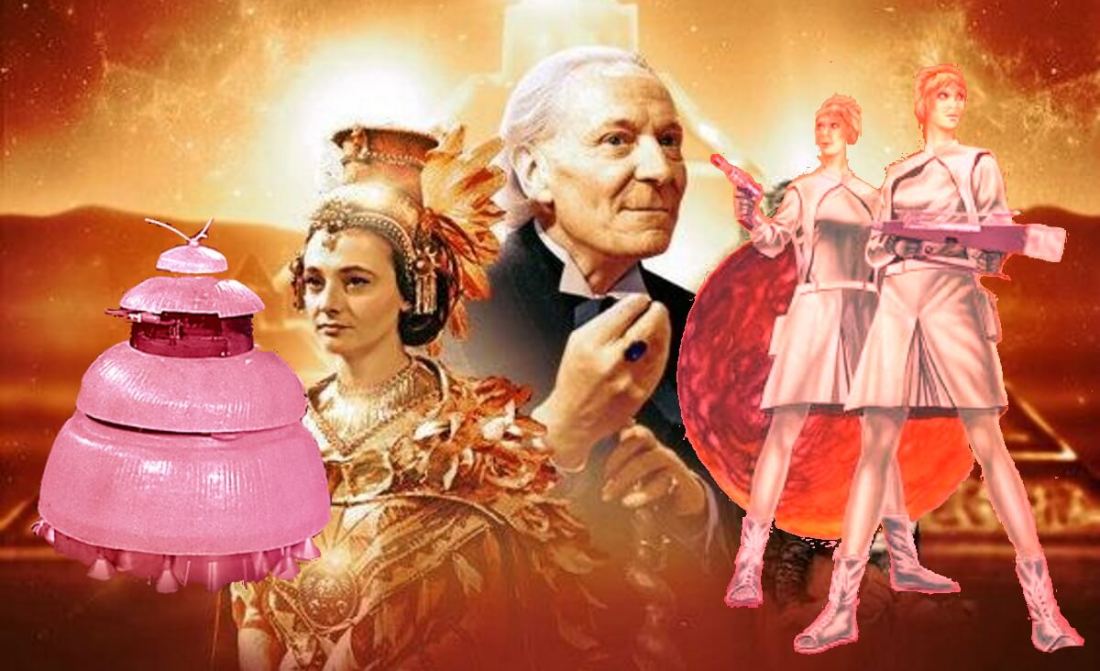
Two very different adventures for the First Doctor: The Aztecs finds the original TARDIS crew trapped in the Aztec empire at the height of its powers, two years before Cortez would arrive to destroy it. When Barbara is mistaken for a god she tries to use her influence to change history and save this civilisation. Meanwhile Galaxy Four sees the Doctor and two of his later friends, Steven and Vicki, caught between two alien races on a dying planet. The beautiful Dravhin women say they are under attack by the ugly inhumanoid Rill but time travellers begin to suspect otherwise.

The cover for this DVD doesn’t do its contents justice, advertising it as simply an improved version of The Aztecs when in fact it really a double bill that also features a recently recovered episode from the Hartnell  era which forms the centre piece of a restored ‘lost’ story Galaxy Four. The Aztecs was the first William Hartnell story to be released on DVD, in 1992 at a time when fan were still buying stories on VHS to complete their collection. It was a natural choice for the fledgling new line, being generally regarded as one of the gems of his period. At the time its picture and sound restoration was impressive but this new version is even sharper and clearer. In addition there are some new extras.

The Aztecs illustrates many of the best qualities of the Sixties era of the show. Very ambitious in scope, with several entwining sub-plots, not to mention recreating the city of Tenochtitlán in a small studio. The script intelligently deals with the moral dilemmas of twentieth century British values clashing with the South American nation’s very different mindset, especially their acceptance of human sacrifice. There is a little bit of time-travel SF as the Doctor tries to stop Barbara from interfering in established history and an educational aspect as writer John Lucarotti explores this ancient culture. All the regulars are in superb form, even Susan whose sub-plot about becoming the reluctant bride of ‘The Perfect Victim” was devised to give actress Carol Ann Ford a well deserved holiday. There’s even some humour as the Doctor’s ignorance of local custom leads to him becoming accidentally engaged to a gentle Aztec woman called Cameca. The serial also benefits from strong guest performances by John Ringham and Walter Randall as the rival high priests. This is possibly my favourite of all William Hartnell’s stories.

If you were to ask any Doctor Who fan what lost story they would like to be rediscovered, it is unlikely that many of them would have named Galaxy Four. Due to the lack of many photographs, virtually no pictures at all of its star monster the Rills, and coming from a less well regarded period of the programme, this is one of show’s more obscure stories. But that means watching it now there is a delightful element of surprise and discovery. Episode 3 – “Airlock” was recovered from a private collector last year. This has been combined with an existing clip from episode one, the surviving soundtrack and a lovingly made fan reconstruction featuring photoshopped images and new modelwork of the scenes where only the robot Chumblies are involved. The producers have made the wise decision to cut out about a third of the reconstructed footage, resulting in a pacier hour long version of the four part story, which does not harm the plot at all, since the original did feature some padding and repetition as characters go to and fron between the two crashed spacecraft and the TARDIS. If you want to experience the complete version, then you can buy the soundtrack on CD.

Galaxy Four is reminiscent of a Star Trek episode in many ways. It has a simple ‘don’t judge by appearances” moral, studio bound desert planet set and it would easy to imagine Captain Kirk trying to seduce one of blonde Dravhan women. What it lacks in sophistication, it makes up for in incidental pleasures such as the endearing Chumblies, robot servants of the Rills which look like three bowls stacked on top of each other. Clearly an attempt to create another money spinning character like the Daleks by author William Emms, the Chumblies failed to catch on with the public. Meanwhile the Rills are purposely rather immobile, unable to leave their ship due to the planet’s atmosphere being poisonous to them but they look suitably bizarre and Robert Cartland provides a fruity theatrical voice for them. Best of all is Stephanie Bidmead as Maaga, the ruthless leader of the Dravhans. She’s intelligent, drily self-aware and a bit of a sadist. Her high point is delivering a memorable speech into the camera as she contemplates the forthcoming death of the Rills and the Doctor. Hartnell and Maureen O’Brien make a good team as they explore together, in fact I think this is as good as I’ve ever seen Vicki.

This two disc set comes with a plenty of extras. There are most of the features from the original release: a Blue Peter item with Valerie Singleton visiting the ruins of Tenochtitlan and giving a potted history of Cortez and Montezuma, “Remembering the Aztecs” – interviews with surviving cast members, “Designing the Aztecs” – an interview with designer Barry Newbury and “Making Cocoa” – an amusing animated guide to making the chocolate drink the authentic Aztec way. Also remaining is the option to watch episode 4 with Arabic dubbing as recorded in the sixties and one of the TARDIS Cams, a series of wordless short videos produced by the BBC’s then newly formed online media department in the early Noughties.

The commentary features producer Verity Lambert and actors Carol Ann Ford and William Russell. It’s not that good unfortunately because their specific memories are few and far between, making most of material just comments on what they are watching like three viewers. It was commentaries like this that prompted the DVD makers to start including a knowledgeable fan in the panel for later sixties stories.

As well as Galaxy Four, the second disc features the brand new DVD content. From the BBC2 archives comes an episode of the history series Chronicle. “The Realms of Gold” is wonderful documentary about the story of Cortez and the Aztecs. If it was being made today it would have dramatic reconstructions, CGI and a booming score. There’s something rather relaxing about its more academic tone, with contemporary illustrations, maps, location filming and an austere score by the Radiophonic Workshop. Also from the library comes what is almost certainly the first Doctor Who TV comedy sketch, a clip from Michael Bentine’s “It’s a Square World” featuring Clive Dunn dressed as The Doctor, playing a rocket scientist.

Many people who buy Doctor Who DVD’s are collecting the whole set. This has encouraged the makers to make several multi-part documentaries spread across several titles. “Doctor Forever!” is taking a look at the wider world of Doctor Who as a phenomenon. This episode is about the merchandise. It’s a subject that could easily fill an hour but this twenty minute feature covers a fair amount of ground, from Sixties Dalekmania to today’s highly detailed action figures. Some of the more unusual items are looked at too, such as the TARDIS Tuner and Tom Baker underpants. It’s one of my favourite features in the package. “A Whole Scene Going” was a Sixties magazine programme and there’s a report on the making of the second Dalek film, including a rare interview with Gordon Flemmyng.

This year there are several special editions of the older Doctor Who DVD titles coming out but this one is I think is the most worthwhile. Well recommended.

Doctor Who – Colony in Space DVD Review

As gorgeous as the new Doctor Who Collection bluray sets are, one of the strengths of the DVD releases was that, for one month, nearly every story, regardless of reputation, got its moment in the sun. Its episodes were the center of a collection of DVD extras, memories and artwork. Because there are some adventures that otherwise might always be the roughage of a season, a spacer between other more celebrated titles. Colony in Space is such a serial. The most six-parterly of all Pertwee six-parters,

The Master has stolen the Time Lord’s secret files about a legendary weapon hidden on the planet Uxarieus. So they take control of the TARDIS to send the exiled Doctor and Jo Grant on a mission to stop him. Unaware of the true reason for their journey, the pair become embroiled in the conflict between a poor farming colony and a powerful IMC mining exploration team. Uxarieus is also the home a race of primitive tribal warriors who live inside an ancient city of incredible technology, ruled by mutated priests. When the Master arrives in disguise, the Doctor begins to realise that there is a far greater danger than just the ruthless IMC Captain Dent and his troops.

One of my favourite Doctor Who novelisations is Doctor Who and the Doomsday Weapon by Malcolm Hulke, based on his own script for Colony in Space. It’s full of interesting characters and what makes them so vivid is their back stories, which also illustrate Earth’s future civilisation. It is a grim over-industrialised society where people have little experience of the outside and big corporations rule. It was shock therefore when I finally saw Colony in Space on UK Gold and found that the television version has very little of what made the book great, such as the Doctor showing the colonists how to hold a simple funeral. A ceremony they had little experience of in their automated lives. Instead these episodes are a bit of a plod, with a lot of the Doctor moving back and forth between the three camps, slowly working out a fairly simple story. The characters are all fairly stiff as well, although Bernard Kay gives some colour to his role as a sympathetic IMC mineralogist and Morris Perry is coldly effective as the fascist IMC Captain Dent. Coronation Street icon Helen Worth also appears as Mary, the young daughter of the colonist’s leader.

It doesn’t help that the planet looks is essentially a mixture of grey/brown sand and rock, even if it is convincingly harsh. Perversely, the Doctor’s first visit to an alien planet in the colour television era finds him driving through an empty quarry for most of the time. Even the alien city is largely rendered in cramped brown rocky corridors and rooms. The Uxarians are not much to get excited about either. Neither the spear-waving primitives or the gargoyle-like priests can talk and despite Jo Grant screaming when they appear, they never seem like much of a threat either. The shrunken Guardian is another disappointment, a very obvious puppet with an actor’s head poking out on top. Speaking of Jo, it’s interesting to compare her first trip in the TARDIS with those of the more recent companions. Whilst Rose, Clara et al greet the universe with wonder and thinks it really cool, Jo steps out of the TARDIS, wrinkles her nose and is asking to be taken back to UNIT HQ within a couple of minutes!

Colony in Space is essentially a western – homesteaders versus the big cattle baron, with the Uxarians playing the Indians. They even have a couple of shootouts with old fashioned rifles.  Thankfully the story does pick up a little once the Master arrives, played with charming evil by Roger Delgado, but its speed never develops into more than a trot.

This DVD is relatively light on extras. “IMC Needs You!” is framed by some amusing South Park style animation but is otherwise a straightforward making-of doc, with much emphasis on the terrible weather and muddy conditions the team had to endure. Probably the most interesting fact is that the script originally called for Dent to have a ruthless female henchman, but Ronnie Marsh the Head of Serials felt that a woman in a leather uniform shooting people was too kinky for family viewing.  All the contributors seem fairly happy with the resulting episodes.

“From the Cutting Room Floor” – features a collection of outtakes and behind the scenes moments from the location filming. It’s one of the more entertaining examples of this feature, with some nice moments of humour from Delgado and Pertwee.

The commentary is a fairly luvvie one this time. Comedian and television historian Toby Hadoke chairs a discussion with stars Katy Manning, Bernard Kay and Morris Perry being joined by director Michael E Briant, Assistant Director Graham Harper (who in recent years has directed the new Doctor Who and the Coronation Street tram crash) and script editor Terrance Dicks. It’s a jolly conversation, with some laughs at the show’s expense, which frankly this story deserves.

After that there are the standard photo gallery and information subtitles, whilst Frank Bellamy’s marvellous comic strip in the Radio Times which promoted the first episode can be opened as a PDF. Colony in Space is a very average story and one for the fan completest rather than the casual viewer.

Doctor Who – The Ark

Monoid and young woman

If there is one idea science fiction has taught us, it is that huge colony ships crewed by generations of humans are generally a bad idea, prone to all kinds of sociological weirdness. Or in the case of this story, employing an another alien race as your servant class is bound to come back to bite you.

Earth is about to fall into the Sun, so the survivors of the human race have set out in a gigantic colony ship to live on the planet Refusis II. Alongside them for the journey are an alien race called the Monoids, who appear to be happy to work as humanity’s servants. When the Doctor (William Hartnell), Steven (Peter Purves) and Dodo (Jackie Lane) arrive, they accidentally infect the crew with the common cold, a virus that future humanity no longer has any immunity to. Soon it looks as if the whole population will be wiped out. Whilst the Doctor races to find an antidote, he is unaware that his presence will shortly have even more significant and unforeseen effect on the future of the human race.

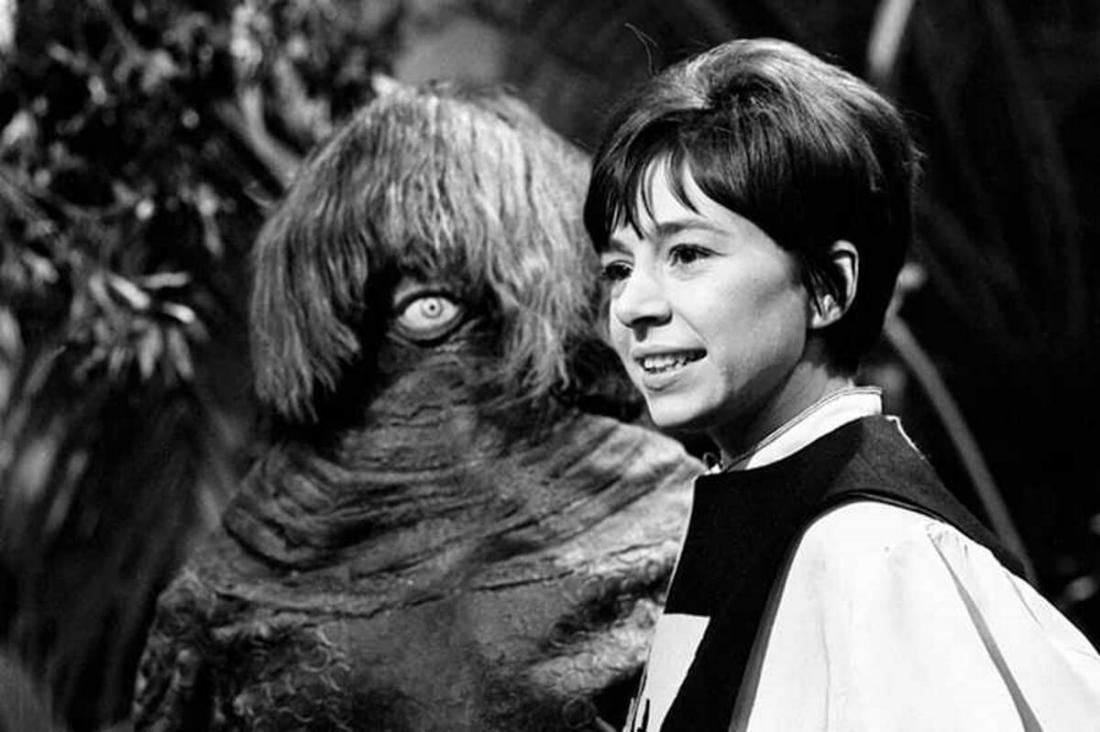
The Ark is a unique story within the history of the programme, with a twist that must have been a real shock back in 1966. It uses the time travel element of the show in a way that few other stories have, at least until Steven Moffat took over as showrunner. For once it addresses the consequences of the Doctor’s travels and encounters with strange new worlds. Unfortunately aside from that concept, this is a story I enjoyed more for its unintentional humour than its dramatic qualities. A lot of the comedy comes from the monster of the month – the Monoids. They resemble a man sized lizard with a Beatles mop top and a single eyeball in its mouth. Its initial appearance is striking but as soon as they start waddling about it is hard to take them seriously. They’re just as funny when they learn to speak and have a charming way of discussing their evil plans out loud, then being surprised when humans hear them. Their leader, simply known as Number One, comes out with one of the show’s most infamous lines, “Take them to the Security Kitchen!”

The humans aren’t much better in their skimpy togas and wooden acting. Of special note is their Commander (Eric Elliot) who delivers every line with a fruity Shakespearian flourish and has more than a passing resemblance to the ineffectual commander of the B-Ark in The Hitch-Hiker’s Guide to the Galaxy. The pace is slow too, even by the standards of the time. Once or twice the cast just literally stands there waiting whilst what looks like an airport truck rolls in slowly and parks.

According to Peter Purves who played Steven, Hartnell was becoming increasingly difficult to work with as a long term illness began to affect his memory.  There’s the odd stumble in his lines but generally for the viewer he is still the Doctor on good form, sometimes imperious and other times quite twinkly. Peter Purves himself is great. Steven is an underrated companion in the series, bringing a welcome energy to the series with a character who was headstrong and principled. This is a good story for him, where he gets to be heroic and take charge in the Doctor’s absence. Meanwhile this was the first full story for Dodo (Jackie Lane) after having arrived at the end of the last story when she mistook the TARDIS for a real police box. She’s quite likeable and makes a good team with Steven, with a pronounced Northern accent, one that swiftly fades over the course of the four weeks it took to make this story. It’s a shame that most of her stories have been junked.

Despite seeing the flaws I do admire the ambition of the serial, creating a vast spaceship with a jungle inside it, the surface of an alien planet, massive statues and shuttlecraft flying through space, all created in a small studio on a budget that wouldn’t pay for one set in the current series.

As is often the way with Hartnell stories, sadly most of the key players are no longer with us to be interviewed. However Peter Purves who played the companion Steven and director Michael Imison are very much alive and join stand-up comedian and fan Toby Hadoke for an affectionate but honest commentary. There are three major DVD extras: “All’s Wells That Ends Wells” is a documentary on H G Wells’ influence on Doctor Who. It’s a nice little piece, although the links with “The Ark” are tenuous. “One Hit Wonder” is a light-hearted feature that celebrates the Monoids and asks why some monsters only appear once in the programme. “Riverside Story” is partially a reminisce about how television drama was made at the BBC’s Riverside studios and also a look at the making of “The Ark”. All three of these features are ably presented by cultural historian Matthew Sweet. In addition there are the essential photo gallery, info text and Radio Times PDF files.

I did enjoy this story but as a fan who loves the series including its foibles. A more casual viewer might be less forgiving. So this is a DVD for the fans of Sixties Doctor Who.

Gareth Preston

Photo copyright Radio Times

Doctor Who – The Mutants

TARDIS

By the ninth season, the Doctor Who production team of Barry Letts and Terrance Dicks were finding their reliable Earth based formula for adventures beginning to constrain them. Happily they had cleverly written themselves an escape clause. The Doctor’s exile could be temporarily relieved by the Time Lords who had imposed it, when they wanted to hypocritically send him on a mission to interfere with other civilisations, the very crime they were punishing him for. The Mutants is one of those mid-table stories, decently made but perhaps lacking anything to really push it into the more memorable classics, but its excellently presented on this DVD.

The Doctor (Jon Pertwee) and Jo (Katy Manning) are sent by the Time Lords to Solos to deliver a mysterious box to an unknown recipient. Solos is a misty planet colonised by Earth where the native, seemingly medieval Solonians are treated as second class citizens and are not surprisingly bitter about their lives. They are also being terrorised by a spate of horrific mutations, as men and women turn into insect-like creatures nicknamed Mutts. When an ambassador from Earth informs the odious Marshall that their faltering empire is pulling out of Solos and giving it independence, the tyrant cannot bear the thought of losing his power. He arranges for the ambassador to be assassinated. The Doctor and Jo soon find themselves on the run and battling tribal warriors, mutants and Earth troops. Only by solving the mystery of the mutations and exposing the corrupt Marshall can they hope to survive.

It surprising that some fans have recently been complaining about Doctor Who being “preachy” when in Jon Pertwee’s time the programme was often telling allegorical SF tales. Racism had been tackled previously by Letts and Dicks in The Silurians and The Curse of Peladon but this is the most explicitly political take on the subject, a direct comment on South Africa’s apathied regime and the colonial attitudes behind it. There is also an ecological thread about future Earth becoming a barren concrete jungle and thus having to export its pollution to other planets. Mixed in with this is the SF body horror trope of humans gradually changing into something strange and inhuman. John Friedlander’s design of the mutant creatures is splendid and when they are scuttling enmasse through the caves they are pretty scary. On a trivia note, the Mutt made a cameo appearance in Frontier in Space and later was reused as another alien race in The Brain of Morbius.

Paul Whitsun-Jones had a long track record of playing flamboyant, menacing villains on TV and as The Marshall he goes into full Brian Blessed mode, shouting his way through the part in a way that may not be subtle  but is certainly entertaining. Pertwee’s Doctor is at his grumpiest in this story, acting as humanity’s conscience and horrified by the treatment of the Solonians and their world.  Special mention ought to go to Christopher Coll as cockney trooper Stubbs, making a lot out of a fairly generic guard character, even with the handicap that his best friend Cotton is played by Rick James, one of the worst actors ever in the series.

They’ve fitted a surprising amount of extras on this disc considering it is a six-part story. “Mutt Mad” is an in-depth if straightforward making-of doc, heavy on talking heads and BBC paperwork. More interesting is “Race Against Time”, a look at the show’s attitude towards casting ethnic actors. While admitting the show could have done more to promote more black faces in prominent roles, generally the show is given a clean bill of health. Oscar winning costume designer James Acheson gives a fascinating interview about his time on the programme in “Dressing Doctor Who”. He was responsible in part for the look of the Sontarans and the Fourth Doctor’s famous scarf. Then there’s a slightly random clip from Blue Peter in which Peter Purves talks about Doctor Who monster costumes, including a Mutt.  The six episodes enjoy an excellent commentary featuring a rotating cast of contributors led by Katy Manning (Jo Grant), Garrick Hagon (Ky), Christopher Barry (director), Terrance Dicks (script editor), Bob Baker (co-writer), Brian Hodgson (special sounds supervisor) and Jeremy Bear (designer). This good value disc is rounded out by the traditional photo gallery, info subtitles and Radio Times listing in PDF format.

Watching “The Mutants” again on DVD I’ve enjoyed it a lot more this time. I used to think it was too long and slow but in fact there is a lot to stir the mind and enjoy.  Pertwee is in great form, the Mutant transformations are quite creepy and I’ll even forgive the dodgy science about what happens when you get a hole in the side of a space station. (clue you don’t stand by chatting next to it just because the air pressure has ‘equalised’).

Gareth Preston

Photo by Chris Sampson, Flickr, used under Creative Commons License.

Vengeance on Varos

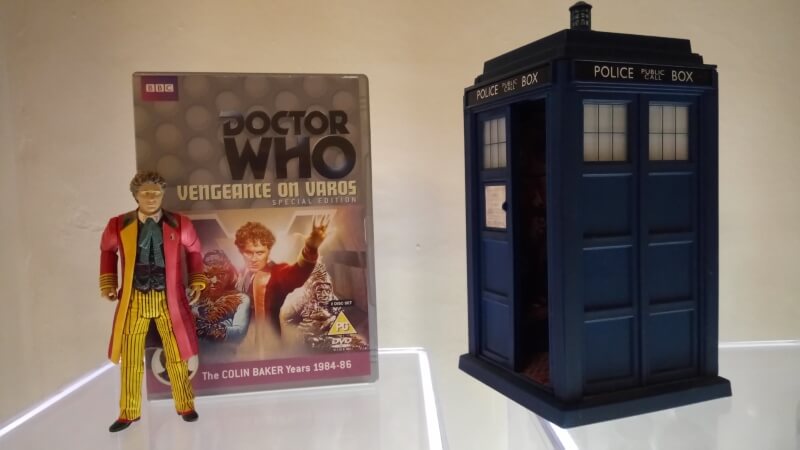
Sixth Doctor action figure, with DVD

Television loves a drama about itself. In fact it is almost a surprise it took 22 years for Doctor Who to set a story in a TV studio. Vengeance on Varos cleverly uses the audience’s awareness of both the language of television, and the lively debate about the effects of screen violence, which has rumbled on since popular entertainment was first projected on to a white sheet. Back in 1985, the whole “video nasty” controversy was still fresh in minds of many UK viewers. The early burgeoning video rental market had seen gory exploitation fare like Texas Chainsaw Massacre, Driller Killer and SS Experimentation Camp suddenly leaving the relatively controlled environment of late-night cinemas and into the living rooms of family homes. Not only that, but objectors pointed out that unlike broadcast television, video recorders had the facility to pause, slow-down and replay disturbing scenes. Doctor Who had courted controversy in the past with some of its frights, and this legacy is also re-examined in this Special Edition DVD. For some fans, Vengeance on Varos is the story that crossed the line in the depiction of violence, by explicitly involving the Doctor as a perpetrator. More on his acid bath murders later.

The TARDIS is stranded in space. Only by obtaining the rare mineral Zeiton 7 can the Doctor hope to travel again. He and Peri make an emergency landing on Varos, an ex-prison planet turned brutal mining colony. Here the Governor and his officers control the population through violent repression and lurid reality television, filming what happens in the “Punishment Dome”. They’ve even started selling packaged programmes of the disturbing footage to other worlds. Somehow the Doctor must escape the many death-traps of the Dome, and outwit the loathsome Sil, an intergalactic business shark.

Vengeance on Varos was the first Colin Baker story to be released on DVD. For the time the extras seemed quite generous, most of them based around the unedited studio footage. But the presentation of the programme on DVD has become a lot more sophisticated since then, as has the methods of converting the video tape into digital. Hence this two-disc special edition with improved picture and sound, plus three new featurettes.

The core of the story is a satirical look, both at violence on television and the debate over its effects on the audience, and modern democracy. Its vision of an emotionally deadened audience, watching a constant diet of violence and death 24 hours a day maybe exaggerated but there are some prophetic observations. About the way news is reported and the cynical producers who shape the material to create stories. Or the risk that continual public referendums via TV voting, could result in meaningless democratic choice and poor government. The real complexities of the planet’s problems are reduced to platitudes and soundbites from the Governor when he asks the people for their yes or no vote. Yes, watching this story in June 2019, its hard for a UK viewer not to think about Brexit and the way the referendum has failed to achieve anything so far, except increasing our cynicism in politics.
“Well he makes me sick!” complains Arak to his wife Etta. “He’s the worst governor we’ve had since…well since…”
“Since the last one?” she finishes mockingly.
This bickering couple who watch the story unfold on the video screen in their dingy room, are obvious avatars for the both the the populace of Varos, and the real life television audience at home. But their commentary gives the rest of the story more reality and a lot of their dialogue is entertainingly meta. “I like that one,” coos Etta at the Doctor, “the one with the funny clothes.”

Television is accused of cheapening human life, reducing traumatic experiences to shallow entertainment. But ultimately it is the evil regime and economic poverty that is driving the misery, so it can be argued that the exploitative television is a symptom rather than the cause. The most important quality of this story is that it both entertains and asks serious questions to get the audience thinking. It also features one of my favourite cliffhangers, a clever post-modern moment where the Doctor’s apparent death is being directed onscreen and the episode ends with the line, “And cut it…now!” If only the end titles had crashed in on the Governor’s words, rather than the television static and Sil’s maniacal laughter, and would have been in my top ten of greatest moments in the show.
Writer Philip Martin had some form with this kind of fourth wall breaking. The second season of his Seventies crime drama Gangsters became increasingly self-aware of its nature as a television show, memorably ending with an actress walking off-set in indignation, as the picture pulled back to reveal the studio set.

Sil is the most memorable character, thanks to a marvellous performance by disabled actor Nabil Shaban and a good costume. This greedy squirming amphibian with a gurgling laugh and pompous manner is the highlight of every scene he appears in. A ruthless, cowardly businessman obsessed with profit over lives, he is an obvious comment of commercial greed but Shaban gives the character a powerful, funny personality, with some nice alien touches, particularly his gurgling alien laugh. He was popular enough to be brought back in the following season and has made a further appearance on audio. This year will see him return in his very own Reeltime spinoff video – Sil and the Devil Seeds of Arodor.

Martin Jarvis is excellent too as the haunted,resigned Governor, a leader who is literally tortured by every negative vote. There’s an interesting complexity about him. Although he mostly presented as a sympathetic character, by contrast with Sil and the duplicitous Security Chief, the fact that he originally came up with the idea of selling footage of the torture as entertainment and his willingness to use executions to achieve his aims means that his hands are far from clean. There is certainly no guarantee when the Doctor leaves that the colony is in good hands. Colin Baker is in his early days here and his Doctor is still pretty bombastic and unsympathetic. Colin Baker’s idea that his Doctor would mellow over time proved to be bad choice in my opinion, since his character too often ended up alienating viewers rather than intriguing them. Worse still, in an already violent story, the Doctor seems to come under the influence of the Dome. He fights with two guards who have recently carried his unconscious body into a disposal room. In the ensuring struggle, one guard falls into a vat of acid, and then accidentally drags his compatriot in. Watching them dissolve the Doctor remarks with a smirk, “You’ll forgive me if I don’t join you!” This hardly seems heroic, especially this Schwarzenegger-esque quip at the end. as they thrash and disappear under the bubbles. A completely wrong choice by actor, writer and director there.

Nicola Bryant is meanwhile fine as Peri, although she is pretty much a victim for much of the story. But her natural emphatic reactions to the wrongness of the world around her as a welcome balance in a story so steeped in amoral attitudes.

As I mentioned above, there are three new extras on this release.  Nice or Nasty hosted by Matthew Sweet is a cheery making-of doc that concentrates on the writers for a change, namely Philip Martin and script editor Eric Saward. It looks into the controversy of the story’s violence, as well as the budget problems. The Idiot’s Lantern sees Channel 4 News presenter Samira Ahmed looking at all the instances where television itself has appeared within Doctor Who. It’s a good succinct feature and its striking just how much both televisions and the language of the medium are threaded into the show. Characters frequently watch television (or video monitors). Events are often reported on by TV presenters to give them more reality. Occasionally characters even comment with self-awareness on the show’s own cliches. “Not even the sonic screwdriver will me get out of this one!” announces a worried Fourth Doctor to the camera in Invasion of Time.

Tomorrow’s Times looks at the press coverage of Colin Baker’s tenure. After an initial burst of positivity with his casting and arrival, sadly most of it was pretty critical. This was the time of the 18-month ‘hiatus’ when Michael Grade nearly cancelled the show and it was here that the show seemed to stop being a popular mainstream hit and the narrative became that of a struggling cult series.

It’s an actor’s commentary for this story: Colin Baker, Nicola Bryant and Nabil Shaban discuss their memories in a laid back manner. The original extras, based on the raw studio recordings are all here. Also archive clips of Colin Baker’s first interviews in the role, on Saturday Superstore and Breakfast Time which are quite charming. There is also a deleted French and Saunders sketch in which they play actors in monster costumes who keep spoiling a take, but it is tin-eared and unfunny. In addition there are the traditional high quality photo gallery and information subtitles.

Despite its relatively low budget qualities, such as the guard’s amusingly slow moving electric buggy which is in-advisedly used in an action scene, this story’s ambition and performances make it possibly my favourite of Colin Baker’s short era in Doctor Who.

Doctor Who – Regenerations Box Set

Regeneration book open and six DVD discs next to it

Regeneration is the genius idea that has enabled Doctor Who to become the longest running science fiction series in the world, rather than a sequence of fantasy television programmes aimed at the British teatime audience over the last five decades. So a DVD box set of regeneration stories, dramatic farewells rather than energetic introductions in this case, is an obvious idea. The resulting cross section of nine stories may not always be the programme at its peak, but probably a more honest portrait of the show than a collection of fan chosen favourites would be.

Here’s another review from my Ciao shopping site archives circa 2013, when a small tsunami of Doctor Who merchandise was sweeping through the shops as part of the 50th anniversary celebrations…

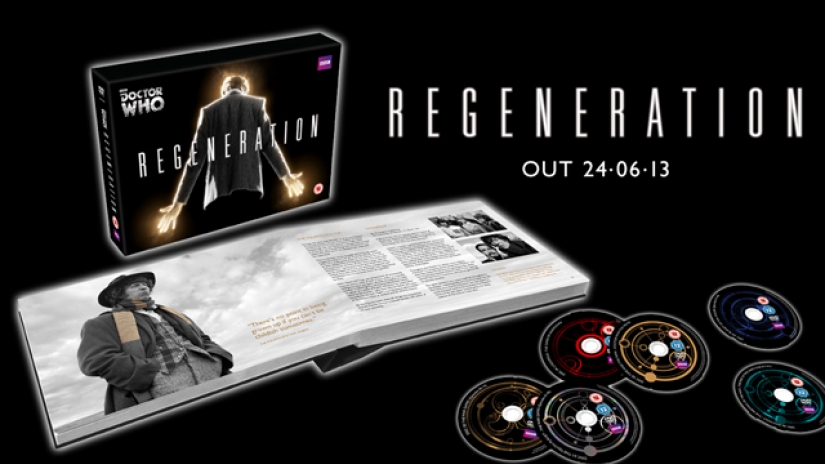
There’s a lot of Doctor Who out there for a new fan. It’s exciting but at same time maybe also a little intimidating for some. Presumably it is that kind of viewer that this 50th anniversary box set is aimed at. Its theme of “regeneration” seems an obvious choice for selecting a choice of stories across the show’s history but it throws up problems too. For a start Colin Baker and Matt Smith hardly get a look in, only appearing in the regeneration scenes themselves, whilst Patrick Troughton is over-represented because his final story is a ten episode epic. In many ways a collection of the Doctors’ debut stories might have been a better idea, not least of which is the fact that such stories often focus on the idea of regeneration much more. True Patrick Troughton would then have had the converse problem, since his debut no longer exists* but a compromise might have been found. Nevertheless the stories we do find here show the programme at its best and worst, so at least it is representative in that sense. All the discs contain new menus designed to match the book and the bare episodes only, none of special features are included from their individual releases. For your money you will get:

The Tenth Planet
A frail Doctor faces the Cybermen for the first time when their home planet of Mondas reappears and a squad of cyborgs invade space command at Antarctica.
A fascinating story which is as much to do with a philosophic debate about humanity as it is an action story. Plenty of good characterisation from the guest cast, particularly Robert Beatty as the aggressive General Cutler. The Cybermen look more like the walking dead, kept alive with a creepy life support system. I think it’s a great design and it’s a shame it was dropped so quickly for the more robotic look we’re familiar with. Episode four no longer exists, so it has been recreated in sepia toned animation. Thankfully the animation is a big improvement on the choppy twenty camera cuts a minute style of The Reign of Terror a few months ago and is an entertaining watch. This story will be unavailable to buy on its own until November, but I can’t see many fans buying this box set just to get hold of this story a few months earlier, especially since it lacks any special features.

The War Games
The TARDIS seems to land in No Man’s Land during World War One, but the Doctor soon discovers that he and hundreds of kidnapped human soldiers from across history are part of an ambitious plan by the alien War Lords.
An epic adventure which not only sees off the Second Doctor but introduces the Time Lords and the Doctor’s origins as well. It’s a splendid story packed with colourful characters, great cliffhangers and funky Sixties designs. Edward Brayshaw is superb as the enigmatic War Chief who carries a surprising secret of his own.

Planet of the Spiders
Mutated spiders from Metebelis 3 plan to invade the Earth and beyond using possessed humans and a perfect blue crystal once stolen by the Doctor.
The Third Doctor bows out in a story involving lots action, a plot inspired by its writer/producer’s interest in Buhdism and some surprisingly effect giant spider puppets. As with many six part stories it can drag in places and some of the scenes on the alien planet are rather stiffly acted. But Jon Pertwee’s farewell to Sarah Jane and the Brigadier, lying on the floor of his laboratory, is touching and probably the closest the Doctor has got to a conventional death scene.

Logopolis
The whole universe is in danger of collapsing as the Doctor and a newly revived Master battle on the mysterious world of Logopolis.
The Fourth Doctor’s final adventure is a very sombre affair, with Tom Baker himself looking worn, ill and lacking much of his familiar sparkle. It’s a story of ideas rather than action and should be commended for trying to bring some hard science into the drama, even if it is not completely successful. It also features my favourite regeneration sequence, with lovely music from Paddy Kingsland.

Caves of Androzani
The Doctor and Peri fight to survive in a squalid tale of drugs, gun-running and revenge on the planet Androzani Minor.
The best adventure in this box set, thanks to an engrossing, blackly comic script, a superlative cast and an unusually dynamic visual style thanks to director Graham Harper, who would go on to direct several episodes of the 21st century revival as well. It’s a case of everything clicking together perfectly.

Time and the Rani
An unstable regenerated Doctor is fooled by the Rani into helping complete her project to create a machine capable of reshaping the whole universe to her own design.
Not just the worst story in the set, but one of the worst stories in the whole of Doctor Who. The story is nonsensical, Sylvester McCoy is given very little help in establishing his Doctor, forcing to him to fall back on improvised slapstick, and whole production looks gaudy and light-entertainment. Kate O’Mara is wasted in a role that requires her to pretend to be Bonnie Langford for half of it.

The TV Movie
The Master endangers the world on New Year’s Eve 1999 when he tries to steal the Doctor’s lives.
An entertaining US television movie which the BBC hoped would lead to a new US co-produced series. That was never likely to happen but it did give us a splendid Doctor in Paul McGann and helped re-energise Doctor Who as a whole. The plot goes somewhat silly at the end but there are a lot of incidental pleasures along the way. It’s become a glimpse of what might have been.

Bad Wolf / Parting of the Ways
The Doctor is horrified to discover a vast Dalek fleet has been controlling humanity for centuries from The Game Station.
Superbly confident adventure that mixes reality television satire with SF action adventure, not to mention combining the present and the far future and facing the Doctor with a major moral dilemma. There are so many memorable scenes, from the ‘death’ of Rose to the unveiling of the gigantic Dalek Emperor, to the Doctor’s holographic goodbye.

The End of Time
The Ood warn the Doctor that something terrible is coming to Earth, something that may destroy time itself, and involves the return of the Master.
A frustrating story that has plenty of great moments, but equally plenty of annoying ones too. The plot doesn’t make that much sense and the Doctor himself is curiously unlikeable much of the time, arrogant and wrapped up in himself. However it features an amazing cast of guest stars and a superb cliffhanger to part one. The Tenth Doctor’s final set of journeys to revisit all his old companions does seem an indulgence too far though and makes his near-death status seem rather ridiculous.

The accompanying slip-cased book is a real thing of beauty, filled with rare photos, exclusive artwork and a thoughtful text by Justin Richards which looks at each story in the set and the regeneration of each Doctor. The design work here is very handsome indeed, printed on high quality paper and it’s a lovely object to handle. My only caveat is that at a mere twenty four pages it is more of a booklet than a proper book. The discs themselves only contain the episodes, with none of the special features included in the main Doctor Who range. Their attractive menus are all specially designed to match the design of the book.

This is the kind of box set that would be terrific to receive as a gift (as in my case), but I think few people would plan to buy this for themselves, since all but one of the stories are already available, and mostly at bargain prices, whilst the book, nice as it is, is hardly essential. As a 50th anniversary celebration I wonder if a “Best of” approach may have produced a better selection of stories since this listing gives us three Master stories but no Daleks save for momentary cameos in The War Games and Logopolis. But if you are looking for a present for the fan in your life and you like them enough to spend nearly £60+ then this set would undoubtedly look good on any coffee table.

* Since this review was written, Troughton’s debut has been released in animated form on DVD and blu-ray.

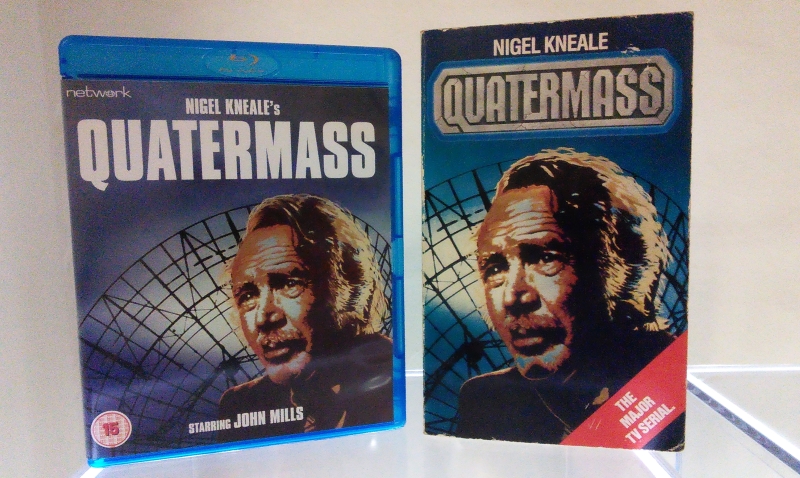
Quatermass on Network’s blu-ray

Quatermass blu-ray case and novelisation

Twenty years after Quatermass and the Pit thrilled British television audiences, Nigel Kneale created a brand new science fiction adventure for a very different era. Instead of the cramped studios of Lime Grove and 405 line TV cameras, Quatermass was made in colour, on film and made on mostly on location. The result was was an epic piece of science fiction television that divided critics and audiences at the time but has gradually risen in appreciation and is now considered very much a part of the Quatermass saga, as well as a fondly remembered ITV drama.

The near future. Seemingly thanks to a worldwide economic crisis, Britain has descended into a state of anarchy. Professor Bernard Quatermass, now an elderly man, his British Rocket Group a distant memory, has come to London to take part in a live television broadcast celebrating a pointless US/USSR space mission. But really he is trying to find his missing granddaughter Hettie. Then to everyone’s shock the spacecraft is inexplicably destroyed. Escaping the furore with a young scientist called Joseph Kapp, Quatermass discovers that masses of young people are being drawn towards ancient sites. Intrigued he and the Kapps go to the nearby stone circle Ringstone Round, only to witness the horrific sight of the whole crowd being wiped out by a huge energy beam from space. With only limited resources and growing danger from fanatical Planet People, a shaky government and violent gangs, Quatermass tries to uncover the nature of a terrifying wholly alien threat.

Nigel Kneale originally approached the BBC with the idea of a fourth Quatermass story, then titled “Quatermass 79”. Star Wars had brought science fiction back into fashion and the corporation was enjoying success with both Doctor Who and Blake’s 7. However the BBC executive most closely involved left for Thames Television and took the project with him. Thames and its cinema division Euston Films were keen to branch out from the gritty two-fisted action fare like The Sweeny which had made their name and correctly predicted that science fiction was going to be the next big trend. In order to raise the budget the project was planned to be made simultaneously as a four part mini-series and a feature film for the USA market. Kneale later said he regretted the strategy, feeling it harmed the structure his script, producing a television series that was too padded and a film that was too short for the story to be properly developed. I beg to disagree.

This set contains both the television series and The Quatermass Conclusion movie version and it is fascinating to compare them. In order for the story to work as a film, an exclusive scene was filmed to cover certain plot points. The biggest story difference between them is a sub-plot about Quatermass becoming lost after a London gang ambush and joining a community of elderly people living in hiding under a scrapyard. In the movie he simply arrives safely at the hospital and witnesses that bizarre transformation of a young girl hit by the alien ray, something that happens without him in the television version. Another major casualty is Quatermass’ friend Joe Kapp, whose family life and later mental disintegration is largely excised. Generally I much prefer the television version, which has room for its characters to develop and generally become even more sympathetic, which in turn makes the violence and the destruction more horrific. There’s also more room for humour too, such as the fuming of a camp director of a soft-core porn television show, whose studio is taken over to transmit a message.

It is wonderful to see Nigel Kneale’s literate, often downbeat, thoughtful script be realised with such an impressive production. Director Piers Haggard had previously helmed the 1971 cult British horror movie “Blood on Satan’s Claw” and many well regarded television dramas. He gives the series a great sense of scale, creating a convincing urban apocalypse and bringing energy and pace to a fairly conversational script. Compared to other British television SF of the time, such as Blake’s 7 and Tom Baker’s Doctor Who, it looks amazingly glossy, shot mostly on location, featuring night filming, and some impressively large scale sets such as Ringstone Round. Only the space shuttle interior lets the side down, looking distinctly like painted wood and lacking the accurate details. Special mention should also go to Marc Wilkinson and Nic Rowley’s melancholy and imaginative music, blending electronic and conventional musical instruments.

A common criticism of the series was that its main human danger, crowds of mesmerised hippies, was an out of date concept for 1979, a time when punk rock was the major youth movement. I’ve always found this a rather shallow argument. Its’ sense of urban decay seems relevant in any age, whilst the way that Planet People and other influenced humans reject science in favour of New Age beliefs is quite prophetic of the mood of anti-intellectulism that appeared in the nineties and continues to a lesser extent today. “Stop trying to know things!” shouts an angry protester at one point. Kneale himself said he felt the onscreen Planet People were too flower-power when he had intended them to be more manic and aggressive.

Quatermass marked John Mills’ third major British television role. As a well-known film star on both sides of the Atlantic, his participation guaranteed the production’s huge (for the time) £1.2 million budget. Playing the famous scientist at a very different time of his life, Mills brings out the professor’s humanity and decency, a man who regrets the way his obsession with manned spaceflight has damaged his family. Writer Nigel Kneale felt the avuncular Mills was miscast and lacked the authority needed for the character. Yet the Quatermass Kneale has written is initially a beaten, lonely old man who gradually rebuilds himself as the story continues and Mills is fine at playing this. Playing Joseph Kapp, Simon McCorkindale, a few years before his international fame in Dynasty, Falcon Crest and ahem Jaws 3D, in many ways represents the man Quatermass used to be, passionate, principled and driven by his work to the point where he puts his family in second place. Kneale was critical of him too in later interviews, saying he was better at playing foolish lightweight men and wasn’t good at playing an intellectual. Barbara Kellerman is excellent as Clare Kapp, his sensitive wife who begins to show signs of alien influence. Veteran actress Margaret Tyzack makes a good companion for the Quatermass as a government District Commissioner called Annie Morgan. The series is filled with familiar TV character faces like Brian Croucher, Brenda Fricker, Ralph Arliss, David Yip, Kevin Stoney and Bruce Purchase. Sharp eyed viewers will also see a pre-fame pop star Toyah Wilcox as one of the hippie travellers.

The serial has been released on VHS and DVD before but Network have once again worked wonders with the HD restoration of the 35mm film footage. The picture quality is quite incredible, filled with detail I’ve never noticed before and making the most of outdoor set pieces such as the riot at Ringstone Round or devastated London. I was worried that HD would be unkind to the special effects of the day. I shouldn’t have worried because the optical effects look better and more detailed than ever before, whilst the modelwork in the space scenes whilst obviously filmed models, looks perfectly acceptable and does not break the serious mood. The brand new 5.1 surround sound mix is equally impressive. However purists will be glad to know there is also the option of the original mono soundtrack.

Extras

With many of the principle people no longer with us, it’s perhaps inevitable that the extras on this release are fairly minimal. No commentaries or new documentary on the production. However this area is more than satisfactorily filled by the enclosed booklet by well-regarded archive TV historian Andrew Pixley. Pixley’s style of writing is exhaustively researched but very accessible. He is already something of a legend amongst cult TV fans for his work documenting series like Doctor Who, Mystery and Imagination, Out of the Unknown and many other Network and BBC DVD releases. Suffice to say that everything you need to know about the making of this series is in this slim volume. He also puts into the context of Nigel Kneale’s whole career.

There is the option for music-only soundtracks for all four episodes, and also whether the view the episodes with the original ITV episode recaps. A silent version of the cinema trailer is there. It’s a shame the soundtrack couldn’t be recreated for it. Probably the least essential extra is a silent, textless version of the movie credits, which is pretty similar to the first scene that opens the TV version. Finally there is an Image Gallery with many rare photos.

As an extra bonus (or gimmick depending on what you think), Network have released the first thousand copies of the blu-ray edition with one of four exclusive covers featuring artwork based on the original four TV title cards. The standard edition features a photo montage which is also used on the DVD release.

This new edition of Quatermass is definitely worth an upgrade if you have a blu-ray player. There is also a restored DVD edition being released simultaneously but with the blu-ray you’ll get a significantly upgraded presentation. It is a thoughtful, excellently made SF event series that deserves to be rediscovered by a whole new audience, as welcome as welcomed back by its admirers.

The Ambassadors of Death

Ambassadors of Death DVD case

Britain’s Mars Probe 7 returns to Earth after a mysterious communication breakdown and its crew are kidnapped by a gangster. These returned astronauts can kill with a simple touch. The Doctor and Liz Shaw soon discover that whoever the silent astronauts are, they can’t possibly be human. What has happened to the original human spacemen? Who is behind a government conspiracy to cover up the UK’s first official alien contact? Why does someone want to provoke Earth’s first interplanetary war?

Jon Pertwee’s era as the Doctor has two distinct periods. The latter involves the UNIT ‘family’, where the Doctor becomes fairly avuncular, his assistants Jo Grant and Sarah Jane have quite young outlooks and personalities and the whole feel of the show is warm. However his first season has noticeably more serious attitude and possibly a more mature one. Pertwee himself is testier, more aggressive and his outfit is mostly sombre colours. Liz Shaw his assistant is definitely a woman with an authority that comes from her impressive academic career. Although her taste for mini-skirts and kinky boots hints at a trendy Seventies outlook too. It could be argued that this season has less variety, with most of the stories taking place in one scientific complex or another and those stories are mostly too long, but I generally prefer this time when the Quatermass influence was more pronounced.

The Ambassadors of Death had a difficult genesis, with veteran writer David Whitaker being asked to produce several drafts, none of which the producers were happy with. Eventually the script editor Terrance Dicks took over the rewrites, along with frequent collaborator Malcolm Hulke. Because of budget problems, it had been decided to extend three of the four stories to seven episodes to save money. Whilst The Silurians brought in a prehistoric plague sub-plot to stretch its story and Inferno gained a trip to a parallel Earth, which helped to transform it into one the programme’s most epic and gripping stories, Ambassadors could only increase the number of kidnappings and attempts on the Doctor’s life, whilst the conspiracy plot hatched by the hidden traitor became both convoluted and full of logic holes. Yet to a large extent these problems do not stop the Ambassadors being entertaining moment by moment, in a Saturday matinee serial sort of way. Director Michael Ferguson is amongst the best directors the original series enjoyed, with a dynamic style and some clever visual tricks which make the most of the limited budget, such as the quick edits in the aliens’ unmasking scene, cutting between the Ambassador and Liz’s reaction. There are several excellent action set pieces, including a gunfight in a warehouse, a helicopter attack on a convoy and a car chase that culminates in Liz Shaw hanging over a raging river. For a while this is as Earthbound as Doctor Who could possibly be, it’s guns and spies and criminals who are motivated by money, damp countryside and television news reports. The Doctor may be an alien but here he could be a younger Professor Bernard Quatermass without any effect on the story. Even the spaceships are merely slightly advanced versions of existing Apollo era tech.

Then at the end of episode five a huge glowing UFO arrives out of nowhere and we suddenly return to a world where the Doctor is our intergalactic ally, exploring its psychedelic alien interior. I quite like the way the aliens never introduce themselves properly and the Doctor has never encountered them before (or since). Their enigmatic nature and briefly glimpsed true forms do help cover the fact they are some of the cheaper aliens the series has featured.

Out of the guest cast, William Dysart stands out as Reegan, the ruthless criminal hired to kidnap and control the aliens. He murders several men in cold blood, but he was also has gallows wit and shrewd intelligence. Cyril Shaps is also memorable as the weasely scientist Lennox, a clever but weak man in far over his head.

For many years this story only existed as a black and white film recording, except for episode one.  There was a colour Betamax recording from America but it was hopelessly blurry. The DVD restoration team have done a marvellous job in restoring the colour. Although the picture is still grainy in a few places, considering they were working virtually from scratch they must be commended. This is a two disc release with the second disc carrying the extras. The main item is “Recovery 7” a making of documentary which concentrates on the stunt men who were a regular feature of Doctor Who’s UNIT era. This seems appropriate considering this is an action heavy story and some coverage was overdue in this range. But it is a shame we could not have learnt more about the earlier versions of the story when it was called “Invaders from Mars” and featured the Second Doctor. The excellent modelwork is also well covered.  “Tomorrow’s Times” is a continuing feature across several of the later Doctor Who DVD’s, looking at the show’s press coverage. Obviously this time it is covering the Pertwee years, and it seems the show got a pretty soft ride from the critics, with only Mary Whitehouse raising complaints over the frightening content of some stories, particularly the killer dolls and policemen in Terror of the Autons. Finally there is the specially shot trailer for Ambassadors, in which Pertwee says key lines from the script (“I don’t know what came down in Recovery 7, but it certainly wasn’t human!”) interspersed with clips from the story. It is quite effective and it is good to see it has survived.

The commentary features a big cast and is one of the most enjoyable for quite a few releases. It is also a little sad that by the time the DVD came out, both Nicholas Courtney and Caroline John had died. But here they are in a cheerful mood, joined by director Michael Ferguson, actors Peter Halliday and Geoffrey Beevers, script editor Terrance Dicks, stunt co-ordinator Derek Ware and stunt performers Roy Scammell and Derek Martin and all moderated by fan and actor Toby Hadoke. Present and correct are the traditional information subtitles and photo gallery.

Whilst as a story it is not up to the standard of the recently released The Mind of Evil, The Ambassadors of Death is a very enjoyable SF adventure story and deserves a re-evaluation by fans, especially if they’ve only seen it edited and in murky monochrome on UK Gold.

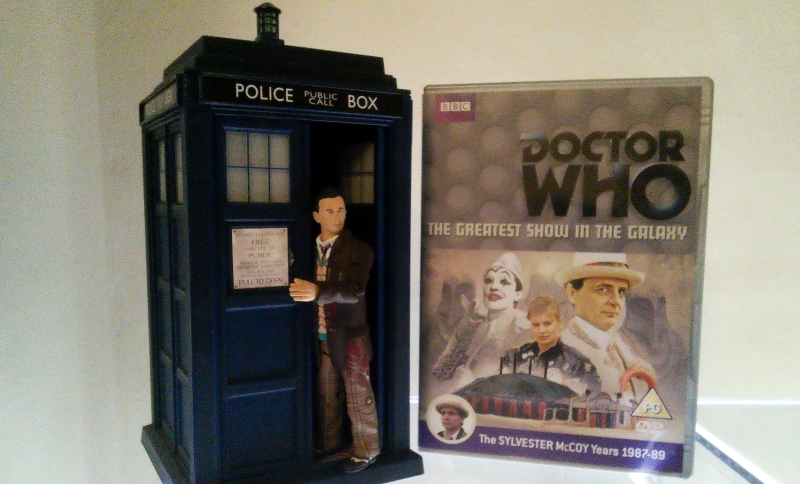
The Greatest Show in the Galaxy

Greatest Show in the Galaxy DVD case

An intelligent spambot invades the TARDIS and persuades the Doctor and Ace to visit the galactically famous Psychic Circus. However when they land on the planet Segonax they soon discover all is far from well. Why are circus folk so keen for the audience to take part in the talent contest? What is the secret of a decaying hippie bus with a deadly robot guardian? Is the circus the real reason travellers as different as Nord the Vandal and intergalactic explorer Captain Cook have arrived or is there something more powerful and ancient luring them here? The Doctor and Ace are going to need every trick up their sleeves to survive this big top!

It’s a little surprising to me that The Greatest Show in the Galaxy is the final Sylvestor McCoy story to be released because I think it’s one of his definitive outings. It is a story where script editor Andrew Cartmell’s taste for comic strip narratives, bizarre images and socialist leanings mesh perfectly with a traditional Doctor Who plot about killer robots, mysterious powerful aliens and a happy place generally being not what it seems. Writer Stephen Wyatt, fresh from his first, generally well-received Doctor Who story Paradise Towers, serves up a gallery of entertaining grotesques. The fact that some of these comic characters turn out to be evil is only enhanced by the way they are presented as being funny and eccentric.

Take Captain Cook, played with theatrical vim by veteran character actor T P McKenna. This bumptious know-it-all is presented as a kind of mirror of the Doctor, a galactic explorer with a sexy goth assistant called Mags. Jessica Martin, best known as a singer and impressionist, is immensely likeable as Mags and under different circumstances it might have been good if she had joined the TARDIS at the end. Many years later Big Finish productions would indeed produce a trilogy of audio stories around the concept. Her big secret is easily guessed by a series of heavy handed clues starting with the name of her home planet Vulpana. But the pompous Captain is no hero at all. He is entirely selfish, and quite ruthless once his life is endangered.  Also caught up in the danger is Nord, a Hells Angel biker played by Daniel Peacock, a cockney actor who seemed to be everywhere in the 80’s. There’s Gian Samanco, best known for being TV’s Adrian Mole and here cast as a rather cruel portrait of an over-earnest fan, just the kind of fanatic who was giving Doctor Who producer John Nathan-Turner a headache in real life. Whilst popping up to play another in her long career of fearsome matriarchs is Peggy Mount.

A bit of trivia, Chris Jury who plays circus member Deadbeat would later audition to play the Doctor in the 1996 TV movie. Aliens fans might recognise marine “Frosty” aka Ricco Ross as the rapping ringmaster

By this stage Sylvestor McCoy has really cracked who his Doctor is. There are flashes of the old physical comedy business with his umbrella and falling over, but there’s much more of a compassionate adventurer who nevertheless has a darker side that allows him to manipulate and even risk others for a greater good. A pleasing streak of anarchy too. “You’re just an old hippie at heart,” comments Ace. Speaking of whom, Sophie Aldred is very comfortable in Ace’s bomber jacket and her cheerful rapport with McCoy is one the programme’s strengths.

This was a troubled production as the making of extra “The Show Must Go On” revealed. The location filming had gone smoothly, but then BBC Television Centre was hit by an asbestos scare and it looked as though the studio recording would be permanently lost, making this Doctor Who’s second unfinished production after Tom Baker’s Shada. Uniquely though, the story’s circus tent setting meant that a marquee could be set up in the car park at Elstree for the interiors. Nevertheless it was less than ideal due to traffic noise and more time was lost when a fire alarm occurred. All this is covered in a decent documentary, which includes some surprising photos of the cast meeting the actors of ‘Allo ‘Allo!

Other special features include a deleted modelwork sequence of the spambot satellite and a music video created to accompany an original song by cast members Christopher Guard, Jessica Martin and T P McKenna. Frustratingly there is no accompanying information about where this song comes from or why it was recorded. “Tomorrow’s Times” is part of an on-going feature about newspaper coverage of the show and sadly has to record that the McCoy era had largely negative press. Victoria Wood’s slightly odd Doctor Who comedy sketch is included since it was broadcast around the same time. Here, future film star Jim Broadbent plays the Doctor in a brief clip that largely mocks the cheapness and made-up science of the show. “But Doctor! I haven’t brought the ming-mongs!” cries the Doctor’s mini-skirted companion. Composer Mark Ayres was auditioned by being tasked to write music for two sequences from this show and he’s included his versions as an extra too.

It’s a pretty busy and interesting commentary, moderated by DVD regular Toby Hadoke. Sophie Aldred, Christopher Guard and Jessica Martin provide the luvvie insight, whilst Stephen Wyatt, Andrew Cartmell and Mark Ayres represent the production side. There’s also the popular information subtitles and the photo gallery and finally PDF material which you’ll need a computer to access. Here the usual Radio Times clippings are joined by a story board for the spambot sequence.

I’ve always been a fan of this story and it is great to see it released on as well-catered a DVD as this one. Lovely painted cover by Lee Binding too.

Quatermass and the Pit – Unearthed Again

Alien spaceship in pit

Great news as the BBC have just released the seminal Quatermass and the Pit on their iPlayer in the Archive section. If you have never seen Nigel Kneale and Rudolph Cartier’s exciting, atmospheric and extremely influential British science fiction serial before, I cannot urge you enough to give it a try, if it is available in your region. It is a permanent resident in my television drama top ten. As child in the 1970’s I remember looking at and later reading my parent’s Penguin paperback editions of the scripts, looking at that handful of photographs in the middle and finding it all so mysterious and intriguing. I’ve no doubt that those books and my first viewing of the Hammer film version had a profound effect on myself and my creativity ever since.

So to celebrate it’s return to the public gaze, I thought I would reprint this old article I wrote for Colin Brockhurst’s marvellous A5 fanzine Circus. It is part of a five part series on the whole Quatermass series and its influence on later works. I’ve been over the article and done a little bit of editing and improving, as well as updating one or two references, so this is the definitive version. I should warn you that there are a few spoilers since this is an overview of a 1950’s television drama, so you may like to watch the programme first if you want a completely fresh experience of it.


Simply, the landmark story. The series which confirmed Professor Quatermass as one of the greats of British TVSF, and which has influenced a generation of science fiction creators with its mixture of the occult and the alien breaking into our present day world. Quatermass and the Pit is one of a handful of TV programmes that have transcended their genre boundaries. It is more than just good SF drama, just as Boys from the Blackstuff and I Claudius are far more than just contemporary drama and historical epic respectively. They are the stuff of phenomena, part of the language of British television.

   Quatermass and the Pit is an archetypal tale of the battle between science and superstition, reason versus instinct. Within it, all the major characters face a challenge to their faith, whether that be in established scientific theories, Christianity or military common sense. Significantly, the alien invasion is only stopped by a combination of supernatural and scientific knowledge, a holistic approach that embraces both sides of human civilisation. The storytelling structure is perfect, with events building slowly, clue by clue, to the shattering conclusion as London is ablaze and ordinary men and women have become something terrible. All the cast’s performances are exemplary; while Rudolph Cartier’s direction is imaginative and large scale in its ambition. The programme’s effect on its viewers was enormous. In a typical anecdote, Hereford city council moved a proposal to adjourn their meeting while they went across the road to a hotel to watch the last instalment. Throughout the country, pubs were empty on Monday nights when Quatermass and the Pit was on. Hob, the final episode appearing to be watched by television’s entire audience and the next day it was the big topic of conversation at the bus stop. But let us begin at the programme’s inception.

Rudolph Cartier and Nigel Kneale were asked by the BBC to consider making another adventure for their popular television creation, Quatermass. They met in Cartier’s office to throw some ideas about, during which Kneale observed that there was a great deal of reconstruction going on in the capital’s blitzed areas. Supposing a group of workmen were to uncover something that looked like an ancient spaceship? The appeal of this was that they could film another alien invasion without repeating the formula of their first two stories. This time the conflict arose from the long-term consequences of an extra-terrestrial contact. Not only that, but the horrors would be based around a contemporary situation that was immediately recognisable to the viewers. To convey the variations of the alien influence in humanity’s psyche, Kneale placed the Professor within a central trio, his companions being archaeologist Dr Roney and military man Colonel Breen.

“It’s a funny word, worn out before anything turned up to claim it. Martians!”

   Quatermass and the Pit‘s premise concerns a mysterious capsule unearthed by a group of archaeologists led by Dr Roney, working on an old blitz site in Knightsbridge. Roney enlists Professor Bernard Quatermass, facing a Whitehall takeover of his British Rocket Group; for his advice and he soon deduces that the cylindrical object is not an unexploded WWII missile but something far older and stranger.

“My name is Quatermass! If that means anything to you…”

Andre Morell is for me the definitive Professor, portraying him as not only a brilliant scientist, but also a compassionate, responsible and ultimately heroic man. He admirable and genuinely likeable, a feature in many of Morell’s performances. In addition his range of expertise is now much broader. As well as rocketry, he displays expert knowledge in the fields of electronics; helping Roney complete his experimental Optic-encephalograph; and biology; identifying the fibres in the capsule as resembling nerve-endings. He has become a general-purpose scientist rather than the rocket engineer of previous tales. Following the trials of Quatermass II, Nigel Kneale seems to have repositioned him as not only the conscientious face of science, but also an anti-establishment idealist, fighting against vested interests and government shortsightedness. In the early committee room scenes it is clear that he has gained the reputation as a troublemaker, treated with long-suffering patronage by most of the other members of the group, except a fellow scientist. (Referred to in the script as the Tweedy Scientist!) His bold statement demonstrates the Professor’s honesty, that he will fight the Ministery’s super weapon, The Dead Man’s Deterrent, all the way. Another man might have compromised or lied to save his position. As far as the military and the minister are concerned, he is yesterday’s man. One who has done sterling work in his time but now stuck in his ways, still clinging to old-fashioned methods rather than facing the larger realities. They barely conceal their relief that Breen, a fervent supporter of the Dead Man’s Deterrent and possibly one of its devisers, is soon to replace him.

Morell also brings out a new, humorous side to the Professor’s character where his predecessors had made him seem a bit dry. He gets in quite a few sly digs at Breen’s obtuseness and his flimsy Nazi weapon theories in the early episodes. Quatermass also displays an amusing flair for deadpan comments. When Potter is unsure whether he can convince Breen to leave the capsule alone, the Professor, who has just left Breen being sick following a Martian sonic assault, remarks, “At the moment I think he’s fairly amenable!” His earlier encounters with the unknown have forced him to have an open mind and so he is more willing to pursue the supernatural elements of the mystery, not because he literally believes in ghosts but because he can conceive that they may be evidence that can point to the truth. Of course, this flexible approach is an anathema to the practical Breen who twists the paranormal elements into further proof of the Professor’s foolishness. That he is susceptible to the Martian influence is a real shock because he has always been the one totally dependable element in earlier stories. In a memorable scene, he fights back against the mental domination and wins only to slip back to his Martian state a few minutes later and attempt to kill Roney. Even though he regains control with Roney’s help, he is fatally tainted and cannot save the world this time.

“Is Colonel Breen an imbecile or a fool?”

Colonel Breen is the complete opposite of the two scientists, not only in outlook but in personality as well. Although he is an officer, he is completely lacking in gentlemanly traits; being aggressive, vulgar, blunt and humourless. There is nothing sympathetic about him. When he tries to be charming, for example, when he is trying to make a fresh start with the Professor at the beginning of his posting as ‘Deputy’ Controller, he comes across only as smarmy and false. The Professor describes him as, “A career militarist of the worst kind.” There is always a danger that his character will slip into pure Monty Python caricature but Anthony Bushell’s performance keeps him on the right side of believability, suggesting a man completely repressed by his military lifestyle. Early on in their partnership the Professor pushes Breen into the Hob Lane problem to see what sort of a man he will be working with and perhaps to try to round off a few of Breen’s sharp corners. His is the classic closed-mind; one that forms a theory almost immediately and then either twists the evidence to fit, in this case that the cylinder is a German V weapon, or ignores it as irrelevant, such as the half-life of the artificially produced radiation at the site being five million years old. All Breen wants to see is that the radiation level is safe and that it will not affect his excavation. Such obtuseness makes his early statement, “This is a problem. I enjoy problems.”, seem more like an affectation since when he is up against a real problem, he doesn’t even try to think his way through it.

Though described as an expert in rocketry, evidence of a good education, Breen’s behaviour is more like that of a philistine. He has no hesitation in bringing in earth-moving equipment to excavate the cylinder, even though he knows it is an archaeological site. When Roney complains that the fossils need care and that a lot of evidence has been destroyed, Breen merely snarls, “You’ve got them haven’t you?” indicating the small pile Roney has salvaged. Fossils have no significance to his job, so he does not care about them, or consider that others might be bothered. His military mind naturally lends itself to secrecy. Even though the cylinder poses no obvious threat or strategic significance, he assumes that his operation is militarily sensitive and his anger at Fullalove the reporter’s presence is way out of proportion. When he reads the reporter’s unkind words in the Gazette the next day, he is almost on the verge of hysteria, evidence that he is becoming increasingly out of his depth as the evidence of the cylinder’s alien origins mounts up. Nothing in Breen’s experience has involved aliens and he lacks the imagination to adapt to the idea. Eventually he cannot cope with the proof, instead pretending that it is not there and replacing it with a pathetically thin story of Nazi propaganda weapons. Unfortunately, the Defence Minister possess a similarly closed mind. He is only concerned with the narrow world of Westminster politics and his own position, a real contrast to Roney’s and the Professor’s readiness to put their good names on the line for the sake of their beliefs. Therefore, it is Breen’s explanation that is accepted, an incredibly frustrating moment of drama. The audience knows that the Professor is right but it also knows that there is no way he can make it sound convincing to men such as these. He is impotent against their ‘common sense’.

“It was a kind of figure! It went through the wall!”

Archaeologist, political hustler, anthropologist and even a bit of an occult expert, Doctor Roney is a man of many parts. Yet although he is an ally and an old friend of the Professor, not to mention being an example of a man who has outgrown his alien inheritance, there is something vaguely unlikable about him. Maybe it is Cec Linder’s tough guy performance but it actually adds to the texture and gives Roney some distinctiveness against the more Oxbridge academic Quatermass as portrayed by Morell. He is excellent in his chosen field but considerably less accomplished at handling the people around him. His passion for his discoveries leads him not only to take risks with his reputation but makes him blunt and short-tempered at times. When the bomb squad arrives, he quickly antagonises Potter by suggesting he is unsuitable to deal with the capsule. His aide Miss Judd is often criticised unfairly as well. Her suggestion that the mysterious cylinder might be a bomb is quite reasonable, given where they are excavating, but he turns on her as though she placed it there deliberately to slow him down. Later when Roney notices her absence during the unearthing of the second skull, he makes a sexist comment that, “She’s probably getting her hair done!” In fact, she is in the library researching the history of Hob Lane for the Professor. Kneale makes a point of contrasting Canadian Roney’s energy and pugnaciousness against the more stoic and convention-bound attitudes of his British contemporaries; especially during the press conference where the cautious attitude of the official host is trampled over by Roney making dramatic predictions about what his discoveries may mean for the story of man’s ancestors.

Barbara Judd is a sensible girl. That really sums up much of her character. For most of the time, she remains practical, level-headed and useful, sometimes making connections that her male compatriots do not see. She is the first to examine the ghostly history of Hob’s Lane in any depth. Her controlled personality makes her sensitivity to the Martian influence even more striking and one imagines that for her, losing control like that is very disturbing. During Episode Six – Hob, the scene where she telekinetically attacks Potter, advancing on him impassively while objects whirl around them is marvellous, particularly since we realise, like him, that there is nothing remaining in her to appeal to.

The inclusion of Captain Potter is meant as a contrast to the bombastic Breen. He is younger, more open to reasonable argument and ultimately proves to be one of the humans who has outgrown his violent Martian heritage. Yet against these recommendations, he is frequently as officious and stuffy as his superior; for instance after talking to the Chilcots he patronisingly dismisses them as senile and daft as a brush. Several times he orders Judd away from the excavation site in a manner that suggests that this is no place for a woman. Although there are lines which suggest a possible relationship developing between Judd and himself, there are no real sparks emanating from either of them to justify this. His immunity from the Martian influence shows that not all military people are automatically bad.

“Tearing into angry young men or sex in the coffee bars!

   Quatermass and the Pit sees the return of the Professor’s old ally, James Fullalove, star reporter for The Evening Gazette. Unfortunately, Paul Whitsun-Jones was unavailable to recreate his role from The Quatermass Experiment so Brian Worth replaced him. Worth’s portrayal is much straighter and traditional than the flamboyant, droll character of before but that is probably better for the darker atmosphere of this story. Nevertheless, his opening scene features some good newsroom banter between him and the News Editor. “I’m in conference!” “With these two?” replies Fullalove gesturing at his fellow hacks. Like the Professor, he is interested in finding out the truth about the cylinder, though in his case for the sake of a story. During their examination of manuscripts at the Westminster Abbey archives, Fullalove reveals a slightly surprising ability to read Medieval Latin! Although initially annoyed at his presence and questions, the Professor soon realises that he has a useful friend in the journalist. At the press conference, Fullalove stoutly defends the Professor and tries to help him break up the event, risking his professional impartiality in front of his colleagues from the other papers. Sadly, his dedication to getting the big scoop ultimately leads to his brutal demise.

Kneale has remarked that Quatermass and the Pit has “a cast of thousands” and that he wrote a bevy of colourful supporting characters to illustrate his plot and bearing in mind that it was still live television, allow the cast to shine through. His ear for realistic, succinct dialogue is at a peak in this story, so for once his working class characters are less caricatured than in previous Quatermass adventures. One of my favourite scenes in the whole story comes in Episode Two – The Ghosts when the Professor visits the Chilcots and the prosaic soothsayer Mrs Groom as she scowls into her tea-leaves. They are examples of the simple undramatic belief in the supernatural that many people have. Mrs Groom prediction of a sea journey is amusingly countered by Mrs Chilcot’s practical point that she can hardly leave her husband alone. The Professor’s tactful questioning of the two women shows his charming sympathetic side and they in turn are down to earth normal folk, rather than fearful yokels. The policeman who shows the Professor about the ruined house while gradually becoming more and more nervous is a good cameo, conveying the menacing atmosphere within the building. Sladden, the cheery drilling expert, begins as a comic turn. “I had to get a bloke out of a safe. Secret job, like this one!” But when his latent powers emerge he becomes a fearful figure, his facial features actually contorting into an approximation of a Martian, staring eyes and a gash of a mouth. Following this incident, his demeanour changes from matey confidence to servile insecurity, exhibiting a child-like trust in the vicar who gives him sanctuary and the Professor who says he can find the answers. This vicar represents the old school faith; firmly believing that he is facing with Satan. In fact, he may well be secretly pleased to be facing unequivocal evidence of the supernatural and that he can do something positive and obvious against it; as opposed to unravelling the causes of complex social ills. For if the Devil exists, then God does as well. In one way the Martian inheritance really is the Devil, the source of man’s self-destructive tendencies. He views the Professor as a threat to his faith, an atheist who will scoff at all that seems important to him. “I understand you’re a scientist – Are you going to explain all this away in fashionable terms!” However, the Professor treats him with respect and goes some way to agreeing that what they have encountered is fundamentally evil. Fullalove points out the next day that the church alone cannot defeat this threat; it has already tried in 1341. It is always a pleasure to see prolific character actor Michael Ripper as the gruff but fair Sergeant of the bomb disposal squad.

“What has been uncovered is evil. It’s as diabolically evil as anything ever recorded”

Once again, producer Rudolph Cartier pushed BBC drama’s technical resources to the limit and achieved impressive results. Quatermass and the Pit‘s biggest innovation was TV’s first significant electronic sound effect, created by the newly formed Radiophonic Workshop. Previously, strange sounds had been made by improvisations such as scraping a thumbnail across the microphone to create a rocket’s roar. The ominous vibration that heralds a Martian attack is an impressive debut because it sounds so unnatural.

Cartier’s direction is gripping, atmospheric stuff. He had a real comprehension of the power of that small screen in the corner of the living room. “There is nothing to distract (the viewer) him.” Although he had never reached Hollywood like some of his fellow European emigres, he was extremely in touch with all the methods of the big screen. As with Quatermass II the scenes of rioting crowds are extremely well choreographed, capturing the frenzy and confusion of the alien takeover. The chaos is illustrated aurally as well, when the professor hears the flesh-crawling howls of all the cats and dogs being slaughtered. Earlier the Professor’s conversation with Sladden in the vestry is memorable for the eerie firelight, which illuminates them as the worker tries to describe his vision. There is a feeling of impending evil suffusing that moment. Cartier had always felt that television was the ideal medium for spine-chillers. “The viewer – I like to think – was completely my in power and accepted the somewhat far-fetched implications… in the cinema, there was usually a titter…”

Although still transmitted live, the series made extensive use of pre-filmed sequences, enhancing its cinematic qualities. Sladden’s flight through the lamp-lit streets of Knightsbridge, his footsteps echoing behind him and the alien throbbing sound pursuing him, is worthy of any classic film noir.

For the first time the series enjoyed its own original music rather than relying on Holst’s Mars. Trevor Duncan provided a dramatic opening theme, which accompanied the titles as they slowly emerged from the ground, etched in a stone slab, while throughout the episodes his atmospheric melodies enhanced the monochrome images immensely.

Quite what Bernard Wilkie and Jack Kline thought when they initially read the script is unrecorded but they rose to the challenge magnificently and created a plethora of haunting special effects sequences. The Martians are sinister, believable creations; comparable to insects found on Earth and yet still containing the stylistic influence of a gargoyle. Their initial appearance at the end of Episode Three – Imps and Demons is a superb moment and there are few people seeing it for the first time who will not flinch when one of them jerks suddenly. The climatic appearance of Hob, hovering over the city like an angel of death is disappointing only in that it is confined to just one scene. Thereafter Hob is only referred to by the cast, or indicated by a bright glow at the edge of the screen. To achieve the capsule’s metamorphosis into the shape of Hob a paraffin wax model of the capsule was melted on camera; a process made extremely messy by the addition of Golden Syrup to the miniature to emphasise that the capsule was changing. As the camera panned upwards, the model of Hob was faded in and out of the picture.

On a more physical level, the poltergeist effects as cables shake, objects fly across the room and the very ground flexes and ripples, are almost seamlessly achieved. The forgiving nature of black and white 405-line video is a help for these scenes. More serious was the final explosion as Roney hurls a length of chain into Hob. In the script, Kneale made it clear that this had to be a near-apocalyptic conflagration. The special effects explosive charge was consequently extra-large; so powerful in fact that Cec Linder had to stand between it and the camera or the equipment would have been damaged. The actor had to be wetted down, wear fire-resistant clothing and eye-pads to prevent himself being either set aflame or blinded by the flash. On top of that, he had to reach the correct marker on the studio floor without being able to see. The resulting explosion is worth it though, on screen.

But the special effects highlight is the race memory of The Wild Hunt, the ritual cleansing of the Martian hives. It lasts about a minute but in that time the viewer is assaulted by a rapid succession of images. Armies of insects leaping along, bodies being shattered, close-ups on pulsating eyes and all the time, a cacophony of strange whistling and chirruping. The sequence has the feel of a vivid nightmare and considering this was decades before sophisticated animatronics or computer animation, its effectiveness is a triumph. The Martian swarm were a series of vac-formed plastic miniatures, the first time the technique had been used for a BBC programme. Although cheap to produce, the models were hellish to stick together neatly (Anyone who has attempted a Seven’s Dalek Kit for the first time will know what I mean!) and some ended up held together by sellotape. Meanwhile the flexing alien iris was in fact an inflating condom.

Clifford Hatt’s set design is very effective. The excavation itself was constructed at Ealing studios, requiring several tons of mud to be laid on the floor. To create the impression of the excavation’s increasing depth, the site’s sides were heightened in sympathy. This is best shown by the supervisor’s hut, which begins at ground level but by the last episode, has been raised well above the cast’s heads. The Martian capsule is a subtle design; despite its simplicity, it is recognisably non-human in conception.

On the same night as the final episode, the BBC current affairs show Panorama featured a short interview with Nigel Kneale, accompanied by two of the Martian insect props. During the item, Richard Dimblebly inquired if the writer was “any sort of ghoul” to create such a frightening story. Unsurprisingly Kneale denied the charge. He did not mind frightening adults but he was concerned that children could have been watching because they were “at the mercy of all the special effects …it may be in his bedroom tonight. That’s not something to play with.”

“This Quatermass, he’s big stuff… Rockets.”

To accompany the first episode, the Radio Times featured a half page article by Kneale, illustrated by a photo of the main cast gathered around a patch of uncovered space capsule. In the piece, the author contemplated the Professor’s continuing popularity; putting it down to the public’s awareness of the influence science is having on their lives. The other element of his success of course, Kneale admitted, were the scene-stealing aliens. Meanwhile on the programme details page there was a picture of Potter investigating the mysterious ‘bomb’. The following issue had a photo of Roney examining the skull, while Episode Three – Imps and Demons was promoted by a photo of Breen. Episode Four – The Enchanted details were accompanied by a photo of Potter crouching within the capsule and Episode Five – The Wild Hunt by a portrait of Barbara Judd. Finally, Hob was illustrated by a photo of the Professor inserted within a small artwork of the Martians. When the series was repeated the following year, the columnist Dafydd Gruffyd toasted Quatermass and the Pit in his overview of the BBC’s year as the series that kept millions at home on Mondays. Part one of the omnibus repeat had a photo of the cast watching the Sergeant as he dug at the newly excavated capsule. The second part was advertised with a photo of Potter dragging the hysterical Barbara away from the pit. The credits were more extensive for this repeat.

By now, television had a much higher profile in the arts page of the newspapers, which incidentally made my research a lot easier than it was for the first two articles. Quatermass‘s stature was such that it enjoyed healthy, favourable coverage from just about everybody, especially after its apocalyptic conclusion. The Sunday Times observed that the opening instalment was, “An excellent example of Mr Kneale’s ability to hold an audience with promises alone.” Furthermore the reviewer feared that, “Sharing them with Mr Andre Morell and Mr Cec Linder is an unnerving prospect.” He also picked up on the sub-plot of the Professor being a prisoner of Whitehall mandarins, rather than the pioneer of earlier stories. The Guardian hailed the dramatic finale as “a BBC triumph”. True the reviewer had been hoping for an army of tripod insects descending on the city and thought that Roney’s iron/water solution was too simple; but since “…the scenes of panic and confusion were brilliantly conceived and carried out” it seemed “…uncharitable to complain.” Observing the enormous effect the series had had on the public, the writer concluded that, “If the Martians ever do invade, they might do it simply by way of television.” Over at the Daily Telegraph, their TV columnist L. Marshland Gander pondered that since Kneale was a Manxman it was perfectly understandable that his Martians should have three legs! He added that Kneale had visibly paled when he suggested a fourth Quatermass serial. After the first episode, Clifford Davies of the Daily Mirror predicted that, “The monotony of Keep it in the Family could drive viewers seeking stimulating entertainment into the arms of Quatermass and the Pit!” Six weeks later he praised the conclusion as “A fantastic production,” though he tempered this with the comment, “It was a modern fairy tale, childish in conception, but like all fairy tales, pointed with a moral.” The Daily Mail gave Episode One – The Halfmen a big thumbs up. “Nigel Kneale’s script and Rudolph Cartier’s production values showed the virtues which have made Quatermass a popular favourite.” The programme’s formula summed up as taking its story seriously but with touches of hokum where appropriate. After asking several rhetorical question such as “What is it?”, the article ended with the reviewer promising, “The Professor can count on my sympathetic attention to these problems…” Later, Hob left him quaking in his shoes, “It was a stunning experience.” He appreciated the slow build-up of tension, the evil growing as the Professor’s understanding increased while the team of The Professor, The Doctor and The Colonel were, “An admirable trio.” He just wondered if anyone else could hear a ringing in their ears – from the direction of Knightsbridge?

For a change, the related merchandise includes more than the published script. That said, the scriptbook is up to the usual high standards of its predecessors. Its Penguin edition features an eerie illustration of a screaming man fleeing the pit and its occupier while against the night sky stands a ruined house. Within were eight pages of monochrome photographs. The Arrow reprint’s cover goes for a marvellous portrait of one of the Martians. The famous Martian sound is preserved on the BBC record, “Twenty Five Years of the Radiophonic Workshop”. More recently a CD of stock music used on Doctor Who in the sixties was released entitled “Space Adventures. Its final bonus track is the stirring theme music from Pit.

In 1988 BBC Video released an omnibus edition on VHS, edited to remove the episodes’ credits and a couple of padding scenes which Kneale had written purely to allow the cast to move to another part of the set during the live transmission. The first missing scene occurs between the scene of the Professor and Roney in the club and the committee room and features a television interviewer questioning passers-by outside the pit. The author approved these edits. In places, the quality improves because the editor incorportated the original 35mm prints where they were available, rather than the telecine copy. Indeed Quatermass and the Pit was one of BBC Video’s better packaged titles, especially compared to the early Doctor Who omnibus titles released at the same time. In 2000, this edition released again as a disappointing DVD without any extras and featuring a rather poor transfer of the VHS. Finally in 2005 the serial was released on DVD along with Quatermass II and the existing episodes on The Quatermass Experiment in a box set entitled The Quatermass Chronicles, unedited and carefully restored by the same team of specialists who were working on the Doctor Who DVD range. It

The homages to this serial deserve an article all of their own. For the moment however it is worth mentioning Doctor Who – The Image of the Fendahl, John Carpenter’s Prince of Darkness and Stephen King’s The Tommyknockers as three of the highest profile productions that have re-used Kneale’s storyline. Such was the notoriety of the series, two famous BBC comedy programmes produced their own parodies shortly afterwards. One came the week after the last episode in Hancock’s Half Hour, in an story called The Horror Serial, when the lad ‘imself, still nervous after watching Quatermass’ adventures, is digging in his garden when he uncovers a mysterious ‘pod’. Believing it to be a Martian spaceship, he immediately calls in the army but to his eventual embarrassment, the truth turns out to be all too terrestrial. The Goons meanwhile discovered The Scarlet Capsule and it was up to Neddy Seagoon as Quatermass OBE, and the usual characters to solve its meaning. Interestingly this episode used the authentic Radiophonic Workshop sound effects.

Kneale has maintained that the Quatermass serials always had more humour than horror in them but Quatermass and the Pit is a triumph of disturbing science fiction. Perhaps Kneale and Cartier realised it would be very difficult to surpass it, or more likely Kneale was tired of the character, but it also marked the end of Quatermass’ black and white era. It would be twenty years before he would face another alien menace and by that time, the whole world of television had changed, as had the Professor himself. How it all happened is unsurprisingly a subject for the next article.