Level 7

Young couple in futuristic control room

by Mordecai Roshwald
Adapted by J B Priestley

The Bomb and the Cold War cast a long shadow over post-war science fiction, especially in film and television. It gave an atmosphere of suspicion and a down-beat feeling about our future and our endeavours to many a story, whether the subject matter directly addressed nuclear war or not. Just like Dr Strangelove, Level 7 is satirically concerned with the minds behind the military, government and armageddon, but finds that mentality considerably less amusing.

It was an audacious plan. Take the brightest and best young members of the armed forces, screen them for suitability and seal them 4500 feet beneath the ground in a secret underground world, the lowest level of a vast bunker. Here they would control the nuclear arsenal of the country and be able to retaliate against the enemy in complete safety from any nuclear reprisal. Level 7 was now their whole world for the rest of their lives, computer designed to be perfect, where the 50/50 split of men and women would eventually marry and raise the next generation of dedicated operators and Level 7 citizens. Everything has been planned for, nothing can possibly go wrong…

At first it seems this episode is going to be another story of an enclosed artificial society going off the rails because of its internal flaws. For a while it follows that pattern, with X127 (Keith Buckley) discovering that he and his eventual wife R747 (Michelle Dotrice) have very little room to be individuals or experience much of what humanises us. Then World War Three begins and a new story takes its place, the arrogance of military leaders who value winning and jingoism over human life, learning too late that the fallout of a nuclear war does not care about sides, and it is far too powerful to be safely managed.

Level 7 works better as an allegory about the horror of nuclear war and the fact that no side can win, rather than a realistic story, since it never really deals with all the practicalities of such a scheme. In Roshwald’s original novel, we start inside the bunker when it has been running successfully for years and protagonist is indoctrinated to this odd society thus skipping some awkward questions. The television episode by contrast deals with the beginning of the plan, when the inhabitants arrive having been told they are going on a training exercise for the weekend. Abruptly the doors are locked and they are told they are never going to return to surface again or have any contact with their old lives. Furthermore their names are changed to numbers and they are told never to use their own or other’s names again. This is pretty extreme and yet not one of the volunteers protests or panics. Granted some seem to have volunteered, but it is clear many of the soldiers had no idea when they arrived. It is explained that one of the criteria is that none of them are married or have children, but it seems incredible that they are all prepared to go along with an plan that they have been deceived into. Even the most rebellious character we meet, X117 (David Collings) merely grumbles about the situation as if it was a delayed flight. Furthermore surely some of their families would start to ask questions when their sons and daughters disappeared on a top secret mission without warning?

The way the planners have assumed that a 50/50 mix of men and women will simply pair up may seem naïve but I regard that more as a satirical joke on the ridiculous attitude of military mind, rather than a mistake of the writers. Another clever plot device is the two man safety protection for the launching of the missiles. Initially the General (Anthony Bate) explains that the two operators who must simultaneously press their buttons to launch the missiles, are there to ensure human judgement takes precedent over that of the strategy computer. The simulated drills quickly prove that the opinions of the operators are immaterial. The system in fact depends of them obeying like robots. When X117 refuses to press his button during a drill, the button is pushed anyway by the General and  X117 is punished ultimately with a lobotomy for disloyalty.

When the nuclear contamination inevitably seeps into the bunker, despite the confident predictions of the military experts, rather than weeks of vomiting, sores and cancer, it arrives as a rather poetic paralysing death. Again this fits an allegorical story rather than a hard science one. Aside from saving the production a lot time consuming make-up, it does create some chilling scenes of rooms filled with frozen bodies.

Watching these episodes in order, perhaps the biggest problem with Level 7 is that is echoes several earlier stories in content and message. So it does not have as much impact as it might have had, having already seen Some Lapse in Time, Thirteen to Centaurus and The Machine Stops. It is handsomely made with some effective sets by Norman James and good direction from Rudolph Cartier, the director behind those earlier SF television touchstones Quatermass and 1984. An intelligent, inevitably depressing, argument against anyone who believed that a nuclear war could be anything other than mutually assured destruction.

 

Lambda 1

Man screams as sinister face appear on TV screen

by Colin Kapp
Adapted by Bruce Stewart

Sometimes it’s good to get out of your comfort zone, even if the results are not particularly successful, because it show you are trying to grow and hopefully you will learn something from the experience. Mixing trippy monochrome fringe theatre visuals with Airport movie melodrama, Lambda 1 is a very odd fifty minutes.

In the far future, international travel revolves around TAU vessels, which can pass into “atomic space” and travel through solid rock. One routine journey between Sydney and London however becomes a nightmare when the ship becomes trapped in the hallucinogenic realm of omega mode. As passengers and crew become increasingly manic, creating a new religion and attempting to murder, it is up to a troubled pilot Paul Porter and his psychologist friend Eric Benedict to pilot the original experimental TAU ship on a desperate rescue mission.

Most episodes of Out of the Unknown are based on stories which have some kind of comment to make on society or technology. Lambda 1 however belongs to that thread of SF which is all about a sense of wonder, of characters facing a bizarre cosmos and vistas quite unlike Earth. Undoubtedly this episode’s best moments are the atomic space depictions. Strange half-melted faces fill the screen, a twisted figure lies in desert, a forest of trees with human arms. None of it is “The face of madness!” as one character cries out, but it is beguilingly earnest in its oddness, and its BBC television centre sensibility.

Sadly most of the running time is not spent gazing at surreal landscapes, but rather watching a cast who are all at sea with dialogue nobody really understands. The fantasy science of Tau with its “modes” and a textbook worth of made up jargon would be a challenge for even the most experienced Star Trek cast member. Who can blame the actors for metaphorically closing their eyes and just running wildly at the script, hoping that speaking loudly and fast will get them through? I’ll single out Charles Tingwell for special mention as the alcoholic TAU cruiser captain, slurring and roaring out his lines as if he’s playing a drunk in a Two Ronnies sketch. The human drama moments are equally over-played like a bad daytime soap. When Porter learns that his estranged wife is not only onboard the stricken vessel, but pregnant too, the moment made me laugh out loud.

So Lambda 1 does not really work at all but I am glad they tried. There is an elegant opening shot which deserves a mention. A long panning shot revealing space-suited figures standing seemingly randomly about a chilly moor. Together with the music it sets a promising tone of oddness, even if it has little bearing on the plot, but the subsequent scenes introducing the passengers and crew in the passenger lounge dilute that tone. As an episode it is not so much bad as – what was that all about?


The Machine Stops

Dying people in a futuristic set

by E M Forester
Adapted by Clive Donner and Kenneth Cavender

It is remarkable to think that the original short story was written in 1909. Right now there is probably a student somewhere writing a SF story about a world where people spend all their time looking at smartphone screens or VR goggles, interacting with others solely through an advanced Internet, and suffering by losing all contact with the real world. That student will probably think they are responding with an original take on today’s First World culture, but The Machine Stops got there first. At one point the rebellious Kuno states that The Machine has destroyed relationships, at which his mother points at her console and says, nonsense she has over a thousand friends. An obvious joke about Facebook, but made in 1966. The story remains a prescient warning about the dangers of over-reliance on technology and its potentially dehumanising effects. E M Forester wrote his cautionary tale as a response to H G Wells’ utopian visions of a hi-tech future. Although to be fair H G Wells himself wrote about the dangers of scientific progress, alongside his more optimistic predictions for technology. Out of the Unknown’s adaptation of the story remains one of its best and most celebrated episodes

The distant future. Following an unexplained apocalypse, humanity lives underground inside a highly advanced technological system which covers the world, called The Machine. People live most of their lives alone inside cubicles, which provide for their every need, communicating only by video or intercom. Procreation and deaths are organised and carefully balanced by the Central Committee. Rationality, science and humanism are the keystones of this civilisation, but secretly many have begun worshipping The Machine, treating their rule-books like bibles. One day university lecturer Vashti receives a message from one of her sons, Kuno, pleading with her to visit him and telling her his plan to visit the surface. When she eventually does travel to his cubicle, he tells her a shocking tale of what happened when he broke the rules and used a secret tunnel to reach the outside world.

This is a simple story and message in many way, yet it has the power and depth of a classic fable. Part of its appeal is the remorseless logic of this society. There is no evil dictator or sinister alien race ultimately behind The Machine, just a succession of decisions made by people ever since they took shelter underground. Personal choices made by individuals to use technology more and more, to increasingly distance themselves from unpredictable others with a barrier of safe electronic communication. That’s a society we can all too easily understand (says I as I write this blog entry). Paradoxically even with the information about The Machine’s workings written down, every generation increasingly relies on the automatic systems. Vital skills and responsibilities become dulled or lost completely. The Machine itself is not a monster. It does not even have a consciousness. It is simply following its programming to maintain an underground society and logically that includes breeding humans to become increasingly passive and weaker so that they fit into the system easier. Early on we learn Kuno has been denied reproductive rights because the computers have detected him building up his muscles and becoming too active. Such a reductive system is leading to an inevitably grim conclusion for supposedly civilised humanity. E M Forester’s story has had a big influence on science fiction. Films like THX 1181 owe an obvious debt to it and the general scenario of a complacent technologically advanced society being undone by itself, except for a few young rebels who question the status quo it is a very familiar pattern.

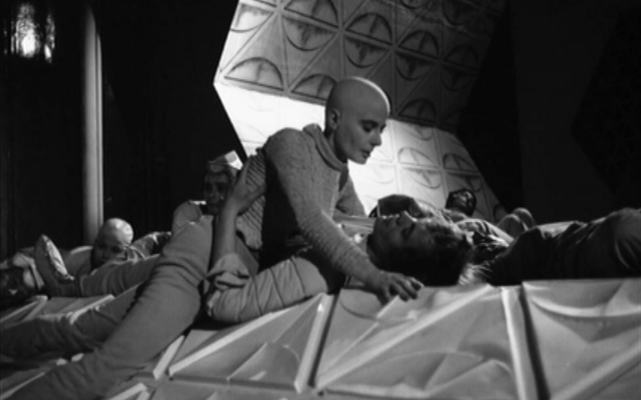
Producer Irene Shubik described this production as one of the hardest jobs she ever had, with its budget stretching requirements for complex futuristic sets, robot tentacles, a monorail, and much of the story set in a small room with a seated actor talking to nothing. Yet director Philip Saville and his team succeeded brilliantly. This is an episode where everything comes together. Its sets and costumes are effective and have not dated too badly compared to many designs seen in season one or say Doctor Who. There is an interesting organic quality to their shapes, despite being entirely mechanical in appearance. Saville’s direction is bold, using fast cutting montages to convey the characters’ confusion, theatrical noir-ish lighting inside The Machine and crisp cold photography on the sunlit surface. The robot tentacles could have been risible but actually come across as menacing as they slither over the grass, thanks in no small part to the electronic sounds created by the Radiophonic Workshop. Incidentally, a particular throbbing sound effect heard at the opening of the episode will be instantly familiar to Doctor Who fans as the background to the Land of Fiction.

The performances are sympathetic to the material too. Established film and stage actress Yvonne Mitchell is excellent as Vashti. Amongst her other credits, she played Julia in the legendary 1954 BBC adaptation of 1984. From the start her haughtiness and complacency is subtly undercut by moments of nervousness and doubt. Even as she sings the praises of life under The Machine, we sense this is a hard but brittle carapace to cover her fears. There’s even some drollness. Complaining to a friend about her request for euthanasia being rejected, she sighs “I am the most unfortunate of women!” It’s just a shame that towards the end as she is marvellously depicting first her growing hysteria and then maternal tenderness, her bald cap is distractingly evident. Michael Gothard is a familiar face from countless British film and television roles, perhaps most famously as the henchman Locque in For Your Eyes Only. He equally impressive as the robust yet slightly hysterical free-thinker Kuno. This angry young man could come across as petulant but Gothard gives him heroism in the way he strives on when obviously being afraid during his escape attempt. Together, the two leads prevent this story become a dry discussion, thanks to their relationship, antagonism with an undercurrent of yearning to be closer. Elsewhere a subtle point is made by Nike Arrighi, who plays the stewardess aboard the airship Vashti uses to travel to meet Kuno. Being regularly exposed to the outside world, albeit flying high above it, her whole demeanour is noticeably more relaxed and natural. A well observed cameo.

This episode subsequently won First Prize at the Fifth Festival Internazionale del Film di Fantascienza (International Science Fiction Film Festival) in Trieste on 17 July 1967. Incidentally BBC Worldwide did consider releasing Out of the Unknown on VHS in the 1990s’ and this would have been the first episode released, in a double bill with another story, similar to the way Blake’s 7 was being sold. However the disappointing sales of Adam Adamant Lives! and Doomwatch discouraged the idea.

The final downbeat conclusion with flailing, crawling inhabitants and flickering lighting is theatrical yet still haunting. I raved about Thirteen to Centaurus a few weeks ago, but right now I think The Machine Stops is the best episode I’ve seen so far.

The Midas Plague

Angry man talks to robot

by Frederick Pohl
Adapted by Troy Kennedy-Martin

Graham Stark is probably best remembered for his various roles in the Pink Panther movies. He had a long busy career as a character actor, but it is rather intriguing to see him as the lead for a change as Morrey, in this broad satire on capitalism and consumerism.

Free energy and robot labour means that future Britain should be a paradise for everyone. In fact, it has become an insane looking-glass world of oppressive consumerism. Whilst the rich one percent can enjoy simple, fulfilling lives, the poor majority are forced to constantly consume new furniture, cars, clothes and more, their houses crammed with goods and servant robots. Downtrodden junior executive Morrey and his wife Edwina are typical suburban prisoners of this life, until Morrey has had enough. He steals prototype “satisfaction circuits” from work and illegally modifies his home robots to become twenty four hour super-consumers on his behalf. In a world where ration avoidance is a crime, how long before his deception is discovered?

I have not read the original Pohl story so I do not know how farcical it is, but this television episode is firmly in Beyond the Fringe territory. Indeed, the opening scene, where Morrey is upbraided by his boss Wainwright for not consuming his allocated amount of food and goods, and being threatened with fewer working hours, is almost a Peter Cook and Dudley Moore skit in itself. Taken as an absurd comedy rather than any kind of serious SF prophecy, this story is pretty entertaining even if it stretches its premise to almost dreamlike proportions. The most obvious element missing from this scenario is resources. Where is all the material for the factories coming from? What has happened to the pollution in such an industrialised society. It’s a reflection of how low environmental concerns were in most people’s consciousness back in 1965 that such questions are never raised.

Troy Kennedy-Martin was already building up a reputation as television writer, with a couple of Wednesday Play‘s under his belt. He provides a script full of entertainingly bizarre comic logic, particularly the courtroom scenes, where Morrey finds himself repeatedly up in front of his stern father in law. The scenes with the black fedora wearing People’s Revolutionaries are an entertaining caricature of the Socialist Worker party too. This satire rarely has laugh-out loud moments, but it is consistently amusing.

The scale of this episode, with a large cast of humans and robots apparently gave the production team quite a few headaches. The robots, all men in one-piece overalls with robot heads, are a simple design but effective, their mechanical caste system is indicated by the amount of detail in their faces, a neat bit of visual storytelling. Peter Sasdy directs it all cleverly, using some interesting overhead shots to emphasise the claustrophobia of Morrey and Edwina’s goods packed home.

Stark is excellent in as the everyman hero, quietly seething as a procession of house robots move around him in an early sequence. Later on he keeps our sympathies as he becomes a secret revolutionary and grows in confidence. British film legend Sam Kydd is equally good as the cheerful cockney burglar Fred. He puts items into other people’s houses rather than taking them out. Anne Lawson performs well as Morrey’s frustrated wife Edwina, although her character is basically a foil for him.

Ultimately Morrey discovers that rather like The Matrix, his whole society is essentially designed to exploit humans and organised to serve the remorseless logic of the robots. The solution initially seems childishly simple, but ties in with the cartoonish nature of the whole drama. The real ending comes next when, faced with life without labour-saving robots, the revolutionaries start compromising their ideals, leaving Morrey to address the audience with a rueful sigh. Rather underlining the whole comedy sketch feel of this installment.

PS. So ends series one of Out of the Unknown and I think it has been fascinating so far. Certainly more pluses than minuses and I love the respect with which the team have been approaching the genre. Here is my ranking of the existing episodes so far:

  1. Thirteen to Centaurus
  2. Stranger in the Family
  3. The Dead Past
  4. Some Lapse of Time
  5. Time in Advance
  6. The Midas Plague
  7. The Counterfeit Man
  8. Sucker Bait
  9. No Place Like Earth
  10. Come Buttercup, Come Daisy, Come..?

Thirteen to Centaurus

Intense young man standing next to computer panel

by J G Ballard
Adapted by Stanley Miller

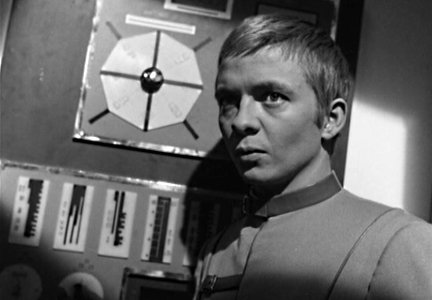
I looked up this short story on www.ballardian.com and was surprised to see it described as untypical and even generic. Yet to me this episode is filled with the familiar J G Ballard theme of a protagonist who deliberately succumbs to a strange new world, in search of another reality. There’s also a protagonist who feels alienated from his own society, despite having no obvious reason for it. Stanley Miller took this already rich short story and turned it into a gripping TV drama with a haunting conclusion and possibly the most fully realised episode of the first series.

Thirteen men and women live in a metal world and seem to believe it to be the whole of reality. But young unusually bright Abel has worked out that there must be something more. Dr Francis has noticed this and lets Abel in on a secret – their world is actually a spaceship heading to a far distant planet, a planet which no one currently aboard will live will reach, but a future generation will. Dr Francis however is keeping a deeper secret from the rest of the crew. He has a secret exit to the outside, because the spaceship is in fact an elaborate simulation on a military base, designed to test whether humans are capable of a multi-generational space mission. Now a new commander has arrived – with orders to shut the experiment down.

You might think I have been thoughtless to  reveal two twists in my synopsis but one of the impressive parts of Thirteen to Centaurus is that it is not built on such revelations, but on the situation and people created by it. Following its own ruthless story logic, the plot investigates  the problems created by a grandiose sociology experiment, whilst cleverly using potential plot holes about the practicalities of creating a spaceflight on the ground.

Apparently the original crew of the ‘ship’ were volunteers but their grown-up children are fully indoctrinated into this artificial world. It seems remarkably immoral and it is not surprising that public opinion has soured towards it. If this story was being adapted a few years later, it is possible a Truman Show reality television angle might have been incorporated into the plot. As it is, we are told that the public are kept updated by regular reports. In one of the episode’s few moments of humour, we learn that there has been audience discomfort at the way the inhabitants have split along class stereotypes – an aloof, aristocratic captain and his son, a sensible, ‘middle-class’ of engineers who basically run the ship, and incurious subservient catering workers. In another satirical instance, the controllers of the project debate marriage as a way of distracting Abel and stunting his intellectual curiosity.

The stakes of this experiment are driven home when General Short calls a meeting of the officers and explains that he has been sent to oversee the project’s closure. Even he allows that it might take a year or more to safely acclimatise the subjects to reality, without them going mad. Public scrutiny has obviously made the authorities circumspect. Even as events become increasingly alarming, no one suggests breaking into the ship.

Dr Francis is a man who seems to be nominally in power, but at the story unfolds it is clear that he has lost his distance. Intellectually and emotionally he is almost as bound to the spaceship as its inhabitants. He regards Abel as his star pupil, his intelligence and intuitive discoveries is proof of Francis’ social theories and the success of the project. His interest in seeing how far this boy can develop, coupled with over-confidence in his influence over the ship, leads him to be far too indulgent to Abel’s suggestions, even when the young man suggests experimenting with the conditioning machine. In the original story, Abel is younger and we see much of the story from his point of view. As a result his actions seem more innocently motivated by dogged curiosity. From the third person viewpoint of this episode, Abel takes on a much more sinister aspect early on, to the point where the doctor seems amazingly naive to give him so much control. Not to mention allowing himself to be the guinea pig. Perhaps subconsciously he wants to submit to this simpler world?

Design-wise the production stands up fairly well. Aside from a one man lift near the start which grinds alarmingly loudly and drowns out the dialogue. The interior of the ship is fairly bland, lots of smooth walls broken up by banks of flickering instrumentation. A striking exception though is the rotating gym, an octagonal room where silhouetted figures exercise whilst a soothing woman’s voice reinforces their worldview, that there is no other world but their’s. The outside world is largely represented by mission control, where I can forgive the unflattering and slightly fetish-looking futuristic military uniforms worn by the personal. The cast are all excellent, hitting the right balance between naturalism and the slight theatricality this drama of ideas needs.

Religion takes on a slightly larger role in the television version. The episode opens with the crew singing “Onward Christian Soldiers” as the old captain’s body is interred, but there’s no discussion on what they understand of the lyrics. Surely it must sound like gobbledygook to them? Especially when we later discover that Abel initially has no real understanding of the idea of God. Its use is the only significant issue I have with the storyline and I wonder if it was just used as a shorthand for “funeral service” without really thinking it through. Later on, Abel does get religion, but with depressing inevitability, starts using it as a justification for his actions, suggesting that this is something built-in to many human spiritual ideas.

What makes this episode so rewarding is the way its big story concepts are explored and are married with richer than normal characterisation. The replica society seems stunted and odd but still practical and controllable at the opening. Yet it spirals out of control in an entirely logical and believable way, each step having a rational justification on its own. This script knows that people often do not have simple motivations. Abel ultimately discovers that the ship is a fake, but still decides to carry on with the mission because it has become a religious article of faith. It is ambiguous whether his climatic mental conditioning of Francis is to take revenge on the doctor or to save his soul. Similarly, has Abel had a kind of breakdown on learning the truth or has his intellect rationalised the revelation within his new religious beliefs, in the same way that many people of faith handle today’s scientific discoveries? So Abel is acting quite rationally, according to the strange way he has been raised. Either way the sight of Francis twitching on the conditioning bed, whimpering “Abel, this is humiliating!” as his identity is altered is one of the most haunting scenes so far in the series. Perhaps because we and him understand exactly how immoral this procedure is that he has inflicted for years on the crew, for the greater good. It’s a satisfying ending that also thrillingly open as to what will happen next.


Sucker Bait

Angry young man in laboratory

By Isaac Asimov
Adapted by Meade Roberts

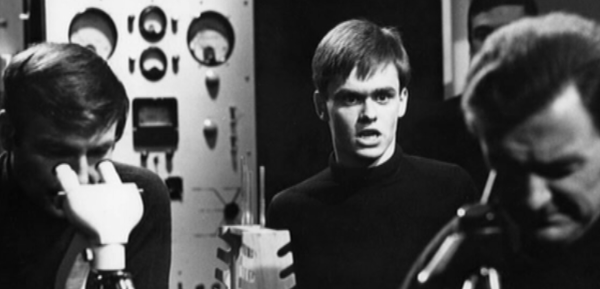
Mark Annuncio is a genius at making connections between often seemingly unrelated facts. He is one of a rare breed of humans called Mnenomics. He is also utterly unable to connect with other people, comes over as neurotic, rude, and requires a special handler who acts as his go-between with the rest of society. Now a set-up like that sounds a TV series all in itself. The brilliant but weird investigator and his “Watson” has been a popular formula in recent years. So it is a little surprising that Mark’s condition and his relationship with Dr Sheffield is just a side issue in this very science orientated episode. As with the earlier The Dead Past, Asimov is most concerned with the over-specialisation of scientists and the way that can cause them to miss vital discoveries.

Chartered spaceship the Gordon G Grundy is taking a party of scientists on a secret mission to the planet Troas, to discover what killed an entire colony. Amongst them is the intense and unpopular Mark Annuncio, raised to be a kind of human super computer. There seems to be no obvious reason why the pioneers died. As outbreaks of mania begin affecting the scientists, the question arises, is the planet really inhabited after all? By some kind of hostile lifeform?

Autism as a phrase may have been coined in 1938 but it is only relatively recently that it has come into the mainstream. Certainly watching this episode today, Mark clearly seems to be on the autistic spectrum, obsessed with learning facts, having no understanding of humour or metaphors, flying into violent anger when he is frustrated. What is disturbing is the suggestion that he has been deliberately made this way. Early on Dr Sheffield explains to the ship’s captain that mnenomics are raised in isolation from the age of five, trained to absorb knowledge and kept away from any human contact that might “contaminate” their minds and form normal patterns of behaviour. Even if the child was already diagnosed as autistic, this sounds like a horrific kind of child abuse, yet Dr Sheffield is unperturbed and the captain makes no protest either. There is a whole story just there and potentially a better one than the scientific investigation that follows.

Sucker Bait is a serious minded play of ideas rather than action. As with many Asimov stories it essentially a series of conversations between scientists about a fantastical problem. This leads to the cast manfully tackling a host of jargon filled dialogue. The summit comes in the scene where Sheffield, a psychologist by profession, tricks the arrogant leader of the expedition Cinam into panicking over a made-up theory about Troas’ twin suns causing psychosis. Actor John Mellion has to deliver a whole stream of made-up science and it no wonder he has to take quite a few deep breaths and looks slightly glassy eyed at points.

The technology of Television Centre is also stretched uncomfortably. The set rattles alarmingly whenever someone walks on the metal gangway and clanking sounds can be heard distractingly off-camera in some scenes. The planet surface is a small, claustrophobic rocky set where the astronauts frequently seem to be weaving around each other since there is so little space.

At the end the revelation of what has been killing the colonists comes as something of an anti-climax. I remember reading this story, and I think it works better on the page. It is logical and ingenious but the whole scene feels a bit flat. Perhaps in part because we have just found out that a potentially exciting climax involving mutiny and the scientists being marooned on the deadly planet all took place off-screen between scenes. Yet its last moments are quietly affecting. Mark, who has been played well by young Clive Endersby, stares out at deep space and confesses that this mission has made him aware of his own mortality for the first time. “And there’s so much left to learn.” he says plaintively. The captain, who earlier been so hostile to his odd passenger, allows him to remain on the command deck this time, counting the stars.

Come Buttercup, Come Daisy, Come..?

Milo O'Shea in character

Written by Mike Watts

There’s something almost irretrievably schlocky about killer plants. Aside from the Triffids and 2008 horror movie The Ruins, stories of plants wrapping their green fronds around victims come over as risible rather than horrifying. Not for nothing is the most famous vege-villain Audrey II the star of a camp musical.

Fishmonger Henry Wilkes has two loves in his life. His wife Monica and his garden of exotic tropical plants. Only recently it appears to Monica that her husband has become obsessed with his hobby, ever since he started receiving cuttings from a postal correspondent called Mr Pringle. And there’s something unnerving about that garden, almost although the plants are actively threatening her health. Henry however is too caught up with the excitement of growing these unusually responsive plants, even when they require a regular feeding of fresh meat.

This is an unsatisfying episode, not deliberately funny enough to be classed a comedy, too polite to go for full monster horror. Quite padded too. Why expensive filming is used to show Henry’s commute on his motorbike and sidecar, when it is entirely superfluous to the plot, is a mystery. There’s already more than enough in the episode to establish his working class suburban credentials. Similarly his shop assistant Anne’s interest in spiritualism is a blind alley. Once it is established that Henry has animated carnivorous plants in his garden, the plot is virtually over and we are only waiting for his wife to discover the awful truth.

On a good note, writer Mike Watts avoids some obvious stereotypes and he’s helped by good underplaying from the central trio of Milo O’Shea, Christine Hargreaves and Patsy Rowlands. It would have been easy to make Henry a rather grotesque or pathetic figure, but he emerges as an essentially well-meaning, naïve man who is far too short-sighted about the consequences of his hobby. His main eccentricity is a dislike of seeing plants used as food, which does stretch credibility somewhat and makes one wonder what his diet consists of. Similarly Monica could have been a shrewish woman who has driven Henry to spend as much time in the garden as possible, but she comes across as a caring individual driven to illness by the strangeness. Anne is essentially a straight foil for Henry. For a while I wondered if there as a hint of attraction between her and the gardener but what there is in the way Patsy Rowlands plays her lines rather than the script.

An unexpected curveball is thrown by the credits – Barbara Woodhouse was the trainer of the Wilkes’ dog. Offers a delicious image of La Woodhouse marshalling the killer vegetation before a take.

Bernard Wilkie and Ron Oates provide some fairly decent puppet plants, the grasping tendrils and roots are effective in short bursts. Most of the time the animation is provided by simple shaking, when I had hopes for a climatic attack on the house. Keeping the origin of the plants a mystery is a good choice. It is better to keep guessing if this is some low-key alien invasion, mad scientist’s plan, or secret government project. Ultimately this trip into Tales from the Crypt territory proves to be a bad match for a series aiming for adult science fiction.

Time in Advance

Two men toasting drinks

by William Tenn
Adapted by Peter Erickson

Some stories can only be told in the science fiction genre. Then there are stories like this one, which could be just as easily be told as a western or a crime thriller. Not only would it only take some simple rewriting to turn this episode into a film noir, it might have been preferable.

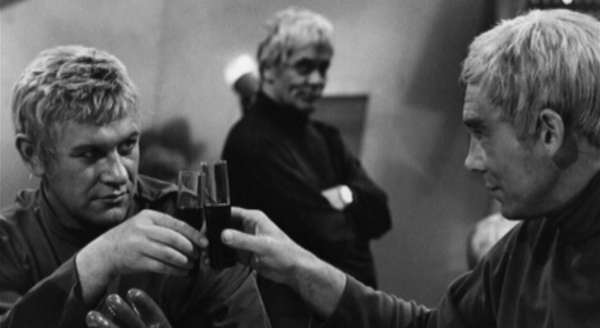
In the far future, there is excitement amongst Earth’s media when a prison ship returns from the outer frontier carrying Crandall and Henck, the first two men to have survived seven years and earned a licence to murder. They are pre-criminals, men who have confessed to their crimes ahead of committing them. They can earn the right to commit their crime by serving a sentence working on harsh alien planets preparing them for colonisation. Moving into a luxury hotel, the two comrades begin to plan their murders, only to discover that much can change in seven years and what they believed was the truth is often not.

There are several problems with this episode. For a start the whole pre-crime idea is a bit daft and it’s hard to understand how such an odd judicial system started up. There’s a debate between a judge and a journalist near the start but it is a bit of strawman affair. “Would you prefer to go back to a time when men were tortured and killed as punishment?” intones the Examiner, played by the gaunt Peter Madden. Are they the only options then? Medieval punishment or a penal suicide mission where its hoped the criminal will change his mind or die in the attempt? It later transpires that normal prisons also exist in this future, making the existence of pre-crime even more confusing.

Then there is Crandall, supposedly a man so determined, ruthless and angry with his ex-business partner that he is prepared to spend seven hellish years to get a chance to kill him. Yet Edward Judd plays him in such an avuncular, reasonable manner that it is hard to believe. Crandall is so sensible and considerate towards others throughout the episode, that surely he would have rationalised away his bitterness during his exile? He might carry a grudge, but to embark on such an extreme revenge? Maybe he was a different man seven years ago but we are given no evidence of that.

Mike Pratt makes a better job of the angry, slightly pathetic Henck, still wound up with resentment towards the woman who trapped him in a loveless cuckolded marriage. His journey is the sub-plot but it actually sounds the more interesting as he tells it in the hotel bar. His imagined perfect dramatic revenge is quickly thwarted by a series of mundane events that leave him feeling cheated and confused.

Padding is another bugbear of this episode, with several stretches of nothing much happening except Crandall living in the future, using various gadgets. I was amused to see that the hotel television seems to be showing out-takes from the Sixties Doctor Who ‘howlaround’ experiments. There is also a return of the show’s curious obsession with blonde wigs, undoubtedly the same ones used a few weeks ago in The Counterfeit Man. Whilst early model shots of the spacecraft landing must be viewed charitably, the shot of the futuristic city skyline combined with live footage taken in a park is excellent.

Where the episode works best is in its moments of black comedy. The camp but sadistic prison guard (Oliver MacGreevy) who hopes his ‘boys’ have a happy time back on Earth. The oily religious man (Ken Parry) who implores Crandall to forgive and forget, then suggests he profit from his licence by killing a businessman of his acquaintance. The fact that Crandall’s ex-wife Polly (Wendy Gifford) is convinced he wants to kill her and is slightly put out when she discovers he never has.

After a sense of lofty ambitions of the first part of the season, Time in Advance feels altogether more pulpish. Melodrama has always been a part of SF magazines output. It is not outrageously bad, it just feels a bit corny. Perhaps it should have been about two men who escape from prison after seven years, having been double-crossed and out for revenge? And half an hour long?

The Dead Past

Two scientists with futuristic machine

by Issac Asimov
Adapted by Jeremy Paul

Even without his name on the credits, I could have guessed this was an Asimov tale, since it has his common themes of extrapolating a scientific fantasy theory in a realistic fashion, and linking it with the idea of a group of experts manipulating society with sociological techniques for its greater good. It’s a model that can be found in novels like End of Eternity, Caves of Steel and the Foundation series. Furthermore the plot is essentially a series of debates between scientists and other experts, a form he uses in a lot of his stories. It is an odd bird of an episode, starting as criticism of science that is led by politicians and big business, moving into time travel of a kind, then ending up with a twist that this story’s apparent villains might have been in the right after all.

In the not too distant future, Arnold Potterley is obsessed with proving his theory that ancient Carthage was not the barbaric civilization that history has painted it. Unfortunately he cannot get any access to the famous Chronoscope, despite his impeccable credentials.The Chronoscope is a device which can project pictures and sound from the past. The government owns the only model and publishes a monthly report based on its discoveries. Potterley persuades a young physicist called Jonas Foster to ignore the strict rules which effectively control all scientific research in the future and investigate the abandoned field of chronoscophy, with the goal of building his own private machine in the basement of his house. However when he does, the two men make a series of unhappy and far-reaching discoveries.

There are some fascinating ideas in this episode that have not really dated at all. In fact the basic story would fit perfectly into an episode of Black Mirror. Potterley initially thinks of the machine as a way of studying ancient history, but his wife Caroline is only interested in revisiting her own history, those years containing their daughter who died at a tragically young age. But even Potterley can see the seductive dangers of reliving the past. “Watching those years, over and over until you go mad?” he tries to warn her. “Parents looking for their children. Children searching for their dead parents. Old men trying to relive their lost youth! Mankind would be living in the dead past!” But it is government minister Thaddeus Araman (a very Asimov name!) who points out the even greater danger of the scope. “What is history? History is one second ago.” This time machine has become the ultimate surveillance device, worse the ultimate voyeur tool, able to show anything from anyone’s life with no possible prevention. In today’s CCTV, social media and selfie obsessed world, the idea has even more resonance. In light of this, the government’s attempts to quash any possible research into the device seem very understandable. However the fact that they keep their machine working and clearly make lots of use of it, weakens their moral authority. Of course their intentions are ultimately doomed, scientific knowledge can always be rediscovered. There’s also a small sub-plot warning about the dangers of scientific research becoming too bureaucratic, individual scientists becoming too specialised and methodical in their knowledge so that they cannot make inspired connections.

Potterley is an interesting character. His pompousness and infatuation with Carthage is rather comical, but there is something slightly unnerving about him too with his clipped tones and buttoned down emotions. It is a fine performance from George Benson. His co-star James Maxell has the drier part as Foster, his dialogue filled with most of the scientific language and his character less defined. But he makes us believe in this conventional young man who imagination is fired and who finds an unexpected reckless streak within himself. Amongst all this discussion between intense academics are two outsider characters who bring some colour to the story. Willoughby Goddard is splendidly dyspeptic as Foster’s veteran journalist uncle and acts mostly as comic relief. Sylvia Coleridge gives a sympathetic portrait of repressed grief playing Caroline Potterley.

An enjoyable play of ideas rather than action. The Dead Past ends on a memorably downbeat image suggesting that Potterly and Araman’s worst fears are coming true. A sequel set in this world of potentially total surveillance by everyone would be challenging but exciting. Perhaps the closest we’ve come to it on television is my favourite Black Mirror episode The Entire History of You. I’m looking forward to the future Asimov adaptations in this anthology.

Stranger in the Family

Father and son with microscope

Written by David Campton

After two episodes set in the future, featuring mostly male professionals and very science fictional concerns, this third episode, based in a contemporary London of shabby flats and pubs, centered around the emotions  and complicated motivations of its protagonists, feels very different. Sharper somehow. Maybe its simply a case that the tension of wondering if a man is an alien in disguise is of a different tenor to that of watching a vulnerable woman being exploited by a man who can will her to obey him regardless.

Boy may seem like just another awkward, sensitive young man in London, but not only is he unusually intelligent, he is telepathic and can control others with his mind. For years he and his parents have prevented his powers being discovered and kept one step ahead of an organisation who want to study him. But years on the run are taking their toll. When Boy falls in love with a struggling actress and meets her conniving agent/boyfriend, matters reach a crisis.

For me the biggest strength of this story, the first to be written directly for the series rather than adapted from a book, is that all its characters are in shades of grey. At first we perceive the men who pursue the Wilsons as unquestionably sinister, but as the story unfolds and I learnt more about Evans and his institution of other mutant children, not to mention his philosophical acceptance that one day his generation may well be replaced by this new evolution, he becomes if not sympathetic, then a practical man with a reasoned argument. It helps that he speaks with the rich urbane tones of Jack May.

Similarly Boy himself is a contradictory mixture, despicable arrogance and selfishness, yet at the same time tragic and vulnerable, shaped into this dangerous innocent by his parents’ well-meaning protection. By being denied exposure to other people, one can assumed he was home schooled, he has no empathy. Like a child, he is squarely at the center of his world and can only see people in terms of what they offer or threaten him. Richard O’Callaghan cleverly uses a singsong cadence in Boy’s speech to emphasize his immaturity.

Charles and Margaret Wilson are also quite nuanced. Two intelligent people who have sacrificed a great deal to protect their son, but now stuck in a cycle of isolation and suspicion. Their love has inevitably become tempered by the understandable stress of looking after a son who is no longer a child. In one of the most memorable scenes, they discuss what to do next, where they can flee, how they can protect him from harm. Then from nowhere Charles says flatly, “I wish he was dead.” Margaret says nothing but her face shows her understanding.

Justine Lord, something of a television regular at the time playing various troubled blondes, is excellent as Paula, a woman whom experience has given a hard outer shell. Yet underneath is someone with a desire for a gentler life. Maybe to some extent she is a stereotype, an actress struggling through unrewarding small jobs, chasing a dream of stardom but all too aware that she is getting older and it’s moving ever faster away. Perhaps secretly believing that shysters like her boyfriend Sonny are as good as its going to get. Her scenes where she comes under Boy’s sexually driven mind control are genuinely uncomfortable, both during and after. With no special effects, the telepathy scenes succeed purely through her and the other actors reactions. A later scene where Boy forces Sonny to nearly drown himself in the bathroom is nearly as unsettling.

So just as good is the moment would-be assassin Brown is driven to murder himself, as he protests with awful calmness as he drives a blade into himself. Brown is played by John Paul, later star of Doomwatch and by odd coincidence his Doomwatch co-star Joby Blanshard turns up as a fellow agent. Actually Brown is a pretty rubbish undercover operative. In his first meeting with the Wilsons as their new neighbour, he is pretty transparent as he peers around their living room, asking about their son, and radiating insincere bonhomie.

This episode has a definite echo of Out of the Unknown‘s spiritual predecessor Armchair Theatre. Take away the telepathy angle and this could easily fit into that series next to A Night Out, another play about a sheltered young man with a pressure cooker home life, trying to spread his wings but sabotaging himself with unhappy consequences. The climax is effective but also curiously low-key. No mob with flaming torches, no pyrotechnics. Just a squalid killing and a few damaged lives.