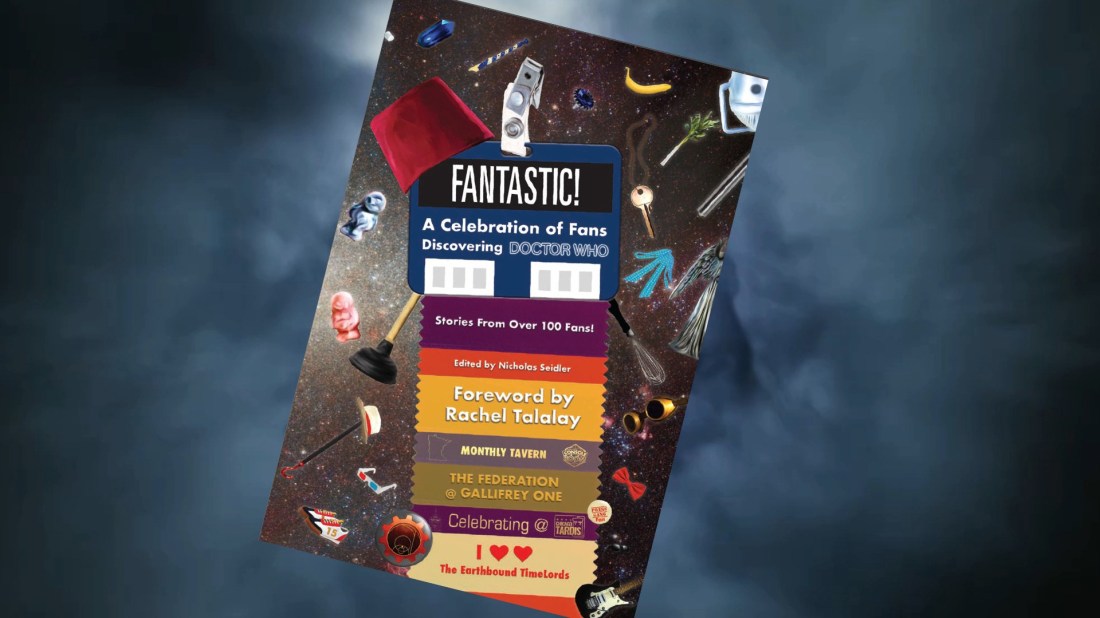
This week sees the release by Zepo Publishing of a brand new book about Doctor Who and specifically its fanbase around the world – Fantastic! A Celebration of Fans Discovering Doctor Who. Editor Nicholas Seidler sent out a questionnaire earlier this year asking Doctor Who fans to contribute memories and thoughts prompted by four questions:
When did they first start watching?
How did they become a fan?
What is their favourite fan related memory?
What story would they recommend to a new viewer?
Over a hundred replies are collected together in this book, including my own. I can honestly say its fascinating reading and at a time when so many fandoms seem to have been infected with negativity and toxicity, it is a useful reminder that the majority of people involved in this world are kind and funny individuals. There is a charming forward by the gifted film and television director Rachel Talalay, who directed several episodes of the series, including the highly rated Peter Capaldi one-hander Heaven Sent.
You can order the book through major booksellers as a hardback or paperback. Find out more about the book by visiting its publishing page. You can also find out about the author’s signing tour at several forthcoming USA conventions and read a preview.
Friend and Very British Futures recurring guest Kara Dennison has an article in the latest edition of Celestial Toyroom Issue 554, the official magazine of the Doctor Who Appreciation Society, reviewing The Story and the Engine. You can download the magazine as a PDF.
Out now on your favourite podcast platform, the latest episode of Very British Futures, covering Bright Eyes, the second Play for Tomorrow from the makers of Play for Today. Broadcast in 1982. Written by Peter Prince and directed by Peter Duffell.
New Year’s Eve 1999. Great Britain is part of the European State. The Euro army is in the midst of a controversial war in the Middle East. Wealthy businessman Sam Howard has come to a French prison to see his daughter Cathy, who has been arrested for being part of a conspiracy to assassinate a pro-war politician, and is now facing execution. The authorities hope he can persuade her to issue an apology regretting her actions, allowing them to commute her sentence to prison time. Waiting outside her cell, Sam’s memory flashes back to earlier New Year’s Eves. 1979 when she was six years old and left with him overnight by his ex-wife. 1989, when she was sixteen and he criticised her 60’s themed party as disrespectful to the genuine struggles of that decade. When she said didn’t care about politics, he told her to start taking an interest and challenge to official line about the coming war. Now a crowd of journalists wait outside the prison, his ex and her legal team are helpless and he must decide whether to ask her to betray her principles to save her life.
One of the good things about making this series is when a guest helps me see a programme in a new, usually better light. This was the case with Bright Eyes and my friend Jon Arnold. An experienced writer and commentator, Jon’s enthusiasm for this play about the generation gap, activism and pragmatic politics was infectious. Hope you find this an interesting episode.
You can find the episode on all major podcast platforms, including Spotify.
I’m pleased to share with you that I am the guest on the latest episode of the podcast Doctor Who – Too Hot for TV, hosted by Dylan Rees. Together we are looking back at two unmade stories from the 1960’s – Farewell, Great Macedon and The Queen of Time. Both have been recreated as dramatised audiobooks by Big Finish. I’m particularly happy with the way this one has turned out. In fact I think it’s the best of my three guest spot so far because I sound more confident and fluid and there’s a lot of interesting Doctor Who behind the scenes details to talk about.. You can listen to the episode here https://www.buzzsprout.com/864883/episodes/17368333-s5-e33-just-a-bit-of-tea-with-a-wee-lassie and all the major podcast apps.
Farewell, Great Macedon was submitted by Moris Farhi to the show’s script editor David Whittaker during the first season in 1964. It features the First Doctor as played by William Hartnell. Unusually amongst the so called “lost stories” of Doctor Who, it exists as a fully written script rather than just an outline, which helps make this adaptation feel just a bit more legitimate. Nigel Robinson, a skilled adapter of early Doctor Who stories, wrote the audio version and Big Finish mainstay Lisa Bowerman directed William Russell and Carol Ann Ford, who played two of the Doctor’s first companions. John Dorney guested as Alexander.
The TARDIS lands in the Hanging Gardens of Babylon, where the travellers meet Alexander the Great who welcomes them with hospitality. But history teacher Barbara realises that they have landed a few days before Alexander’s death and with the TARDIS needing to recharge before it can leave, the four friends find themselves caught up in court treachery. It’s a splendid story and for me one of the high points of Big Finish’s Doctor Who range.
The Queen of Time features the Second Doctor, as played by Patrick Troughton and was written by Brian Hayles. Hayles had written several stories for the series and this proposed adventure owed a large debt to one of them, The Celestial Toymaker. This time Catherine Harvey adapted the detailed plot outline and Lisa Bowerman once again directed. Former companion actors Frazer Hines and Wendy Padbury performed it, with Caroline Faber as Hecuba.
The Doctor and his companions are mysteriously invited to meet Hecuba, the Queen of Time and sister of the Toymaker. Trapped in her realm, the Doctor must ward off Hecuba’s romantic overtures, whilst Jamie and Zoe face a series of deadly puzzles. This is something of a misfire for me and I enjoyed getting into why I don’t like it.
As well as recommending Too Hot for TV as a great podcast anytime, I’ll take a moment to remind you that Dylan’s second book Myths and Legends, a deep cut into independent filmmakers Reeltime Pictures, will be out soon. You can find out more here.
Before I go, my friend Rik Hoskin has had a new short story published in the premiere issue of Goblins and Galaxies Magazine called “Tournament in Frow” and you can find out more below:
After the success of his first BBC Audiobook, Will Hadcroft is back with a new Doctor Who short story, this time featuring the Fifth Doctor, Tegan, Nyssa and Adric, and read by Matthew Waterhouse. He’s delivered an entertaining little SF adventure with a subtext about human exploitation by both other humans and extraterrestrials.
Cover artwork
Still trying to return Tegan to Heathrow airport, the Doctor instead lands the TARDIS in 1830s London. Happily the air hostess turns out to be something of a Charles Dickens fan, so her disappointment is mollified by a chance to explore the setting of most of his novels. The Doctor warns his companions that the real London is much more squalid and dangerous world than is usually shown in the movies. In fact he’s so cautious he even insists they all change into appropriate period clothes for once, which is a fun idea and leads to an entertaining reveal sequence when they step out of the Ship. But the listener already knows that sinister forces are at work. A retired admiral has become an investigator into the odd and inexplicable. He has heard of unexplained disappearances around the workhouses, and desiccated bodies being discovered, killed in a manner beyond human capabilities. Before the Doctor and his friends can begin properly investigating, all four of them are abducted and separated by different parties.
In his first Doctor Who audiobook The Resurrection Plant, Hadcroft had shown a particular interest in darker, exploitative side of the Industrial Revolution and he continues the theme in this story, arguably to even greater effect since much of the unpleasantness he describes is historical fact. Splitting the team up, he depicts the workhouse, the streets and criminal gangs trading in women’s lives with an interesting but balanced amount of detail, illustrating the harshness and injustice without descending into gory shock value. In fact this story would have worked as a pure historical, with a little reworking. Without giving too much away though, there is an alien antagonist to be faced. Bodies drained of life is something of a staple in Doctor Who adventures, as is beings who regard humans as a resource rather than sentient equals, but ultimate resolution to the main mystery is pleasingly Doctorish and ultimately hopeful.
All the regulars are well-depicted. Tegan and Nyssa get some moments of sisterly banter and later prove to be adept at rescuing themselves for once. Adric is headstrong and feels a bit of an outsider in this decidely messy human enviroment, giving some hints of his growing homesickness. There’s a striking moment where he admits to mourning the ‘death’ of the older Fourth Doctor who fitted the father-shaped hole in his life, replaced by a younger man with whom he struggles to connect with, in same comfortable way Tegan and Nyssa appear to. Meanwhile the Doctor is enthusiastic, a touch rueful and there’s an amusing moment where he is annoyed with the “youthful whine” in his voice when he attempts to assert his authority. Matthew Waterhouse does an pretty credible impersonation of Peter Davison’s voice, can still sound convincingly younger as Adric, but makes Janet Fielding sound like a cockney. His natural reading voice is very listenable to though and he does a good job with the guest characters. David Roocroft’s sympathetic sound design does a great job of illustrating Victorian London without drowning us in street barkers, steam horns, and clipclopping carriages.
Doctor Who – Dark Contract is an assured, entertaining trip back to Doctor Who circa 1982. Written with intelligence and with something deeper to say both about our fairly recent past and our responsibilities to each other. It can only enhance Will Hadcroft reputation as an author.
Ever since computer games were invented, Doctor Who fans like myself have wanted to see our favourite show to be part of that world. From Doctor Who – The First Adventure on the venerable BBC B Micro, through Dalek Attack on the PC and Spectrum, to more recent attempts such as Lego Dimensions. Then in 2019 a fully fledged VR game arrived The Edge of Time, courtesy of Maze Theory, but never seemed to make the impact such major project should had. After all, this game lets the player travel in the TARDIS and confront Daleks and Weeping Angels face to face. It has a complete story that puts the protagonist centre stage. When I bought myself a Meta Quest 3 headset, it was a game I purchased almost immediately to experience myself. After Beat Sabre.
Recently there seems to have a dizzying explosion of Doctor Who titles in many videogame subgenres, from time-killing smartphone game Lost in Time to online card game Worlds Apart to guest appearances in big hitters like Fortnite and Minecraft. Up until now, I would say the titles closest to capturing the spirit of the programme were the Doctor Who Adventures released initially for free by the BBC, featuring the Eleventh Doctor and Amy. Whilst enjoyable to play these felt less polished than the perfect AAA game of my imagination, something combining the mechanics and look of say the Mass Effect Trilogy or Fallout 4.
The appropriately named game The First Adventure (1983)
The opening story in The Adventure Game ‘season’ – City of the Daleks (2010)
The Edge of Time is definitely one of most ambitious and big budget attempts to date. It promises a great deal, to actually join the Thirteenth Doctor in an adventure as her temporary companion, flying the TARDIS, battling the Daleks, the Weeping Angels and some new enemies in virtual reality. Unfortunately the earliest releases of the game came with game crashing bugs, despite extensive play testing by Maze Theory, and I think that did damage the game’s reputation. However the version available to buy now is much more robust and also comes with 2020’s Time Lord Victorious DLC bundled in for free.
The landing screen placed me in a rocky area with the TARDIS standing to my left, humming with energy, whilst ahead was the menu. Choosing New Game took me to what would be called the “cold open” of the episode. a shabby laundrette where I was the only customer. The lights start to flicker and the voice of the Doctor, voiced by Jodie Whittaker herself, comes through the static of the television. She’s asking for help, and warning me that I’m in trouble. The lights flicker again and the washing machines fill with slime, covered with blinking eyes. The voice of the Doctor warns me that these are embryo Hydrocs, vicious predators who grow very quickly. Reality is breaking down and I need to get out of there. Some searching and clue solving puzzles follow, as I eventually get through the locked door at the back and summon the TARDIS, just as a Dalek saucer appears overhead and tries to exterminate me. Cue 360 degree panoramic version of the Thirteenth Doctor’s title sequence.
Inside the Thirteenth Doctor’s console room (a design I became more resigned to than ever really liked) the Doctor appears as a hologram and explains that she is trapped at the other end of Time and needs my help to find three rare zeiton crystals with which she can create a vortex manipulator to escape and fix the reality virus which is threatening the whole universe. This plot accidentally anticipates the Flux that the Doctor will face in 2022. First she needs to guide me through flying the TARDIS, which involves turning knobs and pulling levers in a sequence repeating memory game, a bit like Bop It!
There was definitely a thrill to stepping out of the TARDIS on to an unknown planet. That worked each time arrived in a new location. Most of the game is puzzle solving, moving objects about, slotting them into holes. Or combing objects to create an effect. Zapping items with the somic screwdriver was a reliable move. Most of the puzzles were an easy to medium challenge, apart from one aboard a spaceliner involving reflecting a laser beam with rotating mirrors to activate doors, that eventually I had to look up the solution on YouTube. As with many VR games at the moment there is a distinct escape room vibe to the majority of the game, even if the locales allowed for a lot more walking and exploring.
Occasionally there is an action sequence. Escaping the Weeping Angels in an old house, with an unreliable torch and a lift which needs recharging at each floor with a dynamo, was genuinely scary, especially knowing that death meant going back to beginning of the sequence again. By contrast a first person shooter section, driving a Dalek around a temple shooting at other Daleks, became quite frustrating, since unless you managed to time every shot and make it count, death meant starting the whole long section over again, which became pretty wearying. I’m not a fan of the whole timing blows precisely in a sequence kind of combat which Dark Souls has popularised.
Along the way, the villain is revealed as The First, a godlike mother of all life in universe, wishing to punish intelligent life for making so many mistakes. To be honest this section was a bit ponderous, especially since she is so powerful, all the player can do at this point is really stand and watch the Doctor sort things out, again solely as a voice. Despite a last minute race to retrieve three more magic items by revisiting some previous destinations, the climax is underwhelming.
Yet the journey there is pretty entertaining. The whole Weeping Angels section uses those antagonists particularly well, with some moments that are more than worthy of the television series. Sneaking past full-scale Daleks is fun and again feels very reminiscent of the series. Dialogue writer and co-storyliner Gavin Collinson gets the feel of modern day Doctor Who. You get your own companion of a kind, Emer, winningly voiced by Jennifer Saayeng, who has also appeared in a few Big Finish stories. Wielding the sonic screwdriver to scan and manipulate item is satisfying too.
Graphically the style is fairly cartoonish, an acceptable compromise between accurate detail and the speed and size of the game. The two TARDIS console rooms of the Thirteenth and the Tenth’s (for the Time Lord Victorious add-on) are pleasingly recreated, whilst the new locations are colourful and well lit.
Away from the main story, there’s the Time Lord Victorious collectible game, which tries to extend gameplay by adding hidden collectible items in all the locations of the story. These are related to the stories in the BBC’s 2020 multi-platform campaign. Discover all eight and you can play a quiz game. There’s also an Arcade section where the player can replay the title sequence, flying the TARDIS, escaping the Weeping Angels, or battling the Daleks.
In 2021 Maze Theory released a reimagined version of the game for flat screen consoles. Doctor Who – The Edge of Reality replaced the god-like First with the Cybermen as the principle villain and also featured a cameo from the Tenth Doctor. I have not played it but I believe it too was plagued with bugs and seems to have had even less impact than the VR original.
I’ve enjoyed playing this game and think it deserves to be better known. It’s a sincere attempt to put the player inside a Doctor Who adventure and translates a fair amount of the feel of the Thirteenth Doctor’s era. It’s an accessible game for both experience VR players and first timers. Hopefully it will remain in the Steam, MetaQuest and Playstation libraries for the foreseeable future.
Another of my early experiments with my new Meta Quest 3 headset was to watch the 360 degree Doctor Who short animated film which the BBC released in January 2019, featuring the voice of Jodie Whittaker. The Runaway begins with the viewer being accidentally teleported aboard the TARDIS by the Thirteenth Doctor. Apologising, the Doctor explains she is trying to help a young energy being from another dimension return home. The being is a glowing sphere with eyes and the Timelord explains that if it becomes too agitated it will blow up, taking the TARDIS with it. As a story its typical of the kind of mini-episodes which were usually made for Comic Relief, based entirely on the standing set of the console room. The animation is similar to Edge of Time although this cartoon was made by the BBC VR Hub.
It works excellently in the Quest 3, I can see it would function equally well in any 360 viewer, including Google’s Cardboard VR. It’s a sweet little disposable tale, although I missed having any interactivity. If you have a chance to watch it as its meant to be seen, its worth your time though.
I always enjoy recording podcasts, either my own or as a guest. September is turning into a busy month for me. First off is the second part of my interview for The Time Scales YouTube channel. Greg continues our conversation with questions about writing pantomimes, Bolton Little Theatre, Will Hadcroft’s Fine Line story The Chattath Factor, promoting yourself on social media, taking rejection, and the future of Doctor Who. You can watch Part Two here and I hope you’ll find it interesting. Greg and his wife have done a great job creating a programme out of our lengthy, pleasant conversation.
You might remember The Randomiser from previous mentions, a brilliant Doctor Who podcast featuring my old friends Tim Reid and Charles Auchterlonie. It’s a chat show where the two of them debate a story chosen at random, alongside several mini-features like “No complications”, finding magic moments of greatness and naffness in the long-running programme. The latest episode is out now and I had the pleasure of being their special guest for the the second time. We talked about The Faceless Ones, the recent Star Trek The Motion Picture cinema re-release, Bob Baker and Dave Martin’s fascinating children’s drama King of the Castle and held a tribute to the much missed Bernard Cribbins. I only hope we did justice to him. You can listen to Just looking for Wombles, officer on their Anchor.fm website or find them on all the major podcast platforms.
Recently I’ve had the pleasure of being interviewed by Greg for his Youtube channel The Times Scales, a place dedicated to Doctor Who. I’d originally planned to try and keep to a disciplined hour, but we ended up talking for nearly three, so the interview is being released in two halves. You can watch part 1, about being a fan of the classic series, thoughts on the so-called Wilderness Years, and the joy of its mainstream success when it returned. We also talk about my BBV productions, Audio Visuals and my own fan audio stories. The second half will continues with more about Westlake Films, my pantomimes, the future of Doctor Who and the excellent writing advice of Georgia Cook.
We had met online via Will Hadcroft, whom Greg had already interviewed as part of Will’s promotion of his BBC audiobook The Resurrection Plant. Greg was interested in covering my journey as a creative too, so we arranged a date and had an enjoyable conversation. Greg proves to be an excellent interviewer and I think he’ll only get better. You can watch part 1 now below and I hope you get something good out of it. If you have any questions yourself as a consequence, feel free to drop me a line here or on Twitter @gazhack.
It’s surprising to realise that Doctor Who has rarely used the Industrial North as a setting. We have seen adventures set in futuristic factories and warehouses, visited the beginnings of the Industrial Revolution in Mark of the Rani and had a few romps into Steampunk. Big Finish has touched on it in The Peterloo Massacre and Industrial Evolution but that landscape of terraced houses, looming smoke-belching factories and municipal buildings that could be found from Birmingham to Newcastle has remained the province of Coronation Street and contemporary drama. So having the Second Doctor, Jamie and Zoe land on the corner of a cobbled street in Will Hadcroft’s The Resurrection Plant feels quite fresh.
Not that this is the actual North of England. In fact the TARDIS has brought our friends to Calico Three, a small habitable planet where the rural colony the Doctor remembers is in the grip of an unexpected mechanisation. What’s more the factories are capitalism run wild, with human workers mere expendable cogs in the machine. But nobody minds because on this planet everyone can be brought back to life thanks to the Resurrection Plant, even if occasionally they change gender along the way. The travellers investigate but are soon captured, just in time for a factory accident to lead to the creation of a terrifying mutation in the newly grown humans.
The author captures the the characters of the regulars extremely well. Patrick Troughton’s Doctor can be hard to capture in print, since so much of his character is in his delivery, but here he’s compassionate, curious, mischievous and has moments of righteous indignation. Jamie and Zoe both get moments to shine on their own too. The story seems to be setting up as a Frankenstein-influenced piece about Ren, a technocrat facing up to consequences of treating his workforce as commodities, together with a fearsome but misunderstood monster, but there’s a second act twist which takes us into another kind of drama, one that I was worried was going to ruin the authentic Sixties atmosphere that Will had recreated. Thankfully he skilfully avoids this.
Fraser Hines has been sharing his enjoyable Troughton impersonation for a while in Big Finish audio plays and books. It’s great to hear it again. Elsewhere he is an excellent reader in general and tells the story with animation and a good pace. Similarly impressive is the soundscape.
There are echoes of The Rebel Flesh and The Quatermass Experiment, but ultimately this is a great original adventure. It tells a story probably too difficult for the television series of the time to realise well, and instead takes advantage of the freedom of prose. An excellent addition to this year’s mini-Troughton celebration, along with the recently released animated recreation of The Abominable Snowmen.
CD cover
Will Hadcroft of course is a friend of mine and its been marvellous to see him achieve the ambition of writing an official Doctor Who story. He’s previously written several novels and many moons ago an adventure for my old fan audios Fine Line, called The Chattath Factor, which has recently been re-released on Youtube. It was a marvellous story to end my fan series on.
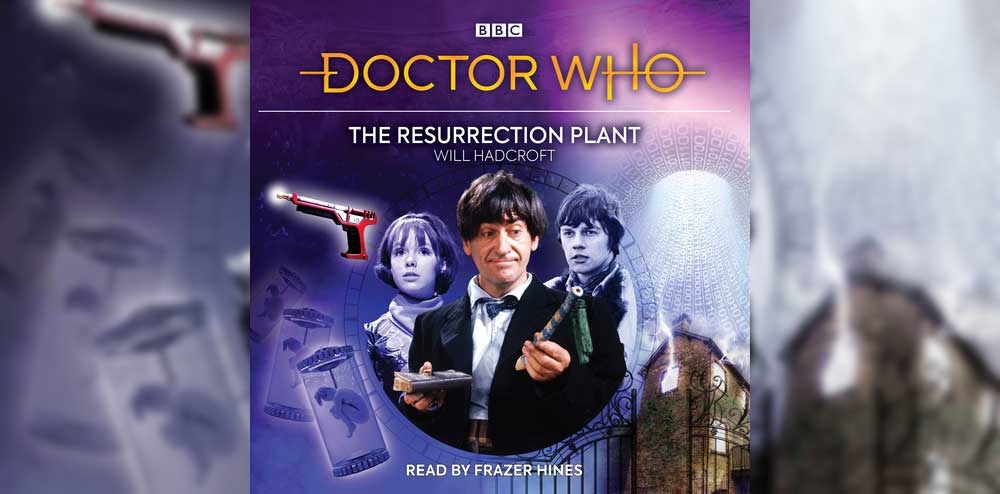
Several fun news items to report on today. My old friend Will Hadcroft has achieved one of his personal ambitions (and mine too someday) of having an official Doctor Who story released. The Resurrection Plant is being released on CD and download by the BBC and Penguin Books on 4th August 2022. It features the Second Doctor (as played by Patrick Troughton), together with Jamie and Zoe and is read by Frazer Hines, who not only played Jamie in the television series but in recent years has been acclaimed for embodying the Second Doctor in new adventures for Big Finish. Here’s the description:
The TARDIS brings its occupants to Calico Three, an Earth-like planetoid where industrial foundries are worked alongside sophisticated technology. The Doctor is staggered to learn about the Resurrection Plant, which re-births anyone mortally wounded in the line of work. While Jamie is put to work in the foundry, Zoe and the Doctor investigate the Plant – but when the machine goes terribly wrong, they must work with the locals to combat a horrifying monster. The Doctor also uncovers a shameful secret that, for him at least, hits close to home.
Will’s been on the publicity trail for his audiobook and was recently extensively interviewed by Greg for the YouTube channel The Time Scales. He’s also just guested alongside myself on The Folklore Podcast.
Hosted by author, lecturer and folklore expert Mark Norman, The Folklore Podcast is a long running series which “…began in the summer of 2016, after it became apparent that there were very few podcasts which dealt with folklore in an accessible and yet informative way. Most were of the storytelling, ‘campfire’ variety. The ethos of this podcast is simple. To bring world-class experts in the fields of folklore and its associated areas of interest to a wide audience, completely free of charge.” (taken from the official Folklore Podcast website)
Will mentioned my name to Mark after being invited on to talk about the crossovers between Doctor Who and folklore. What followed was an entertaining hour and a bit of conversation between the three of us, looking at the ways the programme had used not just British myths but legends of other cultures too, such as China and Greece. A theme developed that in an almost Scooby Doo fashion, whatever was introduced as supernatural was almost inevitably unmasked as alien by the end of the story. We gave special attention to The Daemons, The Awakening, The Curse of Fenric and The Shakespeare Codex. Our debate moved into the show’s educational remit, its treatment of religion and the often thin line between genuine folk stories and cinema inventions. I enjoyed guesting a lot, and you can listen to the finished episode on your favourite podcast platform or directly from the website.
Speaking of podcasts I have recorded two conversations so far, covering The Aliens and The Flipside of Dominick Hide and I am currently editing them for hopeful release later this month. So watch this space.
I am pleased to say that I have graduated from Manchester Metropolitan University after four years, having achieved a First Class honour in BSc Digital Technology and Solutions Apprenticeship.
Finally, I have begun work as the sound designer/operator on Bolton Little Theatre’s forthcoming production of ‘Allo ‘Allo by Jimmy Perry and David Croft. Based on the hit BBC sitcom it will be running from 12th to 17th September and you can book tickets now. This includes me using QLab extensively for the first time and to support this and future web design work I’ve bought my first MacBook after a lifetime of PC use.
Hope you are well. A quick round up of several pieces of interesting news.
Firstly, I am hosting the latest episode of the Official Talking Pictures TV podcast which has just been release, covering the Talking Pictures schedule for second half of October. For non-UK readers, Talking Pictures is marvellous, family run independent UK television channel which shows vintage movies from the 30’s to the 80’s. The podcast was started by Adam Roche, the genius behind the podcasts Attaboy Clarence and The Secret History of Hollywood. Later he handed into the capable hands of Scott Phipps, Mel Byron and Daniel Reifferscheid who’ve been doing a marvellous job since. But they deserve a break, so several regular contributors including myself are handling an episode each.
So I was sent MP3’s of the guest reviews and it was up to me to edit them into a programme, providing the linking material and adding some extra thumbnail reviews. Juggling that with my other work has been a challenge but happily I was able to clear an evening to put it together. Basically trying not to drop the ball. In this show you can hear reviews of films like Mona Lisa, Leave Her to Heaven and The Quatermass Xperiment. You can download it from this link or listen on all the major podcast apps.
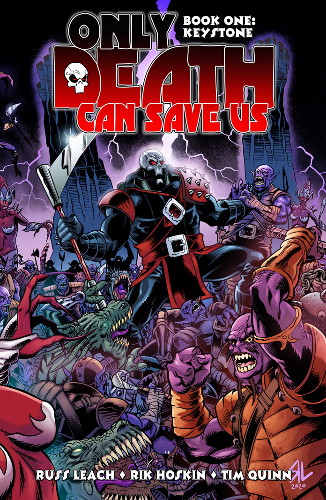
Excellent news from my mate Rik Hoskin. His graphic novel Only Death Can Save Us won the Indie Volt Award from Best Graphic Novel of 2021. Rik adds “I say ‘my’ when really it’s mostly Russ Leach’s work, I just provided the script! Book 2 has just launched crowdfunding on indiegogo, so the award came at a good time!”
Another friend and a splendid guest on the debut episode of my podcast Very British Futures, Nigel Anderson, has been busy on his own video podcast Doctor Who – Most Wanted and episode 3 is on Youtube now. He’s joined by VBF regular John Isles to talk about the Dalek stories, especially the missing or unmade episodes. It’s just as polished as the first episodes and well recommended.







 The Phantom Frame