Terrahawks – Very British Futures

One of the hazards of nostalgia for old children’s television is that fans sometimes forget they’ve done a lot of maturing since they watched their favourite programmes as youngsters. It became a problem for Terrahawks, Gerry Anderson’s comeback to puppet adventures in the Eighties, only to face criticisms from the viewers who’d grown up on Thunderbirds in the Sixties who found these new stringless stories somewhat lacking. Nevertheless plenty of their children did enjoy it, and not just in the UK but in countries such as the United States and Japan too.

Terrahawks could be the strangest, boldest, most Eighties Anderson show you’ve (probably) never seen. If you grew up on Thunderbirds, Captain Scarlet, or Space: 1999, you might think you know what to expect from a Gerry Anderson production: sleek vehicles, heroic pilots, and a tone that balances earnestness with spectacle. But in 1983, Anderson and script editor Tony Barwick created was something far stranger, cheekier, and more anarchic than anything that came before.

Terrahawks is a British science‑fiction series created by Gerry Anderson and Christopher Burr, originally airing on ITV from 1983 to 1986. It marked Anderson’s first new puppet‑driven show since the 1960s, but this time he ditched the iconic Supermarionation look for a new technique dubbed “Supermacromation”— hand and rod puppets more akin to The Muppets or Spitting Image giving the characters a rubbery, cartoonish energy.

Set in the year 2020, the series follows an elite defence force—the Terrahawks—as they protect Earth from a bizarre and theatrical Martian menace led by Zelda, an android witch with a cackling laugh and a flair for psychological warfare. Rumour has it that Anderson encouraged the sculptor to base her face on his ex-wife Sylvia. Her monstrous creations, from cube‑headed robots to grotesque alien offspring, gave the show a surreal edge that set it apart from Anderson’s earlier, more polished worlds.

Even among Anderson’s eclectic catalogue, Terrahawks is an oddity. It mixes slapstick humour with genuine peril, Saturday‑morning colour with unsettling villain designs, and high‑concept sci‑fi with eccentricity only British television could produce.

A few things that make it uniquely memorable are Zelda and her brood – Some of the most distinctive antagonists in Anderson’s universe, equal parts creepy and comedic. The Zeroids – Spherical robot soldiers whose bickering and bravery became a highlight of the show. A playful tone – Less stiff than Thunderbirds, less grim than Captain Scarlet, and far more willing to be weird. Inventive model work – Even with a smaller budget than Anderson’s 60s heyday, the effects team delivered imaginative vehicles and miniature action sequences.

On the Very British Futures podcast, we love exploring the corners of British sci‑fi that deserve a second look—or a first one for the uninitiated. Terrahawks is a perfect fit: ambitious, eccentric, and bursting with ideas that reflect both the legacy of Anderson’s earlier work and the experimental spirit of 1980s television.

In our episode, we dive into why its tone is so different from his 60s classics, the show’s most memorable characters and episodes, and its cult legacy and why it still sparks debate among fans.

You can listen to the episode on Spotify and other major podcast platforms.

Whether you’re nostalgic for the original broadcasts or discovering the series for the first time, the episode offers a fresh, affectionate, and occasionally cheeky look at this odd slice of British sci‑fi history. I was lucky to be joined by regular guest Andrew Roe-Crines and Ken Moss from the Extonmoss Experiment podcast. We’re the perfect companions to your viewing, and Very British Futures is right there to guide you through the model scale madness.
Space: 1999 – Very British Futures

When I was growing up, Space: 1999 was one of the big SF shows. Although I never watched it religiously in the way I followed Doctor Who, nevertheless I had a Dinky die-cast Eagle toy, several annuals and I thought the uniforms looked really cool, especially the colourful jackets they wore in the second season. As a show it was always present in the background, in Look-In magazine, old issues of Starburst and Starlog, and in many of the other SF publications which filled the shops in the wake of Star Wars. Then for a while it seemed to lose its lustre with the fan community, at least in Britain. It became regarded as dull, or camp in the wrong way, an example of how television didn’t ‘get’ SF. But quality will out and in the wake of two serious-minded serial shows of the 90’s both set in one location: Babylon 5 and Deep Space Nine, ITC’s space opera was rediscovered and reappraised. Older fans even detected a story arc to Year One, a suggestion that the Moon’s journey was being controlled by some kind of cosmic higher power, that the Alphans were being prepared for a new destiny on another Earth.

I actually felt that Space: 1999 would already be well covered by podcasts so I avoided it at first. However I am glad I changed my mind because this twentieth episode of the podcast is proving to be one of the most popular episodes so far. Having good contributors helps, and I was delighted to have my friends and talented writers Kara Dennison and Ian Taylor along for the ride. Their contributions are fascinating and amusing.

You can listen to the episode now on Spotify and the other major podcast platforms, including Youtube. Hope you enjoy it and I intend to pick up the frequency of episodes for the remainder of the year. Coming next will be The Comic Strip Presents.

Stingray – Very British Futures

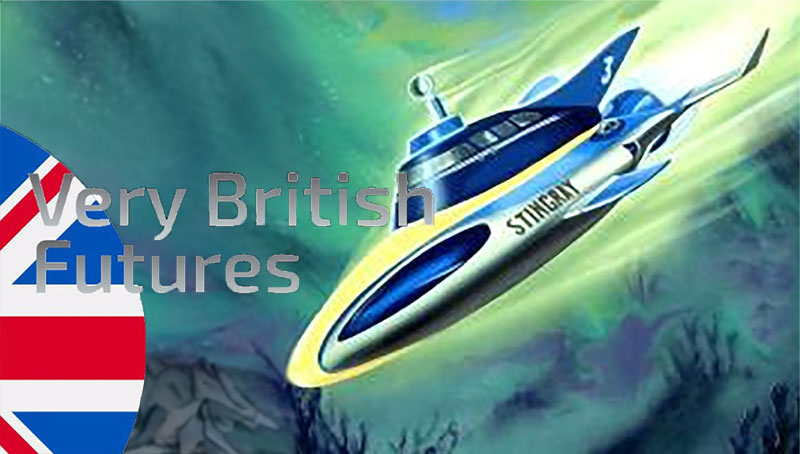
Just in time for Christmas, I’ve released a brand new episode of the Very British Futures podcast, with a seasonal flavour. There aren’t many British TV science fiction programmes that actually feature Christmas, apart from 21st century Doctor Who, but one welcome exception is the works of Gerry Anderson. Most of his puppet shows feature the Christmas holiday and for this special we took a look at Stingray and “A Christmas to Remember”.

Stingray is an odd fish. Although clearly a children’s show, it nevertheless features a largely adult cast of characters who have foibles, who socialise with alcoholic drinks and cigars, and have mature concerns beyond simply defeating the bad guy of the week. Most famously there is the romantic triangle between Troy Tempest, underwater-breathing glamourpuss Marina, and attractive Atlanta Shore, who works at Marineville most of the time. The stories were straightforward, but there was space for humour, and even a touch of satire. Meanwhile the excellent craftsmanship of the AIP team, created one of the glossiest junior shows on television, with memorable images like Stingray erupting from its undersea silo, or Marineville descending underground.

I was keen to get a younger viewer’s opinion for this episode, so invited John and his thirteen year old daughter Amber to be my guests for this mini-episode. It’s a slightly unusual episode as a result, but I hope listener’s enjoy the seasonal flavour and if it’s a success I’ll do another one next year.

YouTube version of the podcast

You can listen to Very British Futures on your favourite podcast app or at the official website

The Day After Tomorrow – Very British Futures

Plenty going on this month but the biggest news for this blog is that there is finally a new episode of my podcast Very British Futures out there – The Day After Tomorrow.

Nothing to do with the dreadful 2004 Roland Emmreich film but everything to do with Gerry Anderson’s continuing efforts to conquer America. UFO had come close but after a strong start in the ratings it had faltered. Space 1999 was doing reasonably well in syndication but the question of a second season was still up in the air. Then Gerry Anderson was approached by George Heinemann, producer of NBC’s new youth orientated anthology strand Special Treat. Special Treat was a series of documentaries and educational family dramas, and Heinemann was looking for a way to dramatise Albert Einstein’s famous theories for children. The result was the 50 minute special The Day After Tomorrow. Hoping it might act as a backdoor pilot for a TV series, Anderson and writer Johnny Byrne (Space 1999, Doctor Who) added the subtitle Into Infinity.

It’s an entertaining family SF adventure and something of an unintended callback to the pioneering Pathfinders in Space series with its young protagonists and parents and the emphasis on science and engineering. The short running time means it moves at a fair clip, and it enjoys the same high-quality production values as Space 1999. For this podcast I tried to reach out beyond my usual circle and recruited Felicia Baxter from the podcast guest site matchmaker.fm Felicia turned out to be a wonderful guest and her fresh perspective and presence make this an excellent episode. It’s also the first of what I intend to be an extra format for the podcast. As well as the traditional discussions with a group of guests, I’d like to more conversational two handers like this, looking at more targeted subjects and shorter form TV plays.

You can hear this episode on your favourite podcast app and also on the web here.


My friend Rik Hoskin has had a good month too. His comic strip adaptation of the second book in The Wheel of Time saga is out now and there’s a new trailer online.

Dynamite Comic’s The Great Hunt, written by Rik Hoskin

In addition he has published a marvellous creepy short story by a scuba diving holiday that takes a strange twist in The Dive, published by Cornice. You can enjoy for free and I recommend you give it a read.