After the success of his first BBC Audiobook, Will Hadcroft is back with a new Doctor Who short story, this time featuring the Fifth Doctor, Tegan, Nyssa and Adric, and read by Matthew Waterhouse. He’s delivered an entertaining little SF adventure with a subtext about human exploitation by both other humans and extraterrestrials.
Cover artwork
Still trying to return Tegan to Heathrow airport, the Doctor instead lands the TARDIS in 1830s London. Happily the air hostess turns out to be something of a Charles Dickens fan, so her disappointment is mollified by a chance to explore the setting of most of his novels. The Doctor warns his companions that the real London is much more squalid and dangerous world than is usually shown in the movies. In fact he’s so cautious he even insists they all change into appropriate period clothes for once, which is a fun idea and leads to an entertaining reveal sequence when they step out of the Ship. But the listener already knows that sinister forces are at work. A retired admiral has become an investigator into the odd and inexplicable. He has heard of unexplained disappearances around the workhouses, and desiccated bodies being discovered, killed in a manner beyond human capabilities. Before the Doctor and his friends can begin properly investigating, all four of them are abducted and separated by different parties.
In his first Doctor Who audiobook The Resurrection Plant, Hadcroft had shown a particular interest in darker, exploitative side of the Industrial Revolution and he continues the theme in this story, arguably to even greater effect since much of the unpleasantness he describes is historical fact. Splitting the team up, he depicts the workhouse, the streets and criminal gangs trading in women’s lives with an interesting but balanced amount of detail, illustrating the harshness and injustice without descending into gory shock value. In fact this story would have worked as a pure historical, with a little reworking. Without giving too much away though, there is an alien antagonist to be faced. Bodies drained of life is something of a staple in Doctor Who adventures, as is beings who regard humans as a resource rather than sentient equals, but ultimate resolution to the main mystery is pleasingly Doctorish and ultimately hopeful.
All the regulars are well-depicted. Tegan and Nyssa get some moments of sisterly banter and later prove to be adept at rescuing themselves for once. Adric is headstrong and feels a bit of an outsider in this decidely messy human enviroment, giving some hints of his growing homesickness. There’s a striking moment where he admits to mourning the ‘death’ of the older Fourth Doctor who fitted the father-shaped hole in his life, replaced by a younger man with whom he struggles to connect with, in same comfortable way Tegan and Nyssa appear to. Meanwhile the Doctor is enthusiastic, a touch rueful and there’s an amusing moment where he is annoyed with the “youthful whine” in his voice when he attempts to assert his authority. Matthew Waterhouse does an pretty credible impersonation of Peter Davison’s voice, can still sound convincingly younger as Adric, but makes Janet Fielding sound like a cockney. His natural reading voice is very listenable to though and he does a good job with the guest characters. David Roocroft’s sympathetic sound design does a great job of illustrating Victorian London without drowning us in street barkers, steam horns, and clipclopping carriages.
Doctor Who – Dark Contract is an assured, entertaining trip back to Doctor Who circa 1982. Written with intelligence and with something deeper to say both about our fairly recent past and our responsibilities to each other. It can only enhance Will Hadcroft reputation as an author.
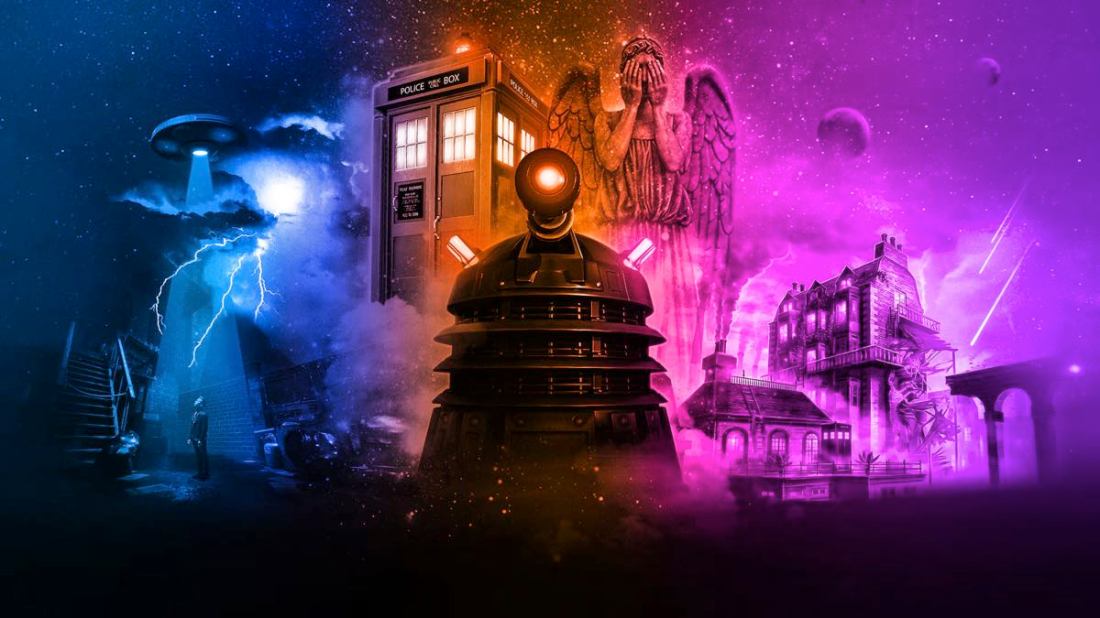
Ever since computer games were invented, Doctor Who fans like myself have wanted to see our favourite show to be part of that world. From Doctor Who – The First Adventure on the venerable BBC B Micro, through Dalek Attack on the PC and Spectrum, to more recent attempts such as Lego Dimensions. Then in 2019 a fully fledged VR game arrived The Edge of Time, courtesy of Maze Theory, but never seemed to make the impact such major project should had. After all, this game lets the player travel in the TARDIS and confront Daleks and Weeping Angels face to face. It has a complete story that puts the protagonist centre stage. When I bought myself a Meta Quest 3 headset, it was a game I purchased almost immediately to experience myself. After Beat Sabre.
Recently there seems to have a dizzying explosion of Doctor Who titles in many videogame subgenres, from time-killing smartphone game Lost in Time to online card game Worlds Apart to guest appearances in big hitters like Fortnite and Minecraft. Up until now, I would say the titles closest to capturing the spirit of the programme were the Doctor Who Adventures released initially for free by the BBC, featuring the Eleventh Doctor and Amy. Whilst enjoyable to play these felt less polished than the perfect AAA game of my imagination, something combining the mechanics and look of say the Mass Effect Trilogy or Fallout 4.
The appropriately named game The First Adventure (1983)
The opening story in The Adventure Game ‘season’ – City of the Daleks (2010)
The Edge of Time is definitely one of most ambitious and big budget attempts to date. It promises a great deal, to actually join the Thirteenth Doctor in an adventure as her temporary companion, flying the TARDIS, battling the Daleks, the Weeping Angels and some new enemies in virtual reality. Unfortunately the earliest releases of the game came with game crashing bugs, despite extensive play testing by Maze Theory, and I think that did damage the game’s reputation. However the version available to buy now is much more robust and also comes with 2020’s Time Lord Victorious DLC bundled in for free.
The landing screen placed me in a rocky area with the TARDIS standing to my left, humming with energy, whilst ahead was the menu. Choosing New Game took me to what would be called the “cold open” of the episode. a shabby laundrette where I was the only customer. The lights start to flicker and the voice of the Doctor, voiced by Jodie Whittaker herself, comes through the static of the television. She’s asking for help, and warning me that I’m in trouble. The lights flicker again and the washing machines fill with slime, covered with blinking eyes. The voice of the Doctor warns me that these are embryo Hydrocs, vicious predators who grow very quickly. Reality is breaking down and I need to get out of there. Some searching and clue solving puzzles follow, as I eventually get through the locked door at the back and summon the TARDIS, just as a Dalek saucer appears overhead and tries to exterminate me. Cue 360 degree panoramic version of the Thirteenth Doctor’s title sequence.
Inside the Thirteenth Doctor’s console room (a design I became more resigned to than ever really liked) the Doctor appears as a hologram and explains that she is trapped at the other end of Time and needs my help to find three rare zeiton crystals with which she can create a vortex manipulator to escape and fix the reality virus which is threatening the whole universe. This plot accidentally anticipates the Flux that the Doctor will face in 2022. First she needs to guide me through flying the TARDIS, which involves turning knobs and pulling levers in a sequence repeating memory game, a bit like Bop It!
There was definitely a thrill to stepping out of the TARDIS on to an unknown planet. That worked each time arrived in a new location. Most of the game is puzzle solving, moving objects about, slotting them into holes. Or combing objects to create an effect. Zapping items with the somic screwdriver was a reliable move. Most of the puzzles were an easy to medium challenge, apart from one aboard a spaceliner involving reflecting a laser beam with rotating mirrors to activate doors, that eventually I had to look up the solution on YouTube. As with many VR games at the moment there is a distinct escape room vibe to the majority of the game, even if the locales allowed for a lot more walking and exploring.
Occasionally there is an action sequence. Escaping the Weeping Angels in an old house, with an unreliable torch and a lift which needs recharging at each floor with a dynamo, was genuinely scary, especially knowing that death meant going back to beginning of the sequence again. By contrast a first person shooter section, driving a Dalek around a temple shooting at other Daleks, became quite frustrating, since unless you managed to time every shot and make it count, death meant starting the whole long section over again, which became pretty wearying. I’m not a fan of the whole timing blows precisely in a sequence kind of combat which Dark Souls has popularised.
Along the way, the villain is revealed as The First, a godlike mother of all life in universe, wishing to punish intelligent life for making so many mistakes. To be honest this section was a bit ponderous, especially since she is so powerful, all the player can do at this point is really stand and watch the Doctor sort things out, again solely as a voice. Despite a last minute race to retrieve three more magic items by revisiting some previous destinations, the climax is underwhelming.
Yet the journey there is pretty entertaining. The whole Weeping Angels section uses those antagonists particularly well, with some moments that are more than worthy of the television series. Sneaking past full-scale Daleks is fun and again feels very reminiscent of the series. Dialogue writer and co-storyliner Gavin Collinson gets the feel of modern day Doctor Who. You get your own companion of a kind, Emer, winningly voiced by Jennifer Saayeng, who has also appeared in a few Big Finish stories. Wielding the sonic screwdriver to scan and manipulate item is satisfying too.
Graphically the style is fairly cartoonish, an acceptable compromise between accurate detail and the speed and size of the game. The two TARDIS console rooms of the Thirteenth and the Tenth’s (for the Time Lord Victorious add-on) are pleasingly recreated, whilst the new locations are colourful and well lit.
Away from the main story, there’s the Time Lord Victorious collectible game, which tries to extend gameplay by adding hidden collectible items in all the locations of the story. These are related to the stories in the BBC’s 2020 multi-platform campaign. Discover all eight and you can play a quiz game. There’s also an Arcade section where the player can replay the title sequence, flying the TARDIS, escaping the Weeping Angels, or battling the Daleks.
In 2021 Maze Theory released a reimagined version of the game for flat screen consoles. Doctor Who – The Edge of Reality replaced the god-like First with the Cybermen as the principle villain and also featured a cameo from the Tenth Doctor. I have not played it but I believe it too was plagued with bugs and seems to have had even less impact than the VR original.
I’ve enjoyed playing this game and think it deserves to be better known. It’s a sincere attempt to put the player inside a Doctor Who adventure and translates a fair amount of the feel of the Thirteenth Doctor’s era. It’s an accessible game for both experience VR players and first timers. Hopefully it will remain in the Steam, MetaQuest and Playstation libraries for the foreseeable future.
Another of my early experiments with my new Meta Quest 3 headset was to watch the 360 degree Doctor Who short animated film which the BBC released in January 2019, featuring the voice of Jodie Whittaker. The Runaway begins with the viewer being accidentally teleported aboard the TARDIS by the Thirteenth Doctor. Apologising, the Doctor explains she is trying to help a young energy being from another dimension return home. The being is a glowing sphere with eyes and the Timelord explains that if it becomes too agitated it will blow up, taking the TARDIS with it. As a story its typical of the kind of mini-episodes which were usually made for Comic Relief, based entirely on the standing set of the console room. The animation is similar to Edge of Time although this cartoon was made by the BBC VR Hub.
It works excellently in the Quest 3, I can see it would function equally well in any 360 viewer, including Google’s Cardboard VR. It’s a sweet little disposable tale, although I missed having any interactivity. If you have a chance to watch it as its meant to be seen, its worth your time though.
Sixteen years since the last straight to DVD revival, twenty-five years since the original television series gave its last bow, Babylon 5 returns polished up as an animated special The Road Home. Is it the beginning of a new era, or a nostalgic curio for the die-hards?
Time has been kind to Babylon 5. It was never a series which relied on the quality of its effects and a movie quality production. It’s strengths was its unashamed respect of literary SF and the power of a good story well told. Matched with rich characterisation that allowed its flawed protagonists to both fail hard and triumph satisfyingly over the years, spending most of the intervening time in stories that were often imaginative and morally grey. After years of only being accessible on VHS and DVD, recent years have seen it return to wide syndication, availability on streaming services and after a long campaign by fans, a HD remastering, all of which has enabled it to be enjoyed by new generations of fans, some of whom were not even born when its final story Sleeping in Light went out on TNT.
Babylon 5 was influential in several ways. It was one of the first SF series to embrace CGI, using the groundbreaking NewTek Video Toaster, which made computer graphics feasible on a cable television budget. It popularised the concept of the story arc. Instead of self-contained, almost interchangeable episodes where the status quo would always be reset after an hour, creator and chief writer J Michael Straczynski (known as JMS to fans) planned a “novel for television” to be told over five seasons. The idea was mocked as vainglorious by many, yet the programme proved that there was an audience who would commit to the journey. Now it would be hard to find a TV series which doesn’t have ongoing threads. Finally there was the way JMS embraced the fledgling internet, specifically Usenet to communicate directly with watchers in a way that hadn’t been possible before. He gave us an insight into the writing and production process of an ongoing, often struggling TV series that was fascinating and educational, as well as building up a whole community around the show.
It’s that ongoing community and the recent revived interest which has allowed The Road Home to exist. That and apparently a new willingness at Warner Bros to exploit a franchise which it was previously content to sit on.
The plot of The Road Home taps into Hollywood’s current love of multiverses and alternative worlds. On his first official engagement off-station, President John Sheridan becomes unstuck in time as the result of a malfunction in the new tachyon-based power generator he is supposed to be inaugurating. Teleporting into the future and the past, he then finds himself travelling sideways in alternate versions of the Shadow War, where the Shadows or the Vorlons win, both with cataclysmic results for humanity and its allies. Worse, if he cannot jaunt home, the multiverse itself might collapse.
Rather like a wedding, how much the viewer gets out The Road Home depends a lot on how many faces you recognise. If the above synopsis seems confusing, then this animated movie will be a lot of sound and fury, signifying not much. As an introduction to Babylon 5, it’s too reliant on pre-knowledge for the vast majority. Yet thanks to JMS’ script and the obvious affection of the production team, at the same time it’s a film that contains everything that made Babylon 5 what it was, good and bad. Action and big SF concepts like quantum physics, nestle with pulp staples like ancient alien cities being discovered, powerful aliens being reawakened, and passionate declarations of undying love. Smart jokes like a galactic vista being interrupted by a search of socks, share time with clunky one-liners. B5 could be moving but it could be amusingly pretentious too and there’s some windy philosophy at “the Rim” of the universe, delivered with deathly, if mellifluous, tones, which could have come straight from an obscure prog rock album sleeve notes.
Tragically, the series has lost more than the usual percentage of cast members. The voice cast contains all the surviving regulars, led energetically by Bruce Boxleitner returning to the role of John Sheridan. It’s great to hear Patricia Tallman, Peter Jurasik, Claudia Christian, Bill Mumy and Tracy Scroggins in character once more. They are joined by a cast of creditable actors taking on other beloved characters and thanks to good casting and direction from casting director Liz Carroll and Matt Peters respectively, none of them jar in the ear. Sadly the episodic nature of the story means that few of the regulars get much time to shine, apart from Sheridan and Delenn, but there’s a lot of fun to be had with the return of fan favourite, the gnomic alien Zathras and most of the funniest moments belong to him.
Visually the film looks marvellous, enjoyably opening out and subtly updating the old locations on the space station and Epsilon 3. It has that recognisable Warner Bros look that’s been seen in many of their recent superhero cartoon movies, tall figures with great cheekbones. Just about everyone is instantly recognisable, although it took me a few moments to recognise Elizabeth Lochley. The production team cleverly incorporate several iconic visual scenes from the series, such as the launching of the Starfurys or the reveal of The Great Machine.
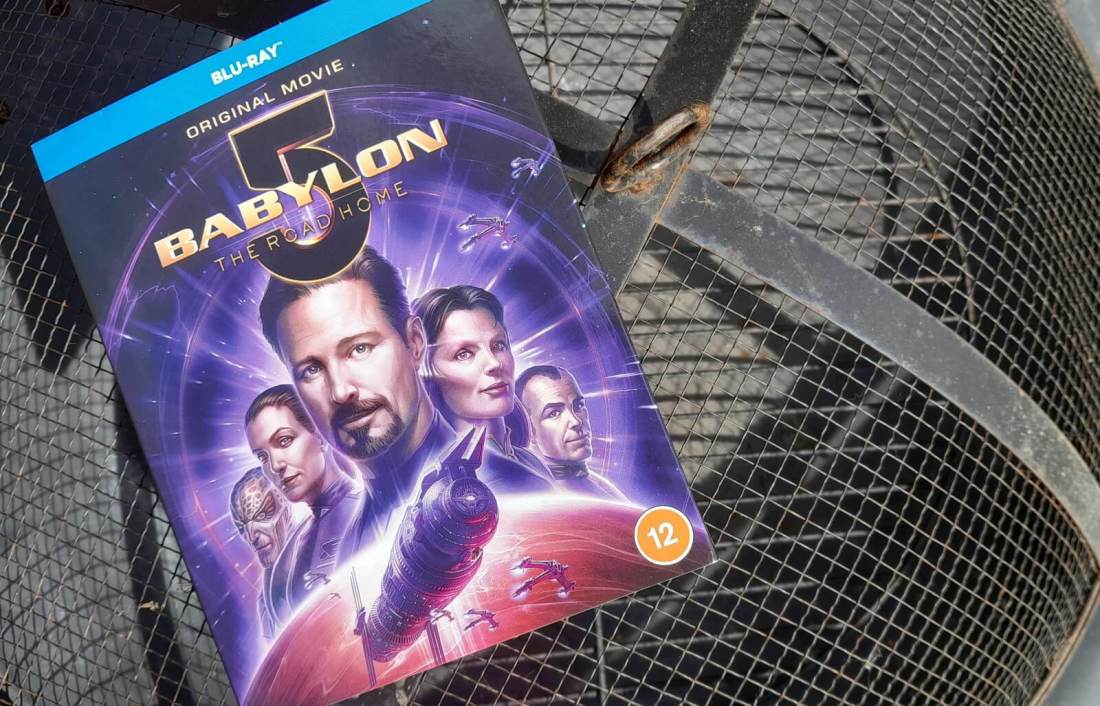
I’m reviewing the bluray release, which comes in a slipcase and has two extras, an enthusiastic commentary by Boxleitner, JMS and supervising producer Rick Morales, and an appreciative making of documentary B5 Forever with some interesting behind footage of the cast recording their parts.
During the documentary, JMS says he has ideas for future animated stories and I certainly hope this special is successful enough for more. As a victory lap and a celebration for long time fans, The Road Home is a treat that doesn’t disappoint. For newcomers, the pilot film The Gathering or the TV movie In the Beginning is still the place to start.
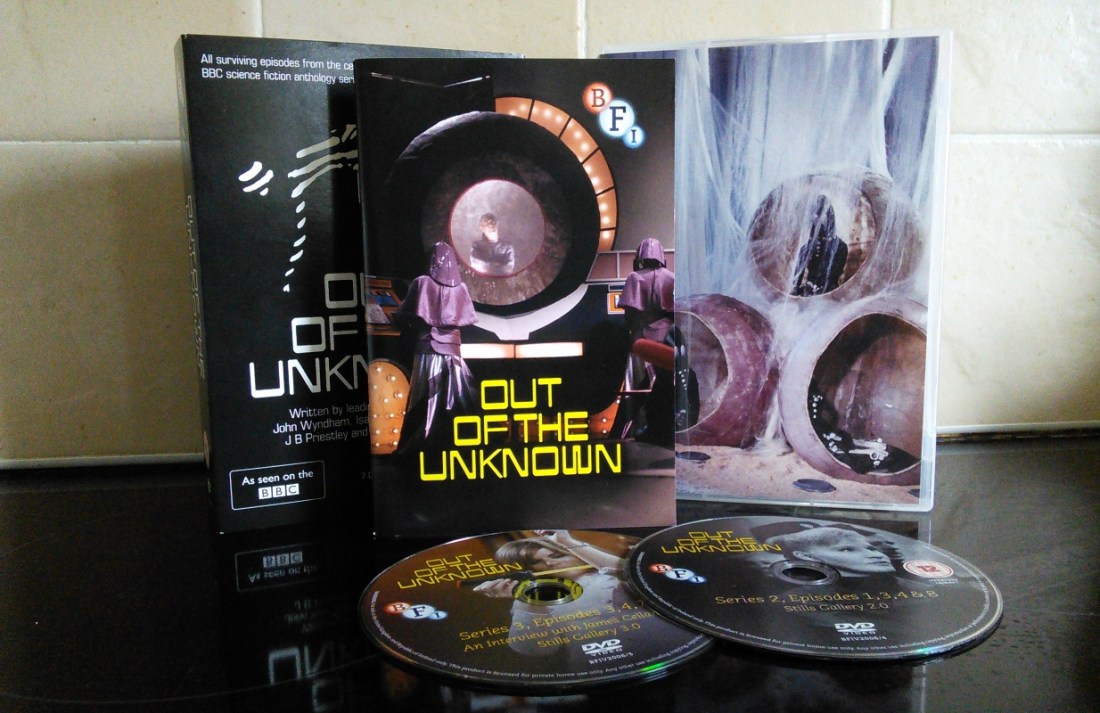
It has been a real pleasure to watch and review this British Film Institute box set of Out of the Unknown. Just to wrap up this series, I thought I would take a look at the collection itself – seven DVD’s in a sturdy plastic case and cardboard sleeve. We have been particularly fortunate that after announcing the release, the BFI listened to and cooperated with a group of classic television enthusiasts to produce a remarkably complete collection, for a programme which is regrettably missing so many episodes. The four reconstructed episodes, eleven commentaries, photo galleries, interview with director James Cellan Jones and the forty two minute documentary Return to the Unknown are all high quality fan contributions. Many of these contributors also worked on the Doctor Who DVD range, another series featuring a very high standard of DVD extras.
In fact the documentary Return to the Unknown has a format familiar to any one who has collected the timelord’s adventures. A collection of talking heads filmed against white, interspersed with vintage photos, BBC documents and apposite video clips. It is a warm tribute to all four seasons, with plenty of fond reminiscences and little in the way of controversy. There is predictably alot of anecdotes about the relatively primitive production facilities of time but also the way BBC2 encouraged innovation. Interesting to note that with Head of Drama Sydney Newman overseeing the series, he once again set up a science fiction series with a young female producer Irene Shubik, assisted by a veteran BBC man George Spenton-Foster, in the same way that Doctor Who began with Verity Lambert and associate producer Mervyn Pinfield. At times the narration does irritatingly present opinion as fact, for example that the surviving episode of season three The Last Lonely Man was also one of the finest. Mark Ward – author of the excellent guide to the series published by Kaleidoscope, contributes as well but he comes across as a little too enthusiastic and uncritical, seeming to describe every episode he mentions as “one of the best ever dramas”.
Without the time to cover the whole series in depth, certain episodes are singled out for more detailed treatment including The Machine Stops, Second Childhood and the Issac Asimov robot stories.The best part of the documentary for me were the intriguing clips from the missing episodes. Wendy Craig is on good form as the reluctant new owner of a handsome robot servant in Satisfaction Guaranteed. Several recoloured scenes from Liar! suggest that it was particularly good story and that Ian Ogilvy gave a brilliant performance as Herbie the telepathic robot. Even the striking end credits of The Fox and the Forest and Andover and the Android are tantalising. We learn that the former was only broadcast the once due to the unusually high repeat fees demanded by Ray Bradbury. In fact, another nice touch to the documentary is that the end credits are done in the same striking graphic design as those of the first two seasons.
Most of the contributors to the documentary also turn up in the commentaries, moderated by comedian and writer Toby Hadoke, a safe pair of hands for these, having hosted a fair number of the commentaries of the later classic Doctor Who DVD releases. He always does his research, has a deep knowledge and love for British telefantasy, and also possess an engaging manner which usually brings out the best in his speakers. As a result the commentaries are all of a pretty good standard, even if the passing decades means the contributors rarely have detailed memories of the filming, beyond one or two particular moments. Although often the onscreen action will provoke some extra thoughts, even if it is just amusement at the costumes.
The image galleries on every disc are impressive, with all the episodes getting some coverage. James Cellan Jones, director of Beach Head gives an informative interview but I could have used some photos to break up the static shot of him talking. What I did not realise until I looked him up was the length and success of his directing career, from Compact in 1963 to Holby City in 2001, by way of many TV movies and mini-series. The Deathday film inserts, which are seen on a television in the background of the episode, do not add anything beyond adding to the box set’s feeling of completeness. Finally there is the excellently written booklet by Mark Ward, as well as a useful episode guide. From this 42 page booklet we can learn enjoyable trivia such as the original intention to have Vincent Price introducing each episode, in the way Boris Karloff had for Out of this World. That the series might have been called 12 Tomorrows. Or that record producer and well-known science fiction fan Ian Levine tried to revive the series in 1981.
This box set is one of the highlights of the BFI’s television range and it is hard to see how it could be much improved upon unless more episodes are uncovered, which seems unlikely now. Picture and sound quality have been restored to a good standard and the inclusion of the reconstructions is a pleasant bonus. It is still quite a pricey set but for fans of BBC science fiction and the so-called golden age of science fiction represented by Asimov, Bradbury, Wyndham et al this is great viewing.
You can read more details and learn where to order it from on the BFI site.
Below is a complete episode guide and a checklist of all my episode reviews, in case you would like to read more of them. Thanks for checking with me and the encouraging comments. I will be back to this blog with more cult reviews in the future, but my next posts will be concentrating on my current theatre work.
So here the series ends, as far as we can know it, since the final episode The Shattered Eye is long since missing. And a series that had been conceived as a showcase for the best of literary science fiction finishes with a ghost story.
George and Millicent Patterson are about to emigrate to Botswana, so are spending their last night in their old, virtually empty flat. But their night turns into a frightening ordeal as they are assaulted by visions which gradually tell the story of a controlling husband who abuses and eventually murders his wife.
It is difficult to review this episode fairly, since we only have a handful of publicity photos, which omit most of the cast, plus the soundtrack. The reconstruction therefore illustrates the audio with pages of the original camera script. It is a shame there was not the time or money to re-type the script, since the faded copy we see is quite hard to read in places. Still I would rather have this version than omit the episode altogether.
Although essentially a supernatural story, The Uninvited did remind me of Sapphire and Steel with its limited interior setting and use of an electronic howl to herald each visitation. The events could be explained as some kind of time rift if you cared too. It is difficult to judge how frightening it might have been since it would have depend a lot on how good the visual shocks in the script were realised.
In a season that has generally featured fraught relationships, it is rather lovely to listen the genuinely loving and affectionate marriage of George and Millie, played with easy naturalism by John Nettleton and June Ellis. The fact they are so likeable and committed to each other, definitely amplifies the horror when it begins because I really did not want anything tragic to happen to them. June Ellis was incidentally the wife of producer Alan Bromley. It is almost a shame that Brian Wilde is remembered for playing ineffectual comedy characters in Porridge and Last of the Summer Wine because he excelled playing sinister, slightly pathetic villains, whether the abusive husband Ramsay here or Mr Peacock in Ace of Wands. The moment where he advances on Millie, telling her she must be punished is unsettling even on audio.
Writer Michael J Bird had already written the controversial To Lay a Ghost for this season. He was something of a specialist in writing contemporary dramas with a supernatural flavouring, penning Maelstrom, The Dark Side of the Sun and The Aphrodite Inheritance as well as guest scripts in quite a few long running BBC series. Whilst this episode is lost, interestingly Michael J Bird rewrote his script as In Possession for Hammer House of Mystery and Suspense in 1984. Another missing Out of the Unknown episode The Last Witness was adapted by Martin Worth for the same series, retitled A Distant Scream.
Perhaps the only criticism I can make of The Uninvited is that it would have fitted comfortably into any of the Seventies supernatural anthologies, such as Dead of Night. It demonstrates that Out of the Unknown had lost its distinctive identity and unique selling point. So it was not surprising that indifferent ratings and incoming new executives with fresh agendas led to it not being picked up again. Survivors, Moonbase 3 and Doomwatch would keep the flag flying for BBC adult-aimed science fiction through the Seventies. Eventually, just as Out of the Unknown sprang from in part from Armchair Theatre, so Play for Tomorrow would spin-off from Play for Today. But that is an article for another time.
I’ve not quite finished with this BFI boxset. Coming up next is a review of the brand new documentary Return to the Unknown and the other extras included in this impressive collection.
More by accident than design, due to the intervening episode The Last Witness being lost, The Man in My Head continues the theme of the misuse of psychology and drug therapy which Welcome Home began. Not only that but its criticism of the military mind, with its emphasis on obedience and the chain of command, and the way most of it takes place in an underground complex, it also recalls season two’s Level 7.
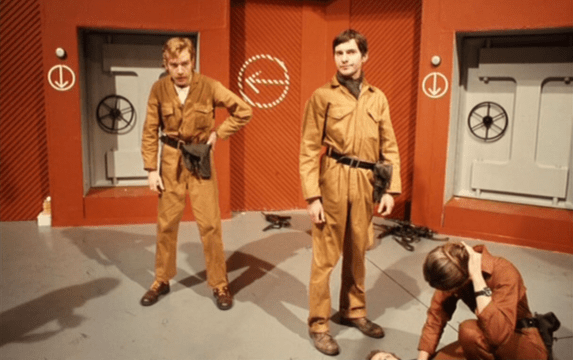
It is the ultimate in covert operations. A crack team of commandos are on a mission to infiltrate and sabotage a hydro-electric power station. Each soldier has been subliminally programmed to only remember the next stage of their mission when they hear a tone on their radio. They have been equipped with specialised personas and skills tailored for this mission. Not only that, but they have been programmed with a backup cover story in case they are captured, which they will utterly believe when it is activated. It looks foolproof on paper, but when the team hits an unexpected accident, doubt, paranoia and identity crisis are soon eating away at them.
With most of the action taking place in a single large set, there’s very theatrical feeling to this episode. Perhaps that explains the slightly larger than life performances from most of the cast. That kind of over-emphasised, reaction-heavy acting that science fiction stories often encourage. Its not necessarily a bad approach, but it lends an artificiality to the episode that makes its final revelations not as much of surprise as it could have been if the episode had been made on film and filmed in a realistic location. Yet theatricality does not mean it is visually flat. Director Peter Creegan makes great use of dramatic camera angles from above and below and the whole production is dramatically lit with the cast’s sweat gleaming faces lit quite noir-ishly in half-light.
Tom Chadbon is excellent as Captain Brinson, the initially cool leader who becomes increasingly unravelled as his leadership and even his identity is challenged by the casually superior Hine, the older scientist who has been working undercover at the plant. It’s a trivial point I’ll admit, but as we reach the end of the series, it is sort of nice to see the return of the dodgy blond moptop wig that was such a staple of the first season. This time it is Kenneth Watson who gets to sport it as Hine.
John Wiles was an experienced television writer with many credits to his name, from Dixon of Dock Green to A Horseman Riding By. He also been a script editor on several BBC shows and produced Doctor Who during most of the later part of William Hartnell’s era, despite not a great fan of science fiction. He had already provided the script for one episode in the fourth season – Taste of Evil – which is now lost. His script is clever in the way it shows how a seemingly logical idea as subliminal programming is filled with pitfalls. Especially when one of the men Fulman triggers his backup programming and becomes a soldier who has accidentally crashed landed in an enemy territory, looking on in bewilderment as his comrades seemingly prepare to carry out a random act of terrorism.
Ultimately the real villains of this piece are the military officers who regard these soldiers are little better than cheap robots who are ultimately disposable. In fact there is an inference that these men and one woman may not even have been real soldiers originally. As a story it still feels quite relevant and is probably the existing episode from this season which could be most easily remade today. It manages to do some fresh with old what-is-real / what-is-imaginary concept that underpins a lot of the fourth season. Unlike Welcome Home, which is based around the mystery of what has been done, The Man in My Head shows us its box of tricks at the start, yet still tells a story with some unexpected twists.
It is less a case of whodunnit than of howtheydunnit in this entertaining paranoia story. Moris Farhi MBE is definitely a renaissance man. Author of several novels, including the multi-award winning Children of the Rainbow, poet, acclaimed writer on Jewish history and philosophy, campaigner for writers imprisoned by oppressive regimes, and jobbing scriptwriter on television series from Return of the Saint to The Onedin Line. His late wife Nina Farhi (nee Gould) was a psychoanalytic psychotherapist and I wonder how much input she had on this story, which involves a psychiatrist abusing his power.
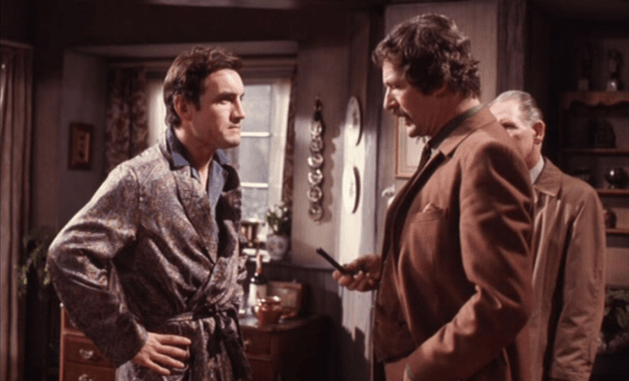
Dr Frank Bowers travels to his new cottage after a long convalescence in hospital following a car accident. To his shock, neither his wife Penny or his friends recognise him, and worse another man is living in his place, who tells him patiently that he is the real Frank Bowers.
This is a much more enjoyable example of the twist followed by twist thriller than Deathday was. There is always a danger with this kind of story that the plot become too contrived and reliant on characters acting very stupidly, but Welcome Home stays just about on the right side of logic. One of its most satisfying revelations is about Bowers’ flashback dreams, which are portrayed through time lapsed photos. We later discover that this is not just a stylistic choice by director Eric Hills, but actually a clue in plain sight as to what is really happening.
Casting Anthony Ainley as Frank Bowers One, as he is named in the credits, is a clever idea because from the start he generates distrust. Later most famous for playing recurring villain The Master in Eighties Doctor Who, Ainley had a flair for the sinister and Frank Bowers initially seems very suspect indeed. When talking to his doctor and then later on the train, his smile is a bit too wide and his bonhomie has touch of mania about it. As he desperately tries to prove his identity, only to be thwarted at every turn, first by circumstance and then by what seems to be a deliberate conspiracy, he does begin to engender sympathy though, and by the end he has become a tragic protagonist.
On the other hand Frank Bowers Two, played by Bernard Brown, first appears as a self-assured, patriarchal personality and pretty much stays like that for the whole story. The only crack in his certainty is when Penny begins to be sympathetic to the other Frank, making him accuse her of being attracted to a younger version who more openly needs her, something he says he hadn’t considered before. Bernard Brown had a long television career of playing lawyers, doctors, officers, and other authority roles. It soon becomes clear that he is the driver behind whatever is happening, but the tension comes from trying to work out what his plan really is.
Special mention should go to Norman Kay’s sinister electronic incidental music, which frequently recalls Doctor Who, another show Kay worked on. In fact thanks to the music, the outdoor filming around a weir rather reminded me of a Jon Pertwee era story.
As with much of the fourth season Welcome Home is more concerned with telling a dramatic story than exploring a concept or issue. It does however touch on the misuse of science and medicine, at a time when psychiatry and other therapies were becoming a popular subject. In shares some DNA with One Flew Over the Cuckoo’s Nest for example. Although only tangentially science fiction, it carries a warning familiar from many short stories – that people who concentrate too much on a future greater good, and justify immoral actions in the short term, frequently suffer severe consequences – and so do the people around them.
Angus Hall was not impressed with the BBC adaptation of his 1969 novel. Nearly twenty years later during a correspondence in the letters page of the BBC’s cultural magazine The Listener, about the recent BBC2 25th anniversary programming, the author wrote in about the absence of any mention of Out of the Unknown in the celebrations. “I still shudder at how my perfectly respectable ‘psychological thriller’ Deathday was turned into a grotesque ‘other-worldly’ travesty by the programme-makers. I trust that Out of the Unknown remains unknown to all present and future television viewers.” Now I have never read his novel so I cannot directly compare, but I can certainly sympathise with with his disappointment because this was a poor instalment. Hall incidentally wrote over twenty books in the crime and horror genre, amongst them Crime Busters, and Devilday, which was adapted into the cult Vincent Price/ Peter Cushing movie Madhouse.
Adam Crosse is a failure. Stuck in a dead-end reporter job for the local paper. Popping pills. Married to the bitter condescending Lydia. When he discovers his wife has taken a lover and that she does not really care that he knows, his frustrations murderously boil over. Afterwards he begins an elaborate cover-up, trying to cast suspicion onto a current serial killer known in the papers as The Kitchen Killer.
I’ve deliberately kept the synopsis short this time because if I told you much more you could probably guess the ‘twist’ a mile off, just as I did. That is one of the problems with this story. The other is that as a study of a mentally ill murderer, this episode comes off a parody of Dennis Potter as its inadequate middle-aged protagonist.
Actually thinking about it that is one of the problems with the whole ‘psychological thriller’ genre that the Seventies and early Eighties used to love so much – it demonises and trivialises mental health issues. Not to mention providing an excuse for some lazy writing. Whilst the story gives us a few motivations for Crosse’s actions, his wife’s infidelity, his sexual inadequacy, the conflict between his desire to be an alpha man and his essentially passive subservient personality, too often the reason for what happens comes down – he’s a nutter.The other big annoyance I have with the genre ever since Les Diaboliques is that the question – is it real or is the protagonist imagining it? – is actually a pretty boring one that often drains the story of tension rather than creating it.
One later section I had assumed must be happening in his mind, is where Crosse goes driving at night and picks up a sexy blonde woman. Or rather she just jumps into his car at the traffic lights. I thought she might be a prostitute but its soon established she isn’t. Apparently she is just a spirited party girl who does things on a whim and for some reason decides a one night stand with a portly creepy older man would be fun, which stretches credibility to breaking point. In fact it would have only made sense if she was a fantasy but she was real. There is also an unexpected bit of gratuitous nudity as she undresses and explores his bathroom on her own, which felt oddly out of place.
The appalling decor could be a clever reflection of unhappiness in the Crosse and Gregory households, but I suspect is just a case of hideous BBC Seventies set design. Everything seems so brown. Even the dream sequence looked ugly.
It is another episode where thirty minutes would have been more than enough. Ultimately Crosse is not a particularly interesting murderer and his mental unravelling has no sense of tragedy, since he did have much going for him in the first place. Again this overall tawdriness may be the point of the story, but if you want to see a drama about a hollow man who finds that even murder cannot free him from a modern hell of mediocrity and poor taste, catch American Psycho instead.
Probably the most obviously science fictional episode of season four, yet it’s strength comes from the character drama. In fact with a little rewriting, much of the plot could work equally well as an espionage yarn or a crime thriller.
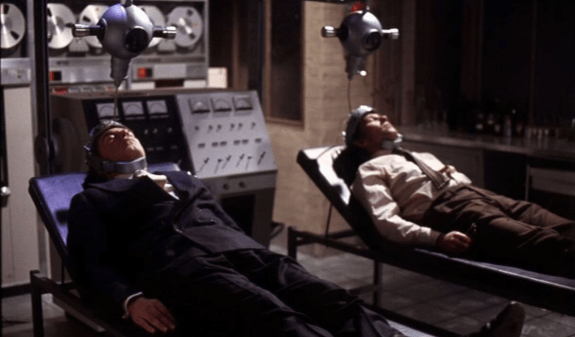
Allen Meredith is a brilliant research scientist who has accidentally discovered a process to transfer a person’s mind into another body, whilst experimenting with a mind reading device. His mild, bookish personality means he has been taken advantage of for years by his arrogant boss Jack Gregory. Allen’s strong-willed wife Ann convinces him to kidnap Gregory, swap bodies and embezzle thousands from the business. The process is a success but Meredith soon finds that stepping into another man’s life is lot harder than just memorising the name of his wife and his date of birth. Particularly when he discovers Gregory is involved in multiple affairs and in debt to a gangster too. Meanwhile the combination of Gregory’s alpha male personality in her husband’s body proves irresistible to Ann and together they plot to steal the money and start a new life.
There’s a trio of excellent performances at the heart of this episode. Jack Hedley is splendid at convincingly playing both the powerful Gregory and the unconfident, desperately improvising Meredith trying to act a tough businessman. His craggy features, often lending to his casting as officers and other authority types, are marvellously expressive as he reacts and bluffs his way through the day. Jack Carlton, a regular face in British films in 50’s and 60’s is almost as good in the mirror role, especially as his seduces Ann to his side. There is some interesting ambiguity as to how genuine his feelings for her are. Alethea Charlton perhaps best known for her roles in ITV period dramas, as well as two appearances in early Doctor Who, including Hur the cavewoman in the very first adventure, is excellent at bringing sympathy to Ann, in what could have been a cardboard hard-boiled role. Through her we come to understand that her plan is the result of years of frustration (of many kinds) as well as ambition. Even though she betrays her husband, she visibly blooms in her attraction to Gregory. Thanks to the way the actress plays it, her howl of despair when she realises her dream of a new start has been crushed by her husband’s mistakes is played as a genuine tragedy, rather than a comeuppance. It was sad to discover that Alethea Charlton died from cancer only five years later.
Meredith’s increasingly calamitous evening and the day as he tries to be Jack Gregory have almost a black comedy element. His attempts to embezzle the money are laughably ham-fisted and almost immediately discovered, but since everyone thinks he is Gregory they assume he must be having some kind of breakdown. On top of that he inflicts a painful night on himself by not knowing that his target has health problems, and he is ill-prepared to deal with all the emotional scenes from the women in his life. By the end of the day he has unintentionally destroyed Gregory’s career!
This is an entertaining story but not too much depth to it. It’s certainly stronger that The Last Lonely Man in dealing with mind transference but the science fiction element is ultimately a gimmick for a story about a con that goes badly wrong. So even in this episode, it shows that the fourth season was less about exploring SF concepts and more about tales with a twist.
Plenty of changes came with Out of the Unknown‘s fourth and final season in 1971, and a new title sequence was just the start. It is an effective montage of surreal imagery that creates an uncanny mood without being too random. An infinite series of opening windows, a flower a hatching from an egg, a face pushing out a white surface. Helping immeasurably is the haunting music – Lunar Landscape by Roger-Roger, which had previously been heard in The Prisoner. More significantly, with Irene Shubik now departed and no more of her curated scripts left in the cupboard, this season saw a decisive move away from science fiction towards the supernatural and psychological suspense. This redesign was suggested by Head of Plays Gerald Savory although publicly in the Radio Times, producer Alan Bromley suggested that the reality of NASA’s Apollo programme had taken the gloss from stories set in space. Personally I think that was a rather spurious argument, not least since it ignores the fact that many of the series’ were set on Earth and that the genre encompassed far more than spaceships. To be fair though it is true that the early Seventies did see a resurgence of public interest in the supernatural.
A more likely reason for the change in style was the increasing difficulty in finding stories to adapt which were feasible on their budget, timeframe, and which did not repeat previous episodes’ plots. Already they had had to remake two old ITV Out of this World scripts in the third season. It’s significant that only one episode this season was adapted from a literary source, Deathday by Angus Wilson, with all the rest being original teleplays. It would be simpler for Bromely and script editor Roger Parkes to approach a TV writer and ask for a supernatural story, that read a hundred or so short stories and novels in search of material, which then had to be adapted for the box. Interestingly Irene Shubik herself would venture into the same psychological realm herself with the 1973 BBC2 anthology The Mind Beyond.
Newly married Eric and Diana arrive at their new home, a large detached renovation in the middle of the countryside. On the surface their life is perfect, they are both beautiful, in love, he is a successful photographer, and Diana feels a special connection with the old house. But there are shadows too. Diana was raped by a stranger when she was a schoolgirl and the trauma has left her terrified of intimacy. A strange figure starts to appear in Eric’s photographs, always watching Diana. Then she starts sleepwalking and even attempts to kill Eric whilst in trance. Can psychiatrist and ghost hunter Dr Philimore help them exorcise this ghostly intruder?
To Lay a Ghost is an uncomfortable watch, even more so today than I think it was in 1971, due to its strain of misogyny and victim blaming. Yet at the same time it is very well made episode (with one exception) especially the outdoor filmed sequences. Ken Hannam gives these a real cinematic sense with the way he uses the camera to stalk the characters, quite literally during the point-of-view opening where the rapist follows short skirted Diana through the woods. The studio interiors are more traditional but still keep the atmosphere of unease going. That one exception is a moment when the ghost throws a light stand at Dr Philimore. The camera lingers on Peter Barkworth clearly standing waiting for his cue to duck. The climatic scene where the ghost moves in a series of flash images is simple but very effective.
Once the disturbing prologue depicting Diana’s sexual assault is over, most of the episode settles into a fairly conventional modern haunted house drama. The mysterious figure appearing in the photographs, and Diana’s attacks of sleepwalking (and sleepwalking attacks) eventually prompt Eric to look into the history of the house and discovering a historical murder involving the mistress of the house and the gardener – Thomas Hobbs. Peter Barkworth arrives as an avuncular ghost hunter, sets up his equipment and encounters poltergeist activity.
Diana is played by a young and exquisitely beautiful Lesley Anne Down, near the start of her career that would lead on to movies and a long career in Hollywood TV mini-series and soap operas. By contrast Iain Gregory, playing Eric, was almost at the end of his. Soon after appearing in Out of the Unknown he left the acting business to become an acclaimed sculptor in ceramics.
It is in the final quarter that the episode becomes really objectionable and I have to warn you that to explain it I am going to have to spoil the ending in the next paragraph or so.
Eric tells Philimore about Diana’s frigidity, a legacy of her schoolgirl trauma. He says has always tried to be understanding about her refusal to have sex. To which Philimore replies, “Yes I think that’s the problem.” He has diagnosed that Diana can only be aroused by a man who rapes her, that in fact she has been sub-consciously looking for a man to abuse her. Her latent psychic sensibilities have made a connection with the ghost of the predatory Hobbs. When Eric tries to make his wife leave the house she starts acting like an evil femme fatale, taunting him for his reluctance to force himself, before laughing mockingly as he angrily leaves. The episode closes with Diana’s excited pleadings as Hobbs’ ghost approaches her.
Whilst it would not be impossible to write a drama about a woman with such mental health problem, it would need to be far more sensitive and researched than what we have here. To Lay a Ghost treats Diana’s desire for abuse as a cheap twist to a conventional ghost story. Playing into the fictional porn fantasy that women want to be dominated and violated is tawdry and possibly dangerous. Even if the episode depicts the ghost as sinister, there’s an underlying judgement that Diana has brought her suffering on herself by her deviance. This episode left a decidedly sour taste in my mouth, despite its impressive technical qualities.





 The Phantom Frame