When I was growing up, Space: 1999 was one of the big SF shows. Although I never watched it religiously in the way I followed Doctor Who, nevertheless I had a Dinky die-cast Eagle toy, several annuals and I thought the uniforms looked really cool, especially the colourful jackets they wore in the second season. As a show it was always present in the background, in Look-In magazine, old issues of Starburst and Starlog, and in many of the other SF publications which filled the shops in the wake of Star Wars. Then for a while it seemed to lose its lustre with the fan community, at least in Britain. It became regarded as dull, or camp in the wrong way, an example of how television didn’t ‘get’ SF. But quality will out and in the wake of two serious-minded serial shows of the 90’s both set in one location: Babylon 5 and Deep Space Nine, ITC’s space opera was rediscovered and reappraised. Older fans even detected a story arc to Year One, a suggestion that the Moon’s journey was being controlled by some kind of cosmic higher power, that the Alphans were being prepared for a new destiny on another Earth.
I actually felt that Space: 1999 would already be well covered by podcasts so I avoided it at first. However I am glad I changed my mind because this twentieth episode of the podcast is proving to be one of the most popular episodes so far. Having good contributors helps, and I was delighted to have my friends and talented writers Kara Dennison and Ian Taylor along for the ride. Their contributions are fascinating and amusing.
You can listen to the episode now on Spotify and the other major podcast platforms, including Youtube. Hope you enjoy it and I intend to pick up the frequency of episodes for the remainder of the year. Coming next will be The Comic Strip Presents.
Ciara, a teenage girl, discovers she has a remarkable inheritance in her DNA, one that propels her into a globe-trotting adventure which involves biotechnology, an enigmatic Maori legend, and the famous voyages of eighteenth century explorer Captain James Cook. Before this entertaining novel is finished, the future of the human race will be in the hands of her and her small group of friends.
This is the debut novel of Terrance McAdams, and I should say upfront that he’s also my cousin. He has written this exciting Young Adult novel, the first in a series, Biocode: Endeavour and he has done an impressive job of mixing real history, recent scientific developments in human physiology, and his own foreign travel experiences into this science fiction adventure.
True, at first I was a little concerned that the book was following the weary trope of the ‘chosen one’ protagonist, for whom all obstacles are solved by their destined specialness, which make others bend rules and give her advantages. Ciara is boarding at the private Sanjung Academy in South Korea, set up by tech billionaire Dr Sanjung Kim next to the government’s Global Education City. It is a kind of super-science Hogwarts. Naturally this means she is surrounded by the best and brightest, whose talents in martial arts, computer hacking, science, and international contacts will come useful later. She’s being troubled by intense dreams, mostly ones where she is Midshipman William Hartley, aboard First Lieutenant James Cook’s ship HMS Endeavour as it discovers New Zealand. She also learns that the real reason she was invited to the academy is that there is alien DNA in her genes. Her dreams and an invitation to an archaeological dig organised by Dr Kim leads Ciara to learn about a race of beautiful blonde people called the Patupaiarehe who had supernatural powers. The truth turns out to be stranger.
Frustratingly for this review I cannot talk much about my favourite element of this story without spoiling it for other readers. Suffice to say that the initial ‘hero with a destiny’ plotline which takes up the first half of the narrative becomes subverted and a very different and a better story emerges.
The author is a teacher who currently lives in South Korea and that local knowledge certainly comes through in the way he conjures up both that country’s culture and describes the environs of New Zealand. He also has a good ear for teenage dialogue and the scenes and relationships between this set of smart, pro-active young heroes rings true without going into tiresome quip-heavy sub-Buffy material. He has a particular interest in encouraging more girls into science, so its not surprise that most of the group are female and generally are the drivers of the story, but they still feel realistic rather than superheroes.
When the true nature of the antagonists does emerge they are excellently depicted and for a while I was wondering how such a powerful enemy could realistically be defeated. There’s plenty of incidents along the way, including a shark attack, kidnappings, battles with Maoris and a even James Bond style mountain base to be infiltrated.
I think Terrance McAdams’ writing will only become richer in future instalments. He’s created an engaging set of leading young characters and brought something fresh to the YA scene with this combination of cutting edge science and traditional adventuring. Although the start of a series, this is perfectly self-contained novel and I can recommend to readers of all ages.
Just in time for Christmas, I’ve released a brand new episode of the Very British Futures podcast, with a seasonal flavour. There aren’t many British TV science fiction programmes that actually feature Christmas, apart from 21st century Doctor Who, but one welcome exception is the works of Gerry Anderson. Most of his puppet shows feature the Christmas holiday and for this special we took a look at Stingray and “A Christmas to Remember”.
Stingray is an odd fish. Although clearly a children’s show, it nevertheless features a largely adult cast of characters who have foibles, who socialise with alcoholic drinks and cigars, and have mature concerns beyond simply defeating the bad guy of the week. Most famously there is the romantic triangle between Troy Tempest, underwater-breathing glamourpuss Marina, and attractive Atlanta Shore, who works at Marineville most of the time. The stories were straightforward, but there was space for humour, and even a touch of satire. Meanwhile the excellent craftsmanship of the AIP team, created one of the glossiest junior shows on television, with memorable images like Stingray erupting from its undersea silo, or Marineville descending underground.
I was keen to get a younger viewer’s opinion for this episode, so invited John and his thirteen year old daughter Amber to be my guests for this mini-episode. It’s a slightly unusual episode as a result, but I hope listener’s enjoy the seasonal flavour and if it’s a success I’ll do another one next year.
YouTube version of the podcast
You can listen to Very British Futures on your favourite podcast app or at the official website
Plenty going on this month but the biggest news for this blog is that there is finally a new episode of my podcast Very British Futures out there – The Day After Tomorrow.
Nothing to do with the dreadful 2004 Roland Emmreich film but everything to do with Gerry Anderson’s continuing efforts to conquer America. UFO had come close but after a strong start in the ratings it had faltered. Space 1999 was doing reasonably well in syndication but the question of a second season was still up in the air. Then Gerry Anderson was approached by George Heinemann, producer of NBC’s new youth orientated anthology strand Special Treat. Special Treat was a series of documentaries and educational family dramas, and Heinemann was looking for a way to dramatise Albert Einstein’s famous theories for children. The result was the 50 minute special The Day After Tomorrow. Hoping it might act as a backdoor pilot for a TV series, Anderson and writer Johnny Byrne (Space 1999, Doctor Who) added the subtitle Into Infinity.
It’s an entertaining family SF adventure and something of an unintended callback to the pioneering Pathfinders in Space series with its young protagonists and parents and the emphasis on science and engineering. The short running time means it moves at a fair clip, and it enjoys the same high-quality production values as Space 1999. For this podcast I tried to reach out beyond my usual circle and recruited Felicia Baxter from the podcast guest site matchmaker.fm Felicia turned out to be a wonderful guest and her fresh perspective and presence make this an excellent episode. It’s also the first of what I intend to be an extra format for the podcast. As well as the traditional discussions with a group of guests, I’d like to more conversational two handers like this, looking at more targeted subjects and shorter form TV plays.
My friend Rik Hoskin has had a good month too. His comic strip adaptation of the second book in The Wheel of Time saga is out now and there’s a new trailer online.
Dynamite Comic’s The Great Hunt, written by Rik Hoskin
In addition he has published a marvellous creepy short story by a scuba diving holiday that takes a strange twist in The Dive, published by Cornice. You can enjoy for free and I recommend you give it a read.
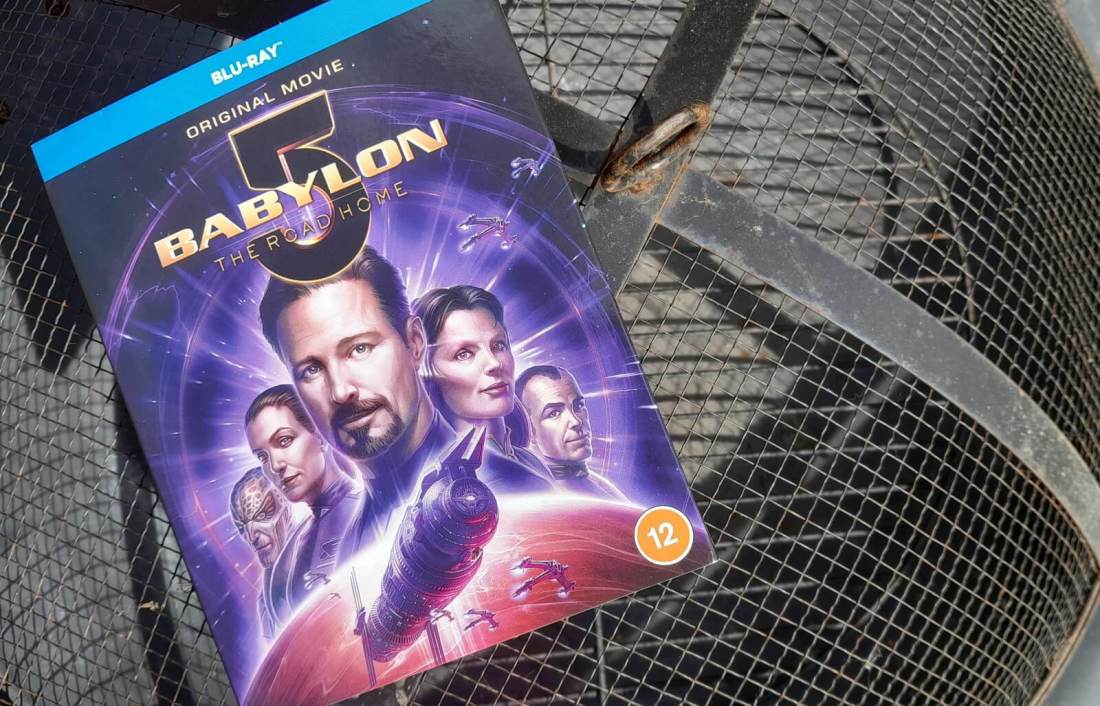
Sixteen years since the last straight to DVD revival, twenty-five years since the original television series gave its last bow, Babylon 5 returns polished up as an animated special The Road Home. Is it the beginning of a new era, or a nostalgic curio for the die-hards?
Time has been kind to Babylon 5. It was never a series which relied on the quality of its effects and a movie quality production. It’s strengths was its unashamed respect of literary SF and the power of a good story well told. Matched with rich characterisation that allowed its flawed protagonists to both fail hard and triumph satisfyingly over the years, spending most of the intervening time in stories that were often imaginative and morally grey. After years of only being accessible on VHS and DVD, recent years have seen it return to wide syndication, availability on streaming services and after a long campaign by fans, a HD remastering, all of which has enabled it to be enjoyed by new generations of fans, some of whom were not even born when its final story Sleeping in Light went out on TNT.
Babylon 5 was influential in several ways. It was one of the first SF series to embrace CGI, using the groundbreaking NewTek Video Toaster, which made computer graphics feasible on a cable television budget. It popularised the concept of the story arc. Instead of self-contained, almost interchangeable episodes where the status quo would always be reset after an hour, creator and chief writer J Michael Straczynski (known as JMS to fans) planned a “novel for television” to be told over five seasons. The idea was mocked as vainglorious by many, yet the programme proved that there was an audience who would commit to the journey. Now it would be hard to find a TV series which doesn’t have ongoing threads. Finally there was the way JMS embraced the fledgling internet, specifically Usenet to communicate directly with watchers in a way that hadn’t been possible before. He gave us an insight into the writing and production process of an ongoing, often struggling TV series that was fascinating and educational, as well as building up a whole community around the show.
It’s that ongoing community and the recent revived interest which has allowed The Road Home to exist. That and apparently a new willingness at Warner Bros to exploit a franchise which it was previously content to sit on.
The plot of The Road Home taps into Hollywood’s current love of multiverses and alternative worlds. On his first official engagement off-station, President John Sheridan becomes unstuck in time as the result of a malfunction in the new tachyon-based power generator he is supposed to be inaugurating. Teleporting into the future and the past, he then finds himself travelling sideways in alternate versions of the Shadow War, where the Shadows or the Vorlons win, both with cataclysmic results for humanity and its allies. Worse, if he cannot jaunt home, the multiverse itself might collapse.
Rather like a wedding, how much the viewer gets out The Road Home depends a lot on how many faces you recognise. If the above synopsis seems confusing, then this animated movie will be a lot of sound and fury, signifying not much. As an introduction to Babylon 5, it’s too reliant on pre-knowledge for the vast majority. Yet thanks to JMS’ script and the obvious affection of the production team, at the same time it’s a film that contains everything that made Babylon 5 what it was, good and bad. Action and big SF concepts like quantum physics, nestle with pulp staples like ancient alien cities being discovered, powerful aliens being reawakened, and passionate declarations of undying love. Smart jokes like a galactic vista being interrupted by a search of socks, share time with clunky one-liners. B5 could be moving but it could be amusingly pretentious too and there’s some windy philosophy at “the Rim” of the universe, delivered with deathly, if mellifluous, tones, which could have come straight from an obscure prog rock album sleeve notes.
Tragically, the series has lost more than the usual percentage of cast members. The voice cast contains all the surviving regulars, led energetically by Bruce Boxleitner returning to the role of John Sheridan. It’s great to hear Patricia Tallman, Peter Jurasik, Claudia Christian, Bill Mumy and Tracy Scroggins in character once more. They are joined by a cast of creditable actors taking on other beloved characters and thanks to good casting and direction from casting director Liz Carroll and Matt Peters respectively, none of them jar in the ear. Sadly the episodic nature of the story means that few of the regulars get much time to shine, apart from Sheridan and Delenn, but there’s a lot of fun to be had with the return of fan favourite, the gnomic alien Zathras and most of the funniest moments belong to him.
Visually the film looks marvellous, enjoyably opening out and subtly updating the old locations on the space station and Epsilon 3. It has that recognisable Warner Bros look that’s been seen in many of their recent superhero cartoon movies, tall figures with great cheekbones. Just about everyone is instantly recognisable, although it took me a few moments to recognise Elizabeth Lochley. The production team cleverly incorporate several iconic visual scenes from the series, such as the launching of the Starfurys or the reveal of The Great Machine.
I’m reviewing the bluray release, which comes in a slipcase and has two extras, an enthusiastic commentary by Boxleitner, JMS and supervising producer Rick Morales, and an appreciative making of documentary B5 Forever with some interesting behind footage of the cast recording their parts.
During the documentary, JMS says he has ideas for future animated stories and I certainly hope this special is successful enough for more. As a victory lap and a celebration for long time fans, The Road Home is a treat that doesn’t disappoint. For newcomers, the pilot film The Gathering or the TV movie In the Beginning is still the place to start.
I like to mix it up on the Very British Futures podcast. After the jolly, lightweight Dominick Hide plays we plunge into the pitch black dystopia of the BBC’s harrowing TV play Nineteen Eighty-Four. Based on George Orwell’s famous prophetic novel, this is ambitious drama brought more lustre to Nigel Kneale and Rudolph Cartier reputations, and remained a high point of Peter Cushing’s career.
The story is set in a futuristic austere Britain where the government is led by the IngSoc (English Socialism) party, headed by a man known as Big Brother. The Party seeks to control every aspect of people’s lives, including their thoughts, emotions, and behaviour. Winston Smith (Peter Cushing) is a low-ranking member of the Party who works in the Ministry of Truth, where he is responsible for altering historical records to conform to the Party’s version of reality. Despite being a loyal member of the Party, Winston is secretly unhappy with the oppressive regime and begins to rebel against it. He begins a secret affair with Julia (Yvonne Mitchell), a party member from the Fiction department. Together they become involved with a group known as the Brotherhood, which is rumoured to be a group of rebels who are plotting against the Party. However the Brotherhood is actually a myth created by the Party to lure out and eliminate any potential dissenters. Despite his efforts to rebel against the Party, Winston is captured and tortured until he fully conforms to their ideology. The novel ends with Winston being released back into society, fully loyal to the Party and completely brainwashed.
Writers Andrew Scott Roe-Crines and John Isles return to the show to join me in discussing the messages of the book and strengths of this television play. Find out about what the papers said, how the IngSoc party operates and the nightmare of Newspeak.
Now I am starting work on the next episode, about ITV’s Chocky trilogy.
Time travel is a dangerous business, not only for what effect changes in the past might affect, but the lure of nostalgia for a seemingly more exciting, more authentic world. A temptation which young Dominick Hide cannot resist any longer. He’s a time travelling historian from a future where life is peaceful and advanced, but most records of the past have been erased by an unknown catastrophe. His curiosity about the wild world of 1980 leads to an adventure which changes his life and that of Jane, a boutique shopowner with whom he falls in love, despite being married to Ava in his present.
Play for Today is generally remembered for its dramatic socially conscious dramas, yet over the years it has featured several notable comedies such as Mike Leigh’s Nuts in May and Jack Rosenthal’s Bar Mitzvah Boy. In fact one of its most successful and beloved installments was a science fiction romantic comedy The Flipside of Dominick Hide. In this episode, we analyse this play and its sequel, Another Flip for Dominick.
Making a welcome return visit for this episode are the warm and witty Tim Reid and Charles Auchterlonie, the hosts of The Randomiser, a podcast reviewing Doctor Who old and new, as well as other British cult TV. Hope you enjoy this one.
You can listen to Very British Futures on all the major podcast platforms, or online at Anchor.FM
It’s been longer arriving than I hoped but Season Two of my podcast Very British Futures is finally taking flight. I’ve found a better way of planning my time, and so I’ve been able to invest some energy into editing my recordings from the last few months.
So first released blinking into the online world is our discussion of The Aliens, E4’s 2016 drama with blackly comic moments, set in a world of human and alien drug dealers, ghettoised resentful alien immigrants and one hapless protagonist who keeps trying to do the right thing but generally just digs himself deeper into trouble.
It has a marvellous cast of people who were just getting recognised for their talent, including Michaela Cole (I Will Destroy You), Jim Howick (Ghosts) and Michael Socha (Being Human) and Michael Smiley (Kill List) and was produced by a lot of the same team responsible for Misfits.
This is also best produced episode so far, thanks to the technical brilliance of Kevin Hiley (Tripodscast) and being the first to be recorded in an actual room instead of online. I was joined by two guests from Tripodscast: Rebecca Wray and Dani Wray. Both of them were excellent and had plenty of fascinating observations about the show and its characters. Look out for their forthcoming new series with John Isles I Don’t Do SF in the new year.
You can listen to the episode at Anchor FM or on all the major podcast platforms. You can also check its dedicated page at my new website for the podcast which also has links for further reading, including the original E4 website which contains a lot more background information about the fictional history of the aliens’ arrival in Britain. For the first season I also put the episode up on this blog as a downloadable MP3. I’ve decided to stop that for season two, partly to cut down on housekeeping, and also to hopefully encourage more listeners to the podcast platforms and build up the podcast’s official stats. If you would like to download a file to listen to offline, may I suggest checking out the episode’s page at Spreaker, which has a download option.
Hope you enjoy this episode. More coming soon, continuing with The Flipside of Dominick Hyde.
It’s very flattering when someone credits you as an inspiration. John Isles and Rebecca Wray were inspired to create their own podcast, partially by my own Very British Futures podcast. Together with Dani Wray, the result is Tripodscast, a series discussing everything you could possibly want to know about John Christopher’s Tripods series. The books, the TV series, the comic strips and more. A good choice, because my episode on the BBC TV series is still my most downloaded instalment.
Episode one is out now and its excellent. A very entertaining 50+ minutes of conversation about the first novel The White Mountains, along with an charming interview with another friend of mine, author Will Hadcroft about his correspondence and eventual meeting with John Christopher, a pen-name of Samuel Youd. It is well produced too and reminds me that when I start season two of my podcast I want to do some in-person recordings as well as Skype chats.
When I started thinking about Outcasts, in my mind it was a series just a few years old, and I was shocked to find out it was actually broadcast in 2011. Nevertheless its striking how little impact this expensive primetime BBC1 science fiction series seems to have made. A quick google search reveals no dedicated fan sites, only a few reviews on newspapers and general purpose geek TV review sites. In the comments section underneath them, a mixture of short thoughts evenly divided between bouchets and brickbats. Creator Ben Richards tried to generate some excitement with teasing a few things which might have happened in season two but to no avail. No streaming company was rushing to Kudos’ door for more stories from Carpathia and it seemed there was no one campaigning for more. And revival campaigns are surely one of the defining factors of SF fandom?
Looking back there hasn’t been a really successful show about colonising a planet, despite the apparent strengths of such an idea. Neither Earth 2, or Terra Nova lasted more than a season and Outcasts continued the trend. Distant space colonies of explorers and farmers it seems, are more a place we like our heroes to visit, have an adventure, then blast off again to somewhere new. Post-apocalyptic survival tales seem to fare better. The Walking Dead and Survivors have both tackled themes about setting up a new society from the ground up and hooked us into the characters and their plight, yet both had more than their share of soapy storylines. Maybe when we go into space we’re always looking for new worlds to explore, preferably with interesting lifeforms to fight or fall in love with.
Perhaps another lesson to learn from Outcasts is that a great episode one is still important. Maybe a Netflix series can afford a slow burn when all the episodes are simultaneously online, although I wish they didn’t indulge in them quite so often, A weekly series however needs to grip from the first night. Most of the really negative, virulent reviews of Outcasts are based on the first episode. Watching the whole series I agree with some of my guests that the series does improve but the drag factor of the first two slow episodes sets a gloomy tone that later episodes never really shook off, even as the plot picks up momentum. At the same time some of the reviews themselves are weirdly hysterical. For example one newspaper asked if Ed Wood Jr (the notorious low-budget director) was in charge. Whatever else can be leveled at the programme, the production values are first class.
In this episode, I’m joined by Nicky Smalley, Dr Rebecca Wray and John Isles to talk about our rewatch of Outcasts and what we think worked and what didn’t. There’s some interesting discoveries along the way.
Essential facts
Cast Hermione Norris – Stella Isen Daniel Mays – Cass Cromwell Amy Manson – Fleur Morgan Ashley Walters – Jack Holt Eric Mabius – Julius Berger Michael Legge – Tipper Malone Liam Cunningham – Richard Tate Langley Kirkwood – Rudi Jeanné Kietzmann – Lily Isen
Production Created by Ben Richards
Written by Ben Richards, David Farr, Simon Block, Jimmy Gardner, Jack Lothian
Produced by Radford Neville Co-produced by Jörg Westerkamp, Thomas Becker, Vlokkie Gordon, David Wicht Executive Produced by Jane Featherstone, Faith Penhale, Matthew Read, Simon Crawford-Collins, Ben Richards Directed by Andy Goddard, Omar Madha, Bharat Nalluri, Jamie Payne
Production companies Kudos Film and Television ApolloMovie Beteiligungs BBC America BBC Wales Film Afrika Worldwide
You can now follow Very British Futures on Audible, as well as Spotify, Apple Podcasts, Google Podcasts and most other major platforms. If they don’t work for you, you can also listen or download it from here:
Very British Futures – Outcasts
As I explain at the end of the episode, this show marks the end of season one. The podcast will be taking a hiatus until Summer 2022, whilst I concentrate on other work. But it will be back. Thanks for reading.