I’m pleased to share with you that I am the guest on the latest episode of the podcast Doctor Who – Too Hot for TV, hosted by Dylan Rees. Together we are looking back at two unmade stories from the 1960’s – Farewell, Great Macedon and The Queen of Time. Both have been recreated as dramatised audiobooks by Big Finish. I’m particularly happy with the way this one has turned out. In fact I think it’s the best of my three guest spot so far because I sound more confident and fluid and there’s a lot of interesting Doctor Who behind the scenes details to talk about.. You can listen to the episode here https://www.buzzsprout.com/864883/episodes/17368333-s5-e33-just-a-bit-of-tea-with-a-wee-lassie and all the major podcast apps.
Farewell, Great Macedon was submitted by Moris Farhi to the show’s script editor David Whittaker during the first season in 1964. It features the First Doctor as played by William Hartnell. Unusually amongst the so called “lost stories” of Doctor Who, it exists as a fully written script rather than just an outline, which helps make this adaptation feel just a bit more legitimate. Nigel Robinson, a skilled adapter of early Doctor Who stories, wrote the audio version and Big Finish mainstay Lisa Bowerman directed William Russell and Carol Ann Ford, who played two of the Doctor’s first companions. John Dorney guested as Alexander.
The TARDIS lands in the Hanging Gardens of Babylon, where the travellers meet Alexander the Great who welcomes them with hospitality. But history teacher Barbara realises that they have landed a few days before Alexander’s death and with the TARDIS needing to recharge before it can leave, the four friends find themselves caught up in court treachery. It’s a splendid story and for me one of the high points of Big Finish’s Doctor Who range.
The Queen of Time features the Second Doctor, as played by Patrick Troughton and was written by Brian Hayles. Hayles had written several stories for the series and this proposed adventure owed a large debt to one of them, The Celestial Toymaker. This time Catherine Harvey adapted the detailed plot outline and Lisa Bowerman once again directed. Former companion actors Frazer Hines and Wendy Padbury performed it, with Caroline Faber as Hecuba.
The Doctor and his companions are mysteriously invited to meet Hecuba, the Queen of Time and sister of the Toymaker. Trapped in her realm, the Doctor must ward off Hecuba’s romantic overtures, whilst Jamie and Zoe face a series of deadly puzzles. This is something of a misfire for me and I enjoyed getting into why I don’t like it.
As well as recommending Too Hot for TV as a great podcast anytime, I’ll take a moment to remind you that Dylan’s second book Myths and Legends, a deep cut into independent filmmakers Reeltime Pictures, will be out soon. You can find out more here.
Before I go, my friend Rik Hoskin has had a new short story published in the premiere issue of Goblins and Galaxies Magazine called “Tournament in Frow” and you can find out more below:
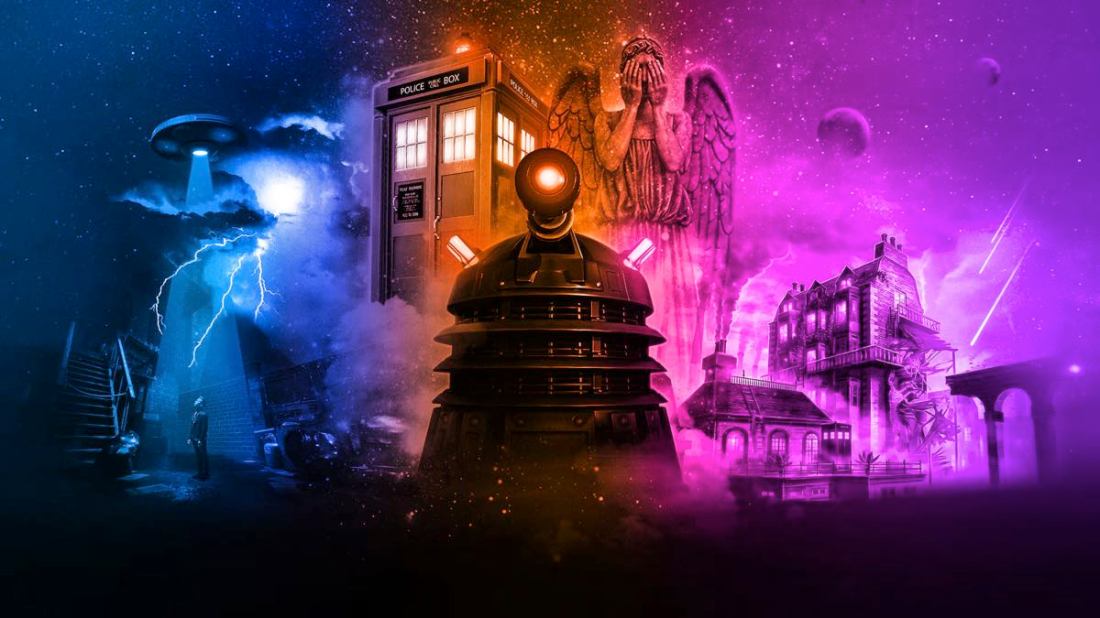
Ever since computer games were invented, Doctor Who fans like myself have wanted to see our favourite show to be part of that world. From Doctor Who – The First Adventure on the venerable BBC B Micro, through Dalek Attack on the PC and Spectrum, to more recent attempts such as Lego Dimensions. Then in 2019 a fully fledged VR game arrived The Edge of Time, courtesy of Maze Theory, but never seemed to make the impact such major project should had. After all, this game lets the player travel in the TARDIS and confront Daleks and Weeping Angels face to face. It has a complete story that puts the protagonist centre stage. When I bought myself a Meta Quest 3 headset, it was a game I purchased almost immediately to experience myself. After Beat Sabre.
Recently there seems to have a dizzying explosion of Doctor Who titles in many videogame subgenres, from time-killing smartphone game Lost in Time to online card game Worlds Apart to guest appearances in big hitters like Fortnite and Minecraft. Up until now, I would say the titles closest to capturing the spirit of the programme were the Doctor Who Adventures released initially for free by the BBC, featuring the Eleventh Doctor and Amy. Whilst enjoyable to play these felt less polished than the perfect AAA game of my imagination, something combining the mechanics and look of say the Mass Effect Trilogy or Fallout 4.
The appropriately named game The First Adventure (1983)
The opening story in The Adventure Game ‘season’ – City of the Daleks (2010)
The Edge of Time is definitely one of most ambitious and big budget attempts to date. It promises a great deal, to actually join the Thirteenth Doctor in an adventure as her temporary companion, flying the TARDIS, battling the Daleks, the Weeping Angels and some new enemies in virtual reality. Unfortunately the earliest releases of the game came with game crashing bugs, despite extensive play testing by Maze Theory, and I think that did damage the game’s reputation. However the version available to buy now is much more robust and also comes with 2020’s Time Lord Victorious DLC bundled in for free.
The landing screen placed me in a rocky area with the TARDIS standing to my left, humming with energy, whilst ahead was the menu. Choosing New Game took me to what would be called the “cold open” of the episode. a shabby laundrette where I was the only customer. The lights start to flicker and the voice of the Doctor, voiced by Jodie Whittaker herself, comes through the static of the television. She’s asking for help, and warning me that I’m in trouble. The lights flicker again and the washing machines fill with slime, covered with blinking eyes. The voice of the Doctor warns me that these are embryo Hydrocs, vicious predators who grow very quickly. Reality is breaking down and I need to get out of there. Some searching and clue solving puzzles follow, as I eventually get through the locked door at the back and summon the TARDIS, just as a Dalek saucer appears overhead and tries to exterminate me. Cue 360 degree panoramic version of the Thirteenth Doctor’s title sequence.
Inside the Thirteenth Doctor’s console room (a design I became more resigned to than ever really liked) the Doctor appears as a hologram and explains that she is trapped at the other end of Time and needs my help to find three rare zeiton crystals with which she can create a vortex manipulator to escape and fix the reality virus which is threatening the whole universe. This plot accidentally anticipates the Flux that the Doctor will face in 2022. First she needs to guide me through flying the TARDIS, which involves turning knobs and pulling levers in a sequence repeating memory game, a bit like Bop It!
There was definitely a thrill to stepping out of the TARDIS on to an unknown planet. That worked each time arrived in a new location. Most of the game is puzzle solving, moving objects about, slotting them into holes. Or combing objects to create an effect. Zapping items with the somic screwdriver was a reliable move. Most of the puzzles were an easy to medium challenge, apart from one aboard a spaceliner involving reflecting a laser beam with rotating mirrors to activate doors, that eventually I had to look up the solution on YouTube. As with many VR games at the moment there is a distinct escape room vibe to the majority of the game, even if the locales allowed for a lot more walking and exploring.
Occasionally there is an action sequence. Escaping the Weeping Angels in an old house, with an unreliable torch and a lift which needs recharging at each floor with a dynamo, was genuinely scary, especially knowing that death meant going back to beginning of the sequence again. By contrast a first person shooter section, driving a Dalek around a temple shooting at other Daleks, became quite frustrating, since unless you managed to time every shot and make it count, death meant starting the whole long section over again, which became pretty wearying. I’m not a fan of the whole timing blows precisely in a sequence kind of combat which Dark Souls has popularised.
Along the way, the villain is revealed as The First, a godlike mother of all life in universe, wishing to punish intelligent life for making so many mistakes. To be honest this section was a bit ponderous, especially since she is so powerful, all the player can do at this point is really stand and watch the Doctor sort things out, again solely as a voice. Despite a last minute race to retrieve three more magic items by revisiting some previous destinations, the climax is underwhelming.
Yet the journey there is pretty entertaining. The whole Weeping Angels section uses those antagonists particularly well, with some moments that are more than worthy of the television series. Sneaking past full-scale Daleks is fun and again feels very reminiscent of the series. Dialogue writer and co-storyliner Gavin Collinson gets the feel of modern day Doctor Who. You get your own companion of a kind, Emer, winningly voiced by Jennifer Saayeng, who has also appeared in a few Big Finish stories. Wielding the sonic screwdriver to scan and manipulate item is satisfying too.
Graphically the style is fairly cartoonish, an acceptable compromise between accurate detail and the speed and size of the game. The two TARDIS console rooms of the Thirteenth and the Tenth’s (for the Time Lord Victorious add-on) are pleasingly recreated, whilst the new locations are colourful and well lit.
Away from the main story, there’s the Time Lord Victorious collectible game, which tries to extend gameplay by adding hidden collectible items in all the locations of the story. These are related to the stories in the BBC’s 2020 multi-platform campaign. Discover all eight and you can play a quiz game. There’s also an Arcade section where the player can replay the title sequence, flying the TARDIS, escaping the Weeping Angels, or battling the Daleks.
In 2021 Maze Theory released a reimagined version of the game for flat screen consoles. Doctor Who – The Edge of Reality replaced the god-like First with the Cybermen as the principle villain and also featured a cameo from the Tenth Doctor. I have not played it but I believe it too was plagued with bugs and seems to have had even less impact than the VR original.
I’ve enjoyed playing this game and think it deserves to be better known. It’s a sincere attempt to put the player inside a Doctor Who adventure and translates a fair amount of the feel of the Thirteenth Doctor’s era. It’s an accessible game for both experience VR players and first timers. Hopefully it will remain in the Steam, MetaQuest and Playstation libraries for the foreseeable future.
Another of my early experiments with my new Meta Quest 3 headset was to watch the 360 degree Doctor Who short animated film which the BBC released in January 2019, featuring the voice of Jodie Whittaker. The Runaway begins with the viewer being accidentally teleported aboard the TARDIS by the Thirteenth Doctor. Apologising, the Doctor explains she is trying to help a young energy being from another dimension return home. The being is a glowing sphere with eyes and the Timelord explains that if it becomes too agitated it will blow up, taking the TARDIS with it. As a story its typical of the kind of mini-episodes which were usually made for Comic Relief, based entirely on the standing set of the console room. The animation is similar to Edge of Time although this cartoon was made by the BBC VR Hub.
It works excellently in the Quest 3, I can see it would function equally well in any 360 viewer, including Google’s Cardboard VR. It’s a sweet little disposable tale, although I missed having any interactivity. If you have a chance to watch it as its meant to be seen, its worth your time though.
Plenty going on this month but the biggest news for this blog is that there is finally a new episode of my podcast Very British Futures out there – The Day After Tomorrow.
Nothing to do with the dreadful 2004 Roland Emmreich film but everything to do with Gerry Anderson’s continuing efforts to conquer America. UFO had come close but after a strong start in the ratings it had faltered. Space 1999 was doing reasonably well in syndication but the question of a second season was still up in the air. Then Gerry Anderson was approached by George Heinemann, producer of NBC’s new youth orientated anthology strand Special Treat. Special Treat was a series of documentaries and educational family dramas, and Heinemann was looking for a way to dramatise Albert Einstein’s famous theories for children. The result was the 50 minute special The Day After Tomorrow. Hoping it might act as a backdoor pilot for a TV series, Anderson and writer Johnny Byrne (Space 1999, Doctor Who) added the subtitle Into Infinity.
It’s an entertaining family SF adventure and something of an unintended callback to the pioneering Pathfinders in Space series with its young protagonists and parents and the emphasis on science and engineering. The short running time means it moves at a fair clip, and it enjoys the same high-quality production values as Space 1999. For this podcast I tried to reach out beyond my usual circle and recruited Felicia Baxter from the podcast guest site matchmaker.fm Felicia turned out to be a wonderful guest and her fresh perspective and presence make this an excellent episode. It’s also the first of what I intend to be an extra format for the podcast. As well as the traditional discussions with a group of guests, I’d like to more conversational two handers like this, looking at more targeted subjects and shorter form TV plays.
My friend Rik Hoskin has had a good month too. His comic strip adaptation of the second book in The Wheel of Time saga is out now and there’s a new trailer online.
Dynamite Comic’s The Great Hunt, written by Rik Hoskin
In addition he has published a marvellous creepy short story by a scuba diving holiday that takes a strange twist in The Dive, published by Cornice. You can enjoy for free and I recommend you give it a read.
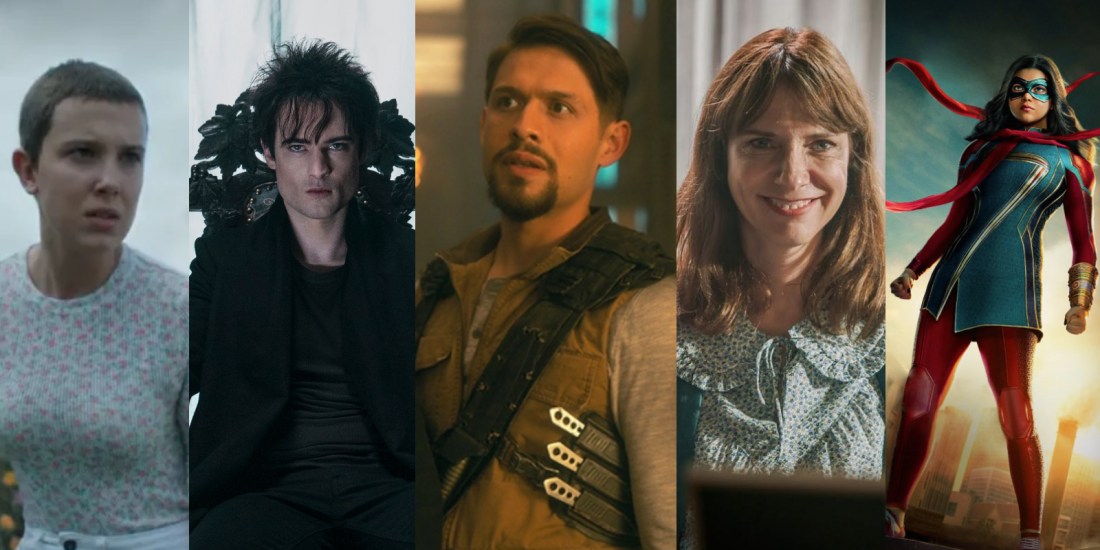
Coming to its fourth season, after a third which seemed to have reached a natural conclusion for most of the characters, I did wonder if Stranger Things could possibly live up to its own hype. There had been some worrying signs of indulgence creeping in, when this was a Netflix series defined by its tight focus on exactly what it was – a pulp horror love letter to Stephen King, John Carpenter and 80’s pop culture. Despite its feature length episodes, the fourth season triumphantly improved on its last season with memorable horror set pieces, great new characters like Eddie and Yuri, some logical yet still unexpected depths being added to the young heroes and most importantly, pace and energy. To be hitting these highs in a fourth series is pretty rare.
The Sandman
Neil Gaiman’s groundbreaking 80’s comic series looked like an impossible adaptation. The hero and his stories were so intrinsically linked to the comic medium of art and dialogue. Surely trying to make this gothic fantasy into a physical piece of television would only make it seem at best pompous and ridiculous, or just deeply compromised. But thanks to Neil Gaiman’s stewardship and a talented team of makers and actors, Netflix’s series captured all the strengths of the comic and added some well chosen translations of the problems. Fan favourites like “Dream of a Thousand Cats” and “The Sound of Her Wings” became new highlights. David Thewlis gave one of the best performances of the years as the malignant but pathetic would be messiah Doctor Destiny.
Inside Man
Stephen Moffat most satisfying work since “The Doctor Falls”, this contained four-part thriller was essentially a farce with the timing aimed at tragedy rather than hilarity. Embracing his misanthropy, he and director Paul McGuigan played with time and the audience. Cleverly challenging our own unconscious prejudices with a story where the murderers and would-be murderers were more sympathetic than the victims. As with many of these locked room murder mysteries, the cleverness might unravel if examined too closely and it relies on certain contrivances disguised as glib jokes. Mary’s apologetic “We’re not the sort of people who break windows,” for example. But at a time when too many prestige series are content to spread out as far as possible, this tight four-parter was short sharp pleasure.
The Umbrella Academy
In recent years, there’s been a fair few deconstructive superhero series and films. For me, The Umbrella Academy became the best of this sub-genre with its third series. The plot was propulsive without being cluttered, giving the characters room to breathe, the humour was often genuinely funny rather than self-consciously wacky and most importantly its damaged family of characters cared about each other, even if there were a lot of pain along the way. It was celebrating different kinds of love, between impossible people that gave this often eccentric saga its heft. Some of it dialogues were memorably acerbic too. Five to Elliot: “Wait a minute. You were actually waiting in your room for someone to come and persuade you to come downstairs again? That is pathetic.”
Ms Marvel
Disney+ has settled into a steady production line of polished, big budget fantasy series, but Ms Marvel stood out amongst them with its smart writing and a winning lead performance from Iman Vellani as the young superhero. The Khan family dynamics were a pleasure to watch, whilst the series took a fairly standard “young person discovers superpowers and tries to balance school, family and adventures” Marvel fomula and made it feel fresh again. Plus it brought a significant piece of history, the India partition to a wider audience too.
Two older series which I discovered this year and devoured were Ted Lasso and Bob’s Burgers. The former was an old fashioned sentimental comedy that once upon a time would starred James Stewart as the eccentric man challenging the mean system with his decency and kindness. As it is, it featured a superb ensemble of characters and a heart warming belief in the power of compassion and understanding that somehow was invigorating instead of sickly. The latter is a near perfect animated sitcom with a family of five characters who work in many combinations. The one-liners keep coming fast and funny, whilst it manages to have flights of screwball fancy whilst portraying a poor working family constantly having to think about money.




 The Phantom Frame