News round up

This is one of those weeks with plenty going on, but none of it really making an significant post in itself. So forgive me if I just bring a few items to your attention and – hopefully – interest.

The Rivals 5 – 12 March 2016

A few weeks ago I shared a promotional video about this local production of Richard Sheridan’s restoration comedy The Rivals which I had made. Little did I know then that I would now be starring in this play myself! Due to a cast member pulling out, I’ve been prevailed upon to play the role of Bob Acres. Acres is is one of the rivals for Lydia Languish’s hand in marriage. A buffoonish but essentially good hearted squire from the country, his attempts to fit into Bath high society go awry when Sir Lucius O’Trigger encourages him to challenge his competitor to a pistol duel, not knowing that his romantic rival is in fact his friend Jack Absolute in disguise.
It is quite a challenge learning a part in little over a week, particularly when the language is archane 18th century English. But with the support of the team and some edits to the more verbose speeches I think I’ll make curtain up. Thankfully the costumes fit me with just few tucks.
The Rivals is on at Bolton Little Theatre 5 – 12 March and if you are interested you can find out more and order tickets at the official website.

Kolchak online audio drama

Sometimes an old job comes back to haunt you. I was recently reminded by my friend Bill about a fan radio version of Kolchak – The Night Stalker which I appeared in. I played a vampire called Pitov. It was an especially fun script and hearing it again I’d forgotten what a polished production it was. As usual I recorded my parts at home and then sent them to be blended in. So it’s certainly worth promoting again. You can download all four episodes from Broken Sea Audio Productions right now.
I’ve had a great relationship with BSAP over the years. As well as my own fan Prisoner radio series, I co-wrote a story called Turf War for their Doctor Who series, and I’ve guest starred in several shows including Escape from New York, Planet of the Apes, The Maltese Falcon and Saga of the Grog and Gryphon.

Rik Hoskin talks Dean Koontz’s Frankenstein

My talented writing pal Rik has been on the publicity trail recently talking about one of his comic strip projects – Dean Koontz’s Frankenstein – based on the series of novels created by bestselling author Dean Koontz. Most famous for horror blockbusters like Watchers and Midnight, Koontz has increasingly pushed into mainstream thrillers/suspense books. Frankenstein however is a return to his pulp roots, a reimagining of the famous story of the scientist and his monster, in which the Monster is the hero and defender of humanity, whilst his creator has become a near-immortal evil, mad scientist. But I ought to let Rik explain it better and you can find out more with these website interviews below:

Bleeding Cool and The Collector’s Guide to Dean Koontz

A couple more projects in the pipeline for myself which I want to tell you about soon, once I’ve finished with The Rivals! Thanks for reading.


Some Lapse of Time

Man having nightmare

A strange story this, mixing science with the practically-supernatural. I can see why it appealed to Irene Shubik for adapting to television, but ultimately it is a story that might have worked better at half an hour. It does feature a few sections where the plot is spinning its wheels and re-emphasising rather than developing. Infused with the Sixties’ Cold War fears and wariness of scientists in white coats, it is another fairly downbeat entry in an anthology that is definitely proving to have a pessimistic view of the future.

Nightmares haunt Dr Max Harrow, ever since his two-year old son died of the rare Hodgkinson’s disease. He dreams about savages, led by frightening old man clutching a finger bone, pursuing him. One night he and his wife Diana are awakened by a policeman calling at his door, who has found a tramp collapsed outside. To Harrow’s shock, not only does the tramp look like his dream tormentor, but he is suffering from Hodgkinson’s disease, a condition that should have killed him in infancy. Booking the tramp into the university hospital where Harrow works, the doctor becomes increasingly obsessed by the old man and his survival. What is the strange language he speaks? Why has he sought out Harrow? Worst of all, why is his body infused with dangerous levels of Strontium 90 radiation?

John Brunner wrote the Hugo and BSFA award-winning novel Stand on Zanzibar, a novel set in a polluted over-populated future Earth. He was also a member of the Campaign for Nuclear Disarmament. Some Lapse of Time reflects his regular themes of environmental destruction, nuclear danger and an uncaring, complacent establishment. Television adaptor Leon Griffiths was also quite politically aware himself. Yet when it comes to the politics, the script is unafraid to mock Harrow’s student-left, Dave Spart-esque speechifying via his boss Professer Leach, “Oh sorry I forgot. We’re the unfeeling monsters aren’t we? Only Max Harrow cares!”

In retrospect, this story comes across like a pacifist version of The Terminator. Instead of a killer robot sent back to violently change the future, Brunner brings back a ragged witness to simply testify about modern society’s self-destructive behaviour and its consequences. Despite his bloodied flint knife, the mutant old man with scarred features does not seem to have had any real plan. Indeed he is possibly even more of a victim than the persecuted Harrow. He only seems sinister in the context of the dream.

We open on a high, with a marvellous piece of nighttime filming. Flickering flames, dancing figures, a caveman suddenly producing a plastic baby doll and destroying it, half-lit staring faces, pointing fingers and shots through distorting lenses. Nothing else in the episode quite matches the drama of its opening. (Designed incidentally by a young man called Ridley Scott, whatever became of him?) Sharing Harrow’s dream is important for the rest of story. Without that evidence, this would be a very different story, of a recently bereaved father having a nervous breakdown. Most of the other SF elements come from his guesswork, until the very end when his theory is clumsily confirmed.

Of note amongst a cast of television regulars, it’s fun to see Pete Bowles for once not playing a toff or a villain, but wielding an ‘ello ‘ello ‘ello accent in the small role of the policeman who introduces the strange vagabond.

For an episode with a fairly sedate pace and room to explain itself, there are some annoying plot holes, mostly centred around the mysterious stranger’s Hodgkinson’s disease. After making a big deal out of it in the first half, once the Strontium 90 is detected, everyone seems to forget about it. Similarly Harrow blames military nuclear testing for Hodgkinson’s, but there does not seem to be any logical connection, just a prejudice on his part. His hatred of politicians does however lead to fine touch of the gothic when the maddened doctor steals an extracted knee bone from surgery, in order to bury it for the shamen of the future.

As with Stranger in the Family, the present day set stories in season one feel much closer to Out of the Unknown’s spiritual parent Armchair Theatre. Although it is a bit pedestrian once we reach the hospital, at least it’s a story that wants to say something.

Sucker Bait

Angry young man in laboratory

By Isaac Asimov
Adapted by Meade Roberts

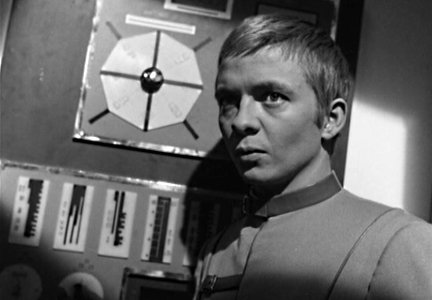
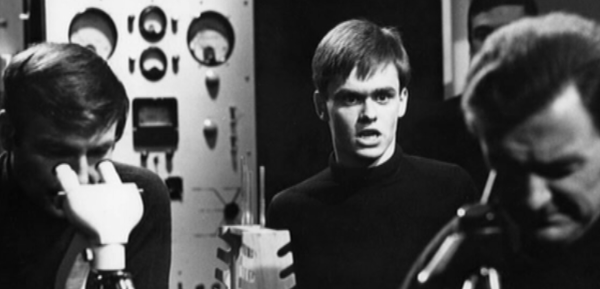
Mark Annuncio is a genius at making connections between often seemingly unrelated facts. He is one of a rare breed of humans called Mnenomics. He is also utterly unable to connect with other people, comes over as neurotic, rude, and requires a special handler who acts as his go-between with the rest of society. Now a set-up like that sounds a TV series all in itself. The brilliant but weird investigator and his “Watson” has been a popular formula in recent years. So it is a little surprising that Mark’s condition and his relationship with Dr Sheffield is just a side issue in this very science orientated episode. As with the earlier The Dead Past, Asimov is most concerned with the over-specialisation of scientists and the way that can cause them to miss vital discoveries.

Chartered spaceship the Gordon G Grundy is taking a party of scientists on a secret mission to the planet Troas, to discover what killed an entire colony. Amongst them is the intense and unpopular Mark Annuncio, raised to be a kind of human super computer. There seems to be no obvious reason why the pioneers died. As outbreaks of mania begin affecting the scientists, the question arises, is the planet really inhabited after all? By some kind of hostile lifeform?

Autism as a phrase may have been coined in 1938 but it is only relatively recently that it has come into the mainstream. Certainly watching this episode today, Mark clearly seems to be on the autistic spectrum, obsessed with learning facts, having no understanding of humour or metaphors, flying into violent anger when he is frustrated. What is disturbing is the suggestion that he has been deliberately made this way. Early on Dr Sheffield explains to the ship’s captain that mnenomics are raised in isolation from the age of five, trained to absorb knowledge and kept away from any human contact that might “contaminate” their minds and form normal patterns of behaviour. Even if the child was already diagnosed as autistic, this sounds like a horrific kind of child abuse, yet Dr Sheffield is unperturbed and the captain makes no protest either. There is a whole story just there and potentially a better one than the scientific investigation that follows.

Sucker Bait is a serious minded play of ideas rather than action. As with many Asimov stories it essentially a series of conversations between scientists about a fantastical problem. This leads to the cast manfully tackling a host of jargon filled dialogue. The summit comes in the scene where Sheffield, a psychologist by profession, tricks the arrogant leader of the expedition Cinam into panicking over a made-up theory about Troas’ twin suns causing psychosis. Actor John Mellion has to deliver a whole stream of made-up science and it no wonder he has to take quite a few deep breaths and looks slightly glassy eyed at points.

The technology of Television Centre is also stretched uncomfortably. The set rattles alarmingly whenever someone walks on the metal gangway and clanking sounds can be heard distractingly off-camera in some scenes. The planet surface is a small, claustrophobic rocky set where the astronauts frequently seem to be weaving around each other since there is so little space.

At the end the revelation of what has been killing the colonists comes as something of an anti-climax. I remember reading this story, and I think it works better on the page. It is logical and ingenious but the whole scene feels a bit flat. Perhaps in part because we have just found out that a potentially exciting climax involving mutiny and the scientists being marooned on the deadly planet all took place off-screen between scenes. Yet its last moments are quietly affecting. Mark, who has been played well by young Clive Endersby, stares out at deep space and confesses that this mission has made him aware of his own mortality for the first time. “And there’s so much left to learn.” he says plaintively. The captain, who earlier been so hostile to his odd passenger, allows him to remain on the command deck this time, counting the stars.

Going behind the scenes of “The Rivals”

Bolton Little Theatre’s next production will be Richard Sheridan’s famous comedy about a clash between greed, snobbery and romantic ideals in 18th century Bath. The play is most famous for giving literature one of its most famous comic characters – Mrs Malaprop, a rich pompous dowager who frequently mangles the English language as she lectures all and sundry. “She’s as headstrong as an allegory on the banks of the Nile!” Sheridan probably based her name on the French phrase “mal a propos” meaning “poorly placed”. Although many comedies had used mixed up phrases before this, including Shakespeare’s, malapropisms has become the popular description of such jokes.

Last week I took my camcorder down to the theatre to interview director Jolyon Coombs about the challenges of staging the play and talk to some of the actors

Hope you find it interesting. “The Rivals” is on 5 – 12 March 2016 in Bolton.
You can book tickets and find out more from the website by clicking here.


Come Buttercup, Come Daisy, Come..?
Milo O'Shea in character

Written by Mike Watts

There’s something almost irretrievably schlocky about killer plants. Aside from the Triffids and 2008 horror movie The Ruins, stories of plants wrapping their green fronds around victims come over as risible rather than horrifying. Not for nothing is the most famous vege-villain Audrey II the star of a camp musical.

Fishmonger Henry Wilkes has two loves in his life. His wife Monica and his garden of exotic tropical plants. Only recently it appears to Monica that her husband has become obsessed with his hobby, ever since he started receiving cuttings from a postal correspondent called Mr Pringle. And there’s something unnerving about that garden, almost although the plants are actively threatening her health. Henry however is too caught up with the excitement of growing these unusually responsive plants, even when they require a regular feeding of fresh meat.

This is an unsatisfying episode, not deliberately funny enough to be classed a comedy, too polite to go for full monster horror. Quite padded too. Why expensive filming is used to show Henry’s commute on his motorbike and sidecar, when it is entirely superfluous to the plot, is a mystery. There’s already more than enough in the episode to establish his working class suburban credentials. Similarly his shop assistant Anne’s interest in spiritualism is a blind alley. Once it is established that Henry has animated carnivorous plants in his garden, the plot is virtually over and we are only waiting for his wife to discover the awful truth.

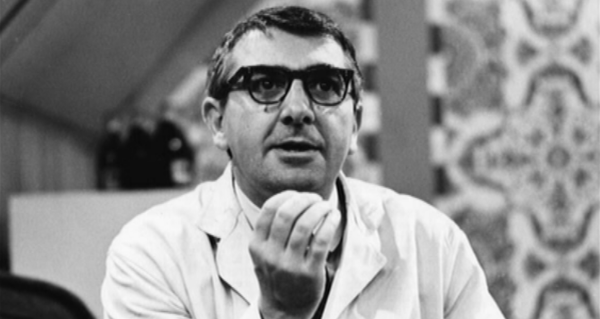
On a good note, writer Mike Watts avoids some obvious stereotypes and he’s helped by good underplaying from the central trio of Milo O’Shea, Christine Hargreaves and Patsy Rowlands. It would have been easy to make Henry a rather grotesque or pathetic figure, but he emerges as an essentially well-meaning, naïve man who is far too short-sighted about the consequences of his hobby. His main eccentricity is a dislike of seeing plants used as food, which does stretch credibility somewhat and makes one wonder what his diet consists of. Similarly Monica could have been a shrewish woman who has driven Henry to spend as much time in the garden as possible, but she comes across as a caring individual driven to illness by the strangeness. Anne is essentially a straight foil for Henry. For a while I wondered if there as a hint of attraction between her and the gardener but what there is in the way Patsy Rowlands plays her lines rather than the script.

An unexpected curveball is thrown by the credits – Barbara Woodhouse was the trainer of the Wilkes’ dog. Offers a delicious image of La Woodhouse marshalling the killer vegetation before a take.

Bernard Wilkie and Ron Oates provide some fairly decent puppet plants, the grasping tendrils and roots are effective in short bursts. Most of the time the animation is provided by simple shaking, when I had hopes for a climatic attack on the house. Keeping the origin of the plants a mystery is a good choice. It is better to keep guessing if this is some low-key alien invasion, mad scientist’s plan, or secret government project. Ultimately this trip into Tales from the Crypt territory proves to be a bad match for a series aiming for adult science fiction.

More NODA happiness

I’m interrupting my Out of the Unknown marathon for a bit of housekeeping.

First off, I’ve been updating the Writing and Audio Drama pages on the left, adding web-links so that you find out more about (and maybe even order) some of my work. For example clicking on any of the pantomime scripts now takes you directly to their pages at Lazy Bee Scripts.

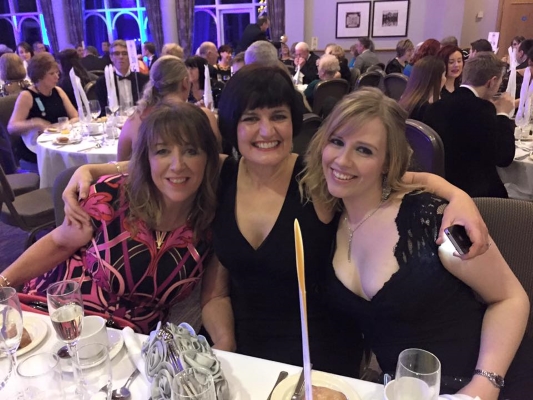
Secondly, but more importantly I’m delighted to announce that my lovely actor friend Bridgett Welch has just won the 2016 National Operatic and Drama Association award for Best Female Comedy Performance (Pantomime) after appearing in my own Rumplestiltskin. The show was premiered by Mawdesley Amateur Dramatic Society. She was indeed a wonderful Dame, but then I thought the whole cast were marvelous. It’s especially lovely because I became involved in amateur theater via MADS and I certainly would not have written any of my pantos without their support over the years.

mads

Bridgett is here on the left, next to fellow MADS Debbie and Emma.

mads2

And here in character as Dame Dolly!

Time in Advance

Two men toasting drinks

by William Tenn
Adapted by Peter Erickson

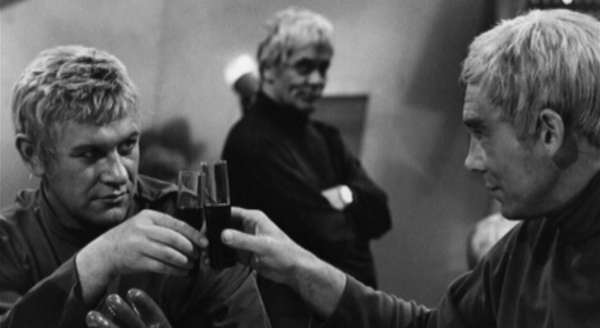
Some stories can only be told in the science fiction genre. Then there are stories like this one, which could be just as easily be told as a western or a crime thriller. Not only would it only take some simple rewriting to turn this episode into a film noir, it might have been preferable.

In the far future, there is excitement amongst Earth’s media when a prison ship returns from the outer frontier carrying Crandall and Henck, the first two men to have survived seven years and earned a licence to murder. They are pre-criminals, men who have confessed to their crimes ahead of committing them. They can earn the right to commit their crime by serving a sentence working on harsh alien planets preparing them for colonisation. Moving into a luxury hotel, the two comrades begin to plan their murders, only to discover that much can change in seven years and what they believed was the truth is often not.

There are several problems with this episode. For a start the whole pre-crime idea is a bit daft and it’s hard to understand how such an odd judicial system started up. There’s a debate between a judge and a journalist near the start but it is a bit of strawman affair. “Would you prefer to go back to a time when men were tortured and killed as punishment?” intones the Examiner, played by the gaunt Peter Madden. Are they the only options then? Medieval punishment or a penal suicide mission where its hoped the criminal will change his mind or die in the attempt? It later transpires that normal prisons also exist in this future, making the existence of pre-crime even more confusing.

Then there is Crandall, supposedly a man so determined, ruthless and angry with his ex-business partner that he is prepared to spend seven hellish years to get a chance to kill him. Yet Edward Judd plays him in such an avuncular, reasonable manner that it is hard to believe. Crandall is so sensible and considerate towards others throughout the episode, that surely he would have rationalised away his bitterness during his exile? He might carry a grudge, but to embark on such an extreme revenge? Maybe he was a different man seven years ago but we are given no evidence of that.

Mike Pratt makes a better job of the angry, slightly pathetic Henck, still wound up with resentment towards the woman who trapped him in a loveless cuckolded marriage. His journey is the sub-plot but it actually sounds the more interesting as he tells it in the hotel bar. His imagined perfect dramatic revenge is quickly thwarted by a series of mundane events that leave him feeling cheated and confused.

Padding is another bugbear of this episode, with several stretches of nothing much happening except Crandall living in the future, using various gadgets. I was amused to see that the hotel television seems to be showing out-takes from the Sixties Doctor Who ‘howlaround’ experiments. There is also a return of the show’s curious obsession with blonde wigs, undoubtedly the same ones used a few weeks ago in The Counterfeit Man. Whilst early model shots of the spacecraft landing must be viewed charitably, the shot of the futuristic city skyline combined with live footage taken in a park is excellent.

Where the episode works best is in its moments of black comedy. The camp but sadistic prison guard (Oliver MacGreevy) who hopes his ‘boys’ have a happy time back on Earth. The oily religious man (Ken Parry) who implores Crandall to forgive and forget, then suggests he profit from his licence by killing a businessman of his acquaintance. The fact that Crandall’s ex-wife Polly (Wendy Gifford) is convinced he wants to kill her and is slightly put out when she discovers he never has.

After a sense of lofty ambitions of the first part of the season, Time in Advance feels altogether more pulpish. Melodrama has always been a part of SF magazines output. It is not outrageously bad, it just feels a bit corny. Perhaps it should have been about two men who escape from prison after seven years, having been double-crossed and out for revenge? And half an hour long?

The Dead Past

Two scientists with futuristic machine

by Issac Asimov
Adapted by Jeremy Paul

Even without his name on the credits, I could have guessed this was an Asimov tale, since it has his common themes of extrapolating a scientific fantasy theory in a realistic fashion, and linking it with the idea of a group of experts manipulating society with sociological techniques for its greater good. It’s a model that can be found in novels like End of Eternity, Caves of Steel and the Foundation series. Furthermore the plot is essentially a series of debates between scientists and other experts, a form he uses in a lot of his stories. It is an odd bird of an episode, starting as criticism of science that is led by politicians and big business, moving into time travel of a kind, then ending up with a twist that this story’s apparent villains might have been in the right after all.

In the not too distant future, Arnold Potterley is obsessed with proving his theory that ancient Carthage was not the barbaric civilization that history has painted it. Unfortunately he cannot get any access to the famous Chronoscope, despite his impeccable credentials.The Chronoscope is a device which can project pictures and sound from the past. The government owns the only model and publishes a monthly report based on its discoveries. Potterley persuades a young physicist called Jonas Foster to ignore the strict rules which effectively control all scientific research in the future and investigate the abandoned field of chronoscophy, with the goal of building his own private machine in the basement of his house. However when he does, the two men make a series of unhappy and far-reaching discoveries.

There are some fascinating ideas in this episode that have not really dated at all. In fact the basic story would fit perfectly into an episode of Black Mirror. Potterley initially thinks of the machine as a way of studying ancient history, but his wife Caroline is only interested in revisiting her own history, those years containing their daughter who died at a tragically young age. But even Potterley can see the seductive dangers of reliving the past. “Watching those years, over and over until you go mad?” he tries to warn her. “Parents looking for their children. Children searching for their dead parents. Old men trying to relive their lost youth! Mankind would be living in the dead past!” But it is government minister Thaddeus Araman (a very Asimov name!) who points out the even greater danger of the scope. “What is history? History is one second ago.” This time machine has become the ultimate surveillance device, worse the ultimate voyeur tool, able to show anything from anyone’s life with no possible prevention. In today’s CCTV, social media and selfie obsessed world, the idea has even more resonance. In light of this, the government’s attempts to quash any possible research into the device seem very understandable. However the fact that they keep their machine working and clearly make lots of use of it, weakens their moral authority. Of course their intentions are ultimately doomed, scientific knowledge can always be rediscovered. There’s also a small sub-plot warning about the dangers of scientific research becoming too bureaucratic, individual scientists becoming too specialised and methodical in their knowledge so that they cannot make inspired connections.

Potterley is an interesting character. His pompousness and infatuation with Carthage is rather comical, but there is something slightly unnerving about him too with his clipped tones and buttoned down emotions. It is a fine performance from George Benson. His co-star James Maxell has the drier part as Foster, his dialogue filled with most of the scientific language and his character less defined. But he makes us believe in this conventional young man who imagination is fired and who finds an unexpected reckless streak within himself. Amongst all this discussion between intense academics are two outsider characters who bring some colour to the story. Willoughby Goddard is splendidly dyspeptic as Foster’s veteran journalist uncle and acts mostly as comic relief. Sylvia Coleridge gives a sympathetic portrait of repressed grief playing Caroline Potterley.

An enjoyable play of ideas rather than action. The Dead Past ends on a memorably downbeat image suggesting that Potterly and Araman’s worst fears are coming true. A sequel set in this world of potentially total surveillance by everyone would be challenging but exciting. Perhaps the closest we’ve come to it on television is my favourite Black Mirror episode The Entire History of You. I’m looking forward to the future Asimov adaptations in this anthology.

Stranger in the Family

Father and son with microscope

Written by David Campton

After two episodes set in the future, featuring mostly male professionals and very science fictional concerns, this third episode, based in a contemporary London of shabby flats and pubs, centered around the emotions  and complicated motivations of its protagonists, feels very different. Sharper somehow. Maybe its simply a case that the tension of wondering if a man is an alien in disguise is of a different tenor to that of watching a vulnerable woman being exploited by a man who can will her to obey him regardless.

Boy may seem like just another awkward, sensitive young man in London, but not only is he unusually intelligent, he is telepathic and can control others with his mind. For years he and his parents have prevented his powers being discovered and kept one step ahead of an organisation who want to study him. But years on the run are taking their toll. When Boy falls in love with a struggling actress and meets her conniving agent/boyfriend, matters reach a crisis.

For me the biggest strength of this story, the first to be written directly for the series rather than adapted from a book, is that all its characters are in shades of grey. At first we perceive the men who pursue the Wilsons as unquestionably sinister, but as the story unfolds and I learnt more about Evans and his institution of other mutant children, not to mention his philosophical acceptance that one day his generation may well be replaced by this new evolution, he becomes if not sympathetic, then a practical man with a reasoned argument. It helps that he speaks with the rich urbane tones of Jack May.

Similarly Boy himself is a contradictory mixture, despicable arrogance and selfishness, yet at the same time tragic and vulnerable, shaped into this dangerous innocent by his parents’ well-meaning protection. By being denied exposure to other people, one can assumed he was home schooled, he has no empathy. Like a child, he is squarely at the center of his world and can only see people in terms of what they offer or threaten him. Richard O’Callaghan cleverly uses a singsong cadence in Boy’s speech to emphasize his immaturity.

Charles and Margaret Wilson are also quite nuanced. Two intelligent people who have sacrificed a great deal to protect their son, but now stuck in a cycle of isolation and suspicion. Their love has inevitably become tempered by the understandable stress of looking after a son who is no longer a child. In one of the most memorable scenes, they discuss what to do next, where they can flee, how they can protect him from harm. Then from nowhere Charles says flatly, “I wish he was dead.” Margaret says nothing but her face shows her understanding.

Justine Lord, something of a television regular at the time playing various troubled blondes, is excellent as Paula, a woman whom experience has given a hard outer shell. Yet underneath is someone with a desire for a gentler life. Maybe to some extent she is a stereotype, an actress struggling through unrewarding small jobs, chasing a dream of stardom but all too aware that she is getting older and it’s moving ever faster away. Perhaps secretly believing that shysters like her boyfriend Sonny are as good as its going to get. Her scenes where she comes under Boy’s sexually driven mind control are genuinely uncomfortable, both during and after. With no special effects, the telepathy scenes succeed purely through her and the other actors reactions. A later scene where Boy forces Sonny to nearly drown himself in the bathroom is nearly as unsettling.

So just as good is the moment would-be assassin Brown is driven to murder himself, as he protests with awful calmness as he drives a blade into himself. Brown is played by John Paul, later star of Doomwatch and by odd coincidence his Doomwatch co-star Joby Blanshard turns up as a fellow agent. Actually Brown is a pretty rubbish undercover operative. In his first meeting with the Wilsons as their new neighbour, he is pretty transparent as he peers around their living room, asking about their son, and radiating insincere bonhomie.

This episode has a definite echo of Out of the Unknown‘s spiritual predecessor Armchair Theatre. Take away the telepathy angle and this could easily fit into that series next to A Night Out, another play about a sheltered young man with a pressure cooker home life, trying to spread his wings but sabotaging himself with unhappy consequences. The climax is effective but also curiously low-key. No mob with flaming torches, no pyrotechnics. Just a squalid killing and a few damaged lives.


The Counterfeit Man

David Hemming sits at a futuristic desk

I should warn you that there are going to be spoilers in this review.

The Counterfeit Man
by Alan Nourse
Adapted by Philip Broadley

Returning to Earth after a disappointing expedition to Ganymede, Dr Crawford, the ship’s medical officer, is shocked when a routine check-up reveals crewman Wescott cannot possibly be human. When a second test comes back normal, the doctor is convinced that they have an alien intruder which can copy humans down to a molecular level. With the reluctant help of Captain Jaffe, Crawford instigates a war of nerves on Wescott, hoping to force the shape-changing alien to reveal itself.

Given the concept of an alien metamorph which can disguise itself as anyone, many a writer would have gone for a whodunnit, raising the paranoia about who the intruder could be. This episode is certainly filled with tension but it is more that of a pressure cooker, slowly ratcheting up the atmosphere. We learn the identity of the ‘counterfeit man’ almost immediately, but tellingly we only know through the conclusions of Dr Crawford. This creates a different kind of tension in the first half, is the doctor correct? In most shipboard dramas, the doctor is a figure of calm reason and authority, but early on it becomes clear that Crawford is quite highly strung for an officer and no poker player, his voice cracking with emotion when he discusses matters with Jaffe. Wescott shows none of the obvious signs of alienness. His speech is natural, his gaze remains un-zombiefied, he only starts to look around suspiciously after he himself falls under suspicion of a crime we know he did not commit. Is Crawford persecuting an innocent man due to his own imagination? David Hemmings is excellent as the likable, increasingly angry Wescott, whilst Alexander Davion hits the right balance between authority and discomfort.

It’s striking looking episode with a large impressive spaceship control deck in gleaming white and chrome. For a story about stealing identities, the crew are strangely clone-like with their near-identical blonde wigs and uniforms. Watching the show with the sound off, you might think that the men (and they are all men, no token female presence here) would talk in a cold, formal fashion. In fact the atmosphere is much more reminiscent of sailors on a navy vessel. “There’s nothing more reassuring than the body of a woman!”, sighs one fellow early on.

But instead of launching into a rendition of “Nothing Like a Dame” at this point, we are treated to the only real weak spot of this episode, the mental breakdown and death of Donnie. Rather than harrowing, this moment is unfortunately quite funny as actor Peter Fraser shouts and staggers around the room, being studiously ignored by the other astronauts. It’s not surprising that Nigel Planer picked it out for his spoof acting class How to Be SF.

As Crawford’s campaign begins to take its toll, the production takes on the feel of experimental theatre. Long tracking shots and close-ups of Wescott looking strung out, soundtracked by some excellent stock music and radiophonic effects I’m pretty sure I’ve previously heard in the Doctor Who adventure The Moonbase. Eventually the story reveals its hand, and Wescott is revealed as an extra-terrestrial in an impressively gloopy special effect sequence, lit with pulsing lights.

If the story had ended here it would have been satisfactory, but a final act pushes it into excellence. With the spacecraft quarantined on Earth, Crawford returns to it only to find his worst fears confirmed, there was a second alien on board. Others might follow what happens better, but to me the climax is interestingly ambiguous. Was the second alien Jaffe, which is what Crawford accuses to the empty room, or does his own fear and paranoia lead him to accidentally release the second alien from its specimen jar when he blasts a workbench with his gun? Either way I was quite struck by the explicitness of the final laser-crisped body, horrible even in monochrome. The production also smartly keeps the aliens’ motivation obscure. We never find out why they want to infiltrate the ship or reach the Earth. This lack of information is intriguing rather than frustrating. Nothing would be clumsier than one of the beings giving a speech about their plans for conquest or tourism.

Let me give  special acknowledgement to George Spenton Foster, who not only directs this striking episode, but as Associate Producer was also instrumental in getting this technically challenging series on to BBC2 in the first place. The Counterfeit Man is notable improvement on the opening story and has aged in quite a cool Sixties retro way.