Time in Advance

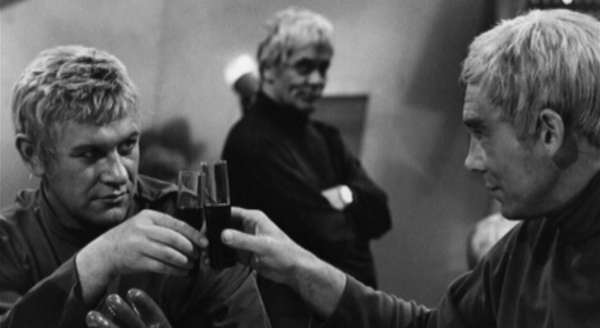
Two men toasting drinks

by William Tenn
Adapted by Peter Erickson

Some stories can only be told in the science fiction genre. Then there are stories like this one, which could be just as easily be told as a western or a crime thriller. Not only would it only take some simple rewriting to turn this episode into a film noir, it might have been preferable.

In the far future, there is excitement amongst Earth’s media when a prison ship returns from the outer frontier carrying Crandall and Henck, the first two men to have survived seven years and earned a licence to murder. They are pre-criminals, men who have confessed to their crimes ahead of committing them. They can earn the right to commit their crime by serving a sentence working on harsh alien planets preparing them for colonisation. Moving into a luxury hotel, the two comrades begin to plan their murders, only to discover that much can change in seven years and what they believed was the truth is often not.

There are several problems with this episode. For a start the whole pre-crime idea is a bit daft and it’s hard to understand how such an odd judicial system started up. There’s a debate between a judge and a journalist near the start but it is a bit of strawman affair. “Would you prefer to go back to a time when men were tortured and killed as punishment?” intones the Examiner, played by the gaunt Peter Madden. Are they the only options then? Medieval punishment or a penal suicide mission where its hoped the criminal will change his mind or die in the attempt? It later transpires that normal prisons also exist in this future, making the existence of pre-crime even more confusing.

Then there is Crandall, supposedly a man so determined, ruthless and angry with his ex-business partner that he is prepared to spend seven hellish years to get a chance to kill him. Yet Edward Judd plays him in such an avuncular, reasonable manner that it is hard to believe. Crandall is so sensible and considerate towards others throughout the episode, that surely he would have rationalised away his bitterness during his exile? He might carry a grudge, but to embark on such an extreme revenge? Maybe he was a different man seven years ago but we are given no evidence of that.

Mike Pratt makes a better job of the angry, slightly pathetic Henck, still wound up with resentment towards the woman who trapped him in a loveless cuckolded marriage. His journey is the sub-plot but it actually sounds the more interesting as he tells it in the hotel bar. His imagined perfect dramatic revenge is quickly thwarted by a series of mundane events that leave him feeling cheated and confused.

Padding is another bugbear of this episode, with several stretches of nothing much happening except Crandall living in the future, using various gadgets. I was amused to see that the hotel television seems to be showing out-takes from the Sixties Doctor Who ‘howlaround’ experiments. There is also a return of the show’s curious obsession with blonde wigs, undoubtedly the same ones used a few weeks ago in The Counterfeit Man. Whilst early model shots of the spacecraft landing must be viewed charitably, the shot of the futuristic city skyline combined with live footage taken in a park is excellent.

Where the episode works best is in its moments of black comedy. The camp but sadistic prison guard (Oliver MacGreevy) who hopes his ‘boys’ have a happy time back on Earth. The oily religious man (Ken Parry) who implores Crandall to forgive and forget, then suggests he profit from his licence by killing a businessman of his acquaintance. The fact that Crandall’s ex-wife Polly (Wendy Gifford) is convinced he wants to kill her and is slightly put out when she discovers he never has.

After a sense of lofty ambitions of the first part of the season, Time in Advance feels altogether more pulpish. Melodrama has always been a part of SF magazines output. It is not outrageously bad, it just feels a bit corny. Perhaps it should have been about two men who escape from prison after seven years, having been double-crossed and out for revenge? And half an hour long?

The Dead Past

Two scientists with futuristic machine

by Issac Asimov
Adapted by Jeremy Paul

Even without his name on the credits, I could have guessed this was an Asimov tale, since it has his common themes of extrapolating a scientific fantasy theory in a realistic fashion, and linking it with the idea of a group of experts manipulating society with sociological techniques for its greater good. It’s a model that can be found in novels like End of Eternity, Caves of Steel and the Foundation series. Furthermore the plot is essentially a series of debates between scientists and other experts, a form he uses in a lot of his stories. It is an odd bird of an episode, starting as criticism of science that is led by politicians and big business, moving into time travel of a kind, then ending up with a twist that this story’s apparent villains might have been in the right after all.

In the not too distant future, Arnold Potterley is obsessed with proving his theory that ancient Carthage was not the barbaric civilization that history has painted it. Unfortunately he cannot get any access to the famous Chronoscope, despite his impeccable credentials.The Chronoscope is a device which can project pictures and sound from the past. The government owns the only model and publishes a monthly report based on its discoveries. Potterley persuades a young physicist called Jonas Foster to ignore the strict rules which effectively control all scientific research in the future and investigate the abandoned field of chronoscophy, with the goal of building his own private machine in the basement of his house. However when he does, the two men make a series of unhappy and far-reaching discoveries.

There are some fascinating ideas in this episode that have not really dated at all. In fact the basic story would fit perfectly into an episode of Black Mirror. Potterley initially thinks of the machine as a way of studying ancient history, but his wife Caroline is only interested in revisiting her own history, those years containing their daughter who died at a tragically young age. But even Potterley can see the seductive dangers of reliving the past. “Watching those years, over and over until you go mad?” he tries to warn her. “Parents looking for their children. Children searching for their dead parents. Old men trying to relive their lost youth! Mankind would be living in the dead past!” But it is government minister Thaddeus Araman (a very Asimov name!) who points out the even greater danger of the scope. “What is history? History is one second ago.” This time machine has become the ultimate surveillance device, worse the ultimate voyeur tool, able to show anything from anyone’s life with no possible prevention. In today’s CCTV, social media and selfie obsessed world, the idea has even more resonance. In light of this, the government’s attempts to quash any possible research into the device seem very understandable. However the fact that they keep their machine working and clearly make lots of use of it, weakens their moral authority. Of course their intentions are ultimately doomed, scientific knowledge can always be rediscovered. There’s also a small sub-plot warning about the dangers of scientific research becoming too bureaucratic, individual scientists becoming too specialised and methodical in their knowledge so that they cannot make inspired connections.

Potterley is an interesting character. His pompousness and infatuation with Carthage is rather comical, but there is something slightly unnerving about him too with his clipped tones and buttoned down emotions. It is a fine performance from George Benson. His co-star James Maxell has the drier part as Foster, his dialogue filled with most of the scientific language and his character less defined. But he makes us believe in this conventional young man who imagination is fired and who finds an unexpected reckless streak within himself. Amongst all this discussion between intense academics are two outsider characters who bring some colour to the story. Willoughby Goddard is splendidly dyspeptic as Foster’s veteran journalist uncle and acts mostly as comic relief. Sylvia Coleridge gives a sympathetic portrait of repressed grief playing Caroline Potterley.

An enjoyable play of ideas rather than action. The Dead Past ends on a memorably downbeat image suggesting that Potterly and Araman’s worst fears are coming true. A sequel set in this world of potentially total surveillance by everyone would be challenging but exciting. Perhaps the closest we’ve come to it on television is my favourite Black Mirror episode The Entire History of You. I’m looking forward to the future Asimov adaptations in this anthology.

Stranger in the Family

Father and son with microscope

Written by David Campton

After two episodes set in the future, featuring mostly male professionals and very science fictional concerns, this third episode, based in a contemporary London of shabby flats and pubs, centered around the emotions  and complicated motivations of its protagonists, feels very different. Sharper somehow. Maybe its simply a case that the tension of wondering if a man is an alien in disguise is of a different tenor to that of watching a vulnerable woman being exploited by a man who can will her to obey him regardless.

Boy may seem like just another awkward, sensitive young man in London, but not only is he unusually intelligent, he is telepathic and can control others with his mind. For years he and his parents have prevented his powers being discovered and kept one step ahead of an organisation who want to study him. But years on the run are taking their toll. When Boy falls in love with a struggling actress and meets her conniving agent/boyfriend, matters reach a crisis.

For me the biggest strength of this story, the first to be written directly for the series rather than adapted from a book, is that all its characters are in shades of grey. At first we perceive the men who pursue the Wilsons as unquestionably sinister, but as the story unfolds and I learnt more about Evans and his institution of other mutant children, not to mention his philosophical acceptance that one day his generation may well be replaced by this new evolution, he becomes if not sympathetic, then a practical man with a reasoned argument. It helps that he speaks with the rich urbane tones of Jack May.

Similarly Boy himself is a contradictory mixture, despicable arrogance and selfishness, yet at the same time tragic and vulnerable, shaped into this dangerous innocent by his parents’ well-meaning protection. By being denied exposure to other people, one can assumed he was home schooled, he has no empathy. Like a child, he is squarely at the center of his world and can only see people in terms of what they offer or threaten him. Richard O’Callaghan cleverly uses a singsong cadence in Boy’s speech to emphasize his immaturity.

Charles and Margaret Wilson are also quite nuanced. Two intelligent people who have sacrificed a great deal to protect their son, but now stuck in a cycle of isolation and suspicion. Their love has inevitably become tempered by the understandable stress of looking after a son who is no longer a child. In one of the most memorable scenes, they discuss what to do next, where they can flee, how they can protect him from harm. Then from nowhere Charles says flatly, “I wish he was dead.” Margaret says nothing but her face shows her understanding.

Justine Lord, something of a television regular at the time playing various troubled blondes, is excellent as Paula, a woman whom experience has given a hard outer shell. Yet underneath is someone with a desire for a gentler life. Maybe to some extent she is a stereotype, an actress struggling through unrewarding small jobs, chasing a dream of stardom but all too aware that she is getting older and it’s moving ever faster away. Perhaps secretly believing that shysters like her boyfriend Sonny are as good as its going to get. Her scenes where she comes under Boy’s sexually driven mind control are genuinely uncomfortable, both during and after. With no special effects, the telepathy scenes succeed purely through her and the other actors reactions. A later scene where Boy forces Sonny to nearly drown himself in the bathroom is nearly as unsettling.

So just as good is the moment would-be assassin Brown is driven to murder himself, as he protests with awful calmness as he drives a blade into himself. Brown is played by John Paul, later star of Doomwatch and by odd coincidence his Doomwatch co-star Joby Blanshard turns up as a fellow agent. Actually Brown is a pretty rubbish undercover operative. In his first meeting with the Wilsons as their new neighbour, he is pretty transparent as he peers around their living room, asking about their son, and radiating insincere bonhomie.

This episode has a definite echo of Out of the Unknown‘s spiritual predecessor Armchair Theatre. Take away the telepathy angle and this could easily fit into that series next to A Night Out, another play about a sheltered young man with a pressure cooker home life, trying to spread his wings but sabotaging himself with unhappy consequences. The climax is effective but also curiously low-key. No mob with flaming torches, no pyrotechnics. Just a squalid killing and a few damaged lives.


The Counterfeit Man

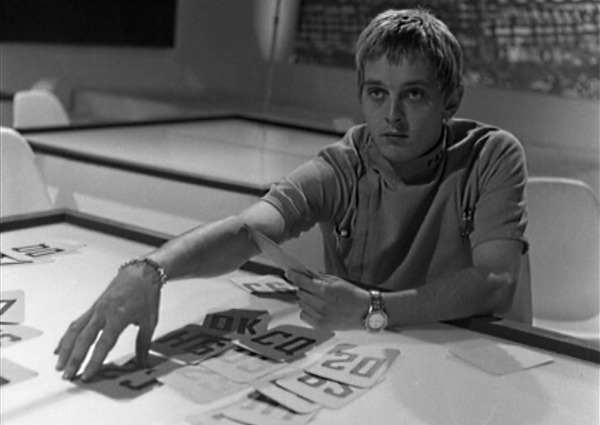
David Hemming sits at a futuristic desk

I should warn you that there are going to be spoilers in this review.

The Counterfeit Man
by Alan Nourse
Adapted by Philip Broadley

Returning to Earth after a disappointing expedition to Ganymede, Dr Crawford, the ship’s medical officer, is shocked when a routine check-up reveals crewman Wescott cannot possibly be human. When a second test comes back normal, the doctor is convinced that they have an alien intruder which can copy humans down to a molecular level. With the reluctant help of Captain Jaffe, Crawford instigates a war of nerves on Wescott, hoping to force the shape-changing alien to reveal itself.

Given the concept of an alien metamorph which can disguise itself as anyone, many a writer would have gone for a whodunnit, raising the paranoia about who the intruder could be. This episode is certainly filled with tension but it is more that of a pressure cooker, slowly ratcheting up the atmosphere. We learn the identity of the ‘counterfeit man’ almost immediately, but tellingly we only know through the conclusions of Dr Crawford. This creates a different kind of tension in the first half, is the doctor correct? In most shipboard dramas, the doctor is a figure of calm reason and authority, but early on it becomes clear that Crawford is quite highly strung for an officer and no poker player, his voice cracking with emotion when he discusses matters with Jaffe. Wescott shows none of the obvious signs of alienness. His speech is natural, his gaze remains un-zombiefied, he only starts to look around suspiciously after he himself falls under suspicion of a crime we know he did not commit. Is Crawford persecuting an innocent man due to his own imagination? David Hemmings is excellent as the likable, increasingly angry Wescott, whilst Alexander Davion hits the right balance between authority and discomfort.

It’s striking looking episode with a large impressive spaceship control deck in gleaming white and chrome. For a story about stealing identities, the crew are strangely clone-like with their near-identical blonde wigs and uniforms. Watching the show with the sound off, you might think that the men (and they are all men, no token female presence here) would talk in a cold, formal fashion. In fact the atmosphere is much more reminiscent of sailors on a navy vessel. “There’s nothing more reassuring than the body of a woman!”, sighs one fellow early on.

But instead of launching into a rendition of “Nothing Like a Dame” at this point, we are treated to the only real weak spot of this episode, the mental breakdown and death of Donnie. Rather than harrowing, this moment is unfortunately quite funny as actor Peter Fraser shouts and staggers around the room, being studiously ignored by the other astronauts. It’s not surprising that Nigel Planer picked it out for his spoof acting class How to Be SF.

As Crawford’s campaign begins to take its toll, the production takes on the feel of experimental theatre. Long tracking shots and close-ups of Wescott looking strung out, soundtracked by some excellent stock music and radiophonic effects I’m pretty sure I’ve previously heard in the Doctor Who adventure The Moonbase. Eventually the story reveals its hand, and Wescott is revealed as an extra-terrestrial in an impressively gloopy special effect sequence, lit with pulsing lights.

If the story had ended here it would have been satisfactory, but a final act pushes it into excellence. With the spacecraft quarantined on Earth, Crawford returns to it only to find his worst fears confirmed, there was a second alien on board. Others might follow what happens better, but to me the climax is interestingly ambiguous. Was the second alien Jaffe, which is what Crawford accuses to the empty room, or does his own fear and paranoia lead him to accidentally release the second alien from its specimen jar when he blasts a workbench with his gun? Either way I was quite struck by the explicitness of the final laser-crisped body, horrible even in monochrome. The production also smartly keeps the aliens’ motivation obscure. We never find out why they want to infiltrate the ship or reach the Earth. This lack of information is intriguing rather than frustrating. Nothing would be clumsier than one of the beings giving a speech about their plans for conquest or tourism.

Let me give  special acknowledgement to George Spenton Foster, who not only directs this striking episode, but as Associate Producer was also instrumental in getting this technically challenging series on to BBC2 in the first place. The Counterfeit Man is notable improvement on the opening story and has aged in quite a cool Sixties retro way.

No Place Like Earth

Two colonists watch alien miners

I enjoy SF TV anthologies a great deal. American television has tended to dominate this field from The Twilight Zone downwards, but the BBC has provided a handful of worthy entries, none more so than Out of the Unknown. As I was growing up it was a series that was an intriguing mystery for me. Mentioned in passing during articles on Doctor Who but fairly undocumented in the main. Certainly never repeated. I caught up with a few episodes in my tape-trading days but I never thought that an official box set would emerge as handsome as the one that has.

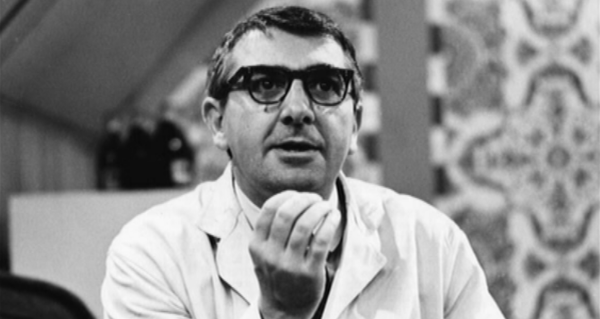
Beginning in 1965 and running for four seasons on BBC2, Out of the Unknown was the brainchild of producer Irene Shubik. An experienced story editor who had worked on the acclaimed ABC anthology Armchair Theatre, she had a long-standing love of literary science fiction and felt intelligent, notable short stories and novels would make good thought-provoking television drama. She probably also wanted to prove that SF could deal with adult dilemmas, as well as simple juvenile escapism.

I recently received the British Film Institute’s splendid Out of the Unknown DVD box set for Christmas. A talented team has not only expertly restored all the existing episodes in the BBC archives, but added four reconstructions of lost episodes, created some interesting looking extras and finished it off with a scholarly booklet on the history of the series. So I thought it might be a fun idea to share my thoughts of the series with you as I watch it.

No Place Like Earth
by John Wyndham
Adapted by Stanley Miller

What is it about most anthology titles sequences that they tend to the sinister? It’s hard to think of any that do not have a feeling of impending threat to them. Out of the Unknown is no different, a sequence of abstract images (including a fear-struck man’s face) whilst Norman Kay’s music features a swooping harp and muted horns that end on a note of suspense. Man is definitely not going boldly to the final frontier here, he is treading warily. It is an effective opening though and feels very much of its Sixties era.

Earth has been destroyed and the remains of humanity are surviving on several small colonies. One of them is Mars, where Bert drifts along the canals, trading his repair skills for provisions and dreaming of the old days. Annika, the matriarch of one of his favourite Martian families is keen for him to marry her eldest daughter, but Bert is restless. His answer seems to come when a ship arrives from Venus, recruiting men to create a new Earth on that hostile planet. But he soon finds that Venus is far from the brave new start he hoped for.

Based on two Wyndham stories stitched together, Time to Rest and No Place Like Earth, this opening installment still feels a bit padded out. Apparently producer Irene Shubik was unhappy with how the episode had turned out and wanted to launch with The Counterfeit Man by Alan E Nourse but was overruled by head of drama Sydney Newman who preferred using a more famous author. With its canals, noble savage Martians and a jungle Venus it is clearly a whimsical science fantasy and old-fashioned even by Sixties standards. The elegiac theme of Bert’s nostalgia for an Earth that never was recalls to something of the later chapters of The Martian Chronicles, except Bradbury’s stories are richer and their fantastical elements are more clearly shown to be a deliberate style of the novel with his re-imaging of Mars as the American mid-west. It’s not a bad story by any means and well-acted, but it often just plods and everything is spelled out when it could have been left as subtext. The biggest offender is an elderly Venus colonist who gives a long long speech describing the oppressive crooked society that has arisen on Venus since the Earth’s destruction. However Terrance Morgan is a good lead as the idealistic dreamer Bert and it is fine to see a young bewitching Hannah Gordon as Zaylo, the Martian maid who wants to domesticate him.

Designer Peter Seddon’s set for the Martian ruins is an excellent creation, recalling Egyptian and Mayan architecture. The spacesuits and Venus overalls are somewhat cartoonish by comparison but the realisation of the primitive native Venusians is quite clever in using stocking masks to obscure their faces.

Reading the booklet I discovered this episode under-ran by six minutes. It did not feel like that. I think better is to come.

Thank you NODA! Rumplestiltskin review

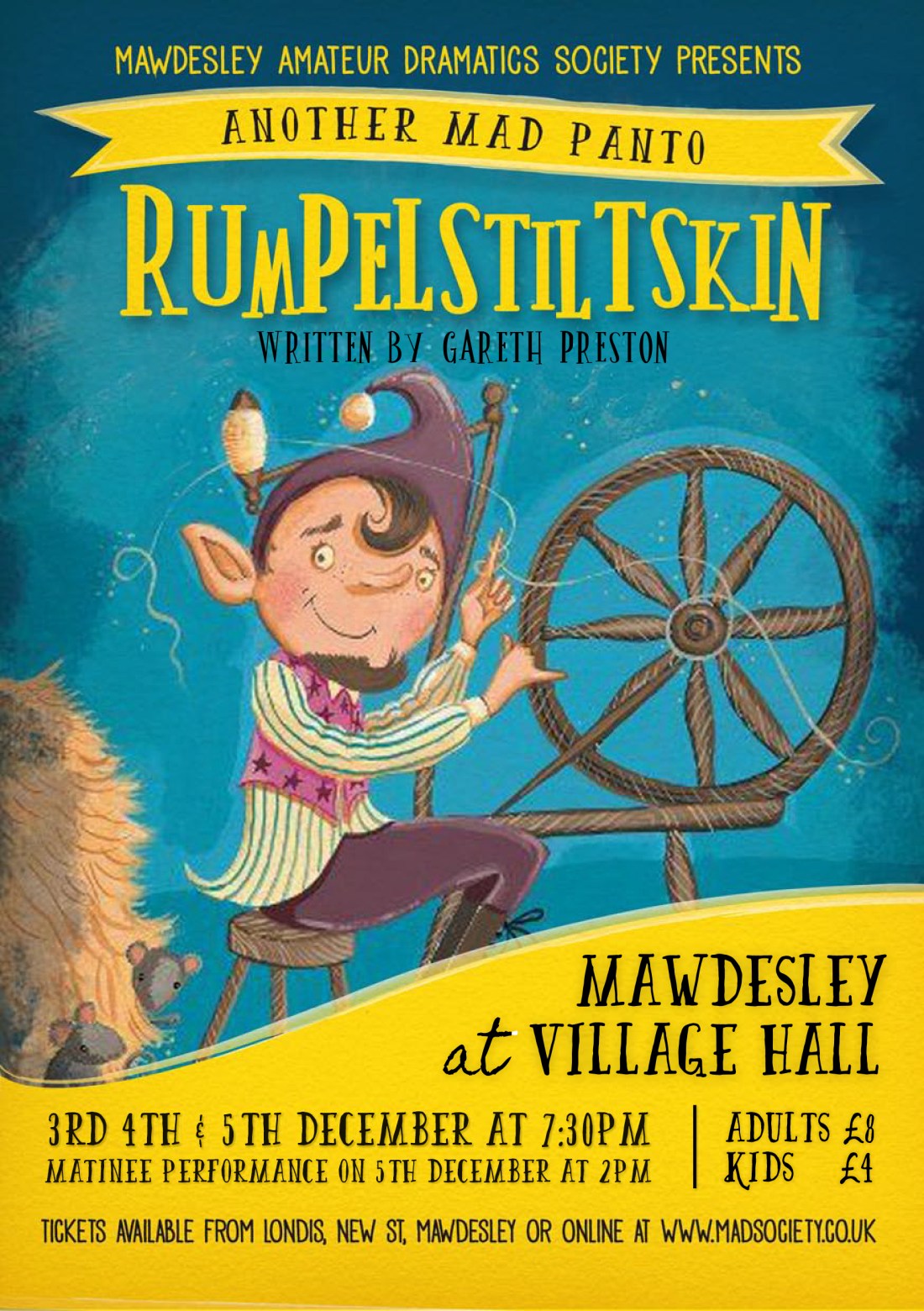
Rumplestiltskin poster

I have been sent a marvelous review by Luke Taberer and Lloyd Bamber of the National Operatic and Dramatic Association (NODA) of Rumplestiltskin, as staged by my good friends at Mawdesley Amateur Dramatic Society. I really enjoyed their slick production, especially some of their inspired ad-libs and interpretations in the best panto tradition. Such as casting a small boy as the fearsome Bear in Clutchwood Forest!

“The show was well received by the audience, which could be heard throughout. The script was a superb choice, as it had content which could be appreciated by all ages and flowed very well.”

You can read the whole report by clicking on the link below:

https://www.noda.org.uk/events/reports/rumpelstiltskin_1

Many thanks for the kind words guys.

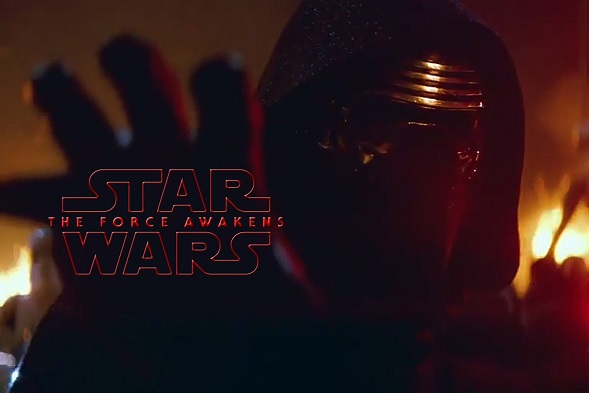
History repeating itself? Star Wars The Force Awakens reviewed

Warning: This review contains spoilers.

Breathe a sigh of relief; The Force Awakens is not going to embarrass you at parties. The latest instalment is fun, comfortable, even exciting in places. It is eager to be liked, commits no major faux pas, but at the same time it never inspired me or made me feel anything more than entertained. At least on this first viewing. Odd to admit, but the first and second trailers on Youtube affected me more deeply than the ultimate movie I saw on the big screen.

Perhaps it is not so surprising however. When I went to see Star Wars back 1978 with my dad and sister Gail, I came out a little disappointed. After all the hype and reading the novelisation twice before I had even been to the cinema, Star Wars was good, just not overwhelming. George Lucas’s creation has been one of the big influences on my youthful imagination, probably second only to Doctor Who. For years, I saw other films through the prism of a galaxy far far away. I can see now it was the whole universe that excited me. For me, Star Wars was always more than just the movies, but the action figures I created more stories with, the novels and comics, even the not-quite-Star Wars products that came in its wake like Battlestar Galactica or Starlord comic.

I am not surprised that JJ Abrams initially turned down to the film. The Force Awakens has to satisfy middle-aged fans who want a film that will stroke their nostalgia, whilst containing enough sophistication in the story and characters that they do not feel embarrassed to be watching an essentially childlike SF fantasy. Episode VII also needs to find and thrill young audiences for whom both trilogies are something from their parent’s/siblings’ distant past. Oh yes and launch a new Disney empire of spin-off movies, TV series and a tsunami of merchandise. Amazingly I think he has managed to deliver that film. The only drawback is that he has had to play it very cautiously indeed.

The biggest surprise is how deliberately Episode VII resembles Episode IV in story moments. A cute droid with vital plans for a vast superweapon. A desert planet. A bar filled bizarre aliens. Said superweapon having one vital weak spot requiring a X-wing raid, whilst another commando group sneaks about the gleaming corridors. Not to mention shout outs to the ice world of Hoth, the green forests of the rebel base on Yarvin’s moon and a supreme leader who favour dark robes and appearing as a giant hologram. At times it feels alarmingly more like a reboot rather than a continuation, that the team are relying a bit too heavily on the imagery of the older films to reach our emotions.

There is progress elsewhere though. More women taking part and a wider ethnicity is welcome, as is Kylo Ren, a villain who is not quite as straightforward as usual. His struggle for his identity and unwillingness to believe in or accept forgiveness for his crimes is a believable motivation, one that also ties in with the series’ mythic storytelling. In fact throughout the movie, casting younger faces in the bad guy roles pays off well, making the First Order feel more like an extremist movement of a radicalised generation.

Interesting that the only famous faces in the movie belong to the original generation of Star Wars. This franchise does not need celebrities or A-list stars and it is the better for casting relative unknowns in all the major roles. Daniel Craig’s cameo appearance as a Stormtrooper is all the better and funnier for being revealed only in the end credits crawl. JJ Abrams has come up trumps in choosing Daisy Ridley, John Boyega and Oscar Issac as his new trio of heroes. Three charismatic young actors who just like Hamill et al can the comic strip bubble dialogue off the paper and make it feel real and human. As for the veterans, they all do more than simply phone it in, as they could easily have. Ford especially is such a good actor he actually makes Solo look like he is having a good time. Plus it is sweet to think of Peter Mayhew back in the furry suit as Chewbacca, at least for the growling scenes.

Great to see the dirty, rusty lived-in universe of the original trilogy back and the green screen work kept under control. BB-8 is a wonderful robot design that lends itself to an impressive amount of expression. For me there is still not been a spaceflight sequence to match the asteroid belt battle in Empire Strikes Back, achieved with models and opticals, but the fight through the wreckage of a star destroyer is beautifully choreographed. The battle with the hideous tentacled Takodana monsters are probably the best surprise in the film, a frenetic corridor chase which takes the franchise into Alien territory for a few moments.

Generally, the plot held few surprises for anyone who has seen many Star Wars-inspired films. I was generally correct in guessing what came next, although the reveals of the Millennium Falcon and that Kylo was Han and Leia’s son were genuine shocks, which I enjoyed.

Ultimately, JJ Abrams and writers Michael Arndt and Lawrence Kasdan understood that Star Wars always owed more to Greek legend and the Brothers Grimm than to science fiction. The Force Awakens is at its best when it puts tragic destiny at its core, of heroes making bad choices with terrible outcomes. It also adds more detail and richness to the Star Wars world’s future, without alienating newcomers and boring them with continuity. Maybe it does not take too many risks itself, but it has built a foundation for future instalments to be bolder.


  1. Note: I wish cinemas would sign some kind of agreement to limit adverts and trailers to fifteen minutes. Is it necessary to advertise so many summer blockbusters, which will not be with us for six months or more? Half an hour of cinematic adverts and epic superhero trailers made me feel exhausted before the two hour plus movie had even begun.


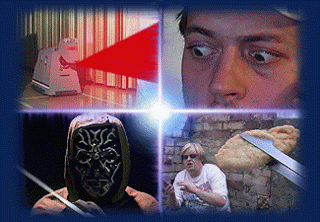
Westlake Films has a new home on the Internet

One constant that has threaded through my creative life for more than ten years now has been Westlake, a group my friends and I formed to make short films, for our entertainment and hopefully for others. Through this group I’ve been able to write scripts and see them turn into actual videos. Not to mention opportunities to act, produce, be a microphone boom operator, a cameraman, a gopher and to get stage punched and kicked far too often!

Now we have a new website, thanks to the diligent efforts of Kevin Hiley and Andrew Crines, and you can find it right here at http://westlakefilms.blogspot.co.uk/   Many of the films have been re-digitised with improved picture and sound quality for this new site. You can stream them on YouTube or download them for free!

Over the years we’ve made original stories and documentaries, comedy skits, fan films (mostly about Doctor Who) and music videos. It’s been a great learning experience, as well as a lot of fun.

Here’s a few of my recommendations if you have not tried Westlake before:

In the Fan Films section

K9 and Bloke – an affection send-up of the awkward Doctor Who spinoff that tried to make the Doctor’s robotic pet a leading star. Charlie Wall plays a shabby PI who solves local crimes with the aid of a long-suffering K9. Written by myself and guest starring Nigel Peever.

In the Films section

Memories of the Mill – John Isles talks to his grandfather Frank Brook about his working life as they tour a preserved steam driven mill in Burnley, in this nostalgic documentary.

Help Wanted – a short ghost story inspired by the tales of the great M R James. A thief’s life becomes a nightmare when he violently robs a church. Written by myself and featuring great music by Peter Wicks.

In the Haberdashery section

The Unoriginal Adventures of Robin Hood – a wickedly funny mash up of a couple of BBC fantasy shows which were on air at the time, written and performed by the cast.

This is just a small selection of what you can find. Hope you enjoy it and we would all would love to hear your thoughts.

The Thrill of Love

Last night I was watching the rehearsals for Bolton Little Theatre’s next production – The Thrill of Love. It is an excellent play by Amanda Whittington, probably best known for her award winning play Bollywood Jane, and based on the true story of Ruth Ellis. Ellis was an ambitious young woman who for a while had a profitable career as a nightclub hostess in post-war London. But she became infamous as the last woman to be executed in the UK, following her conviction for the murder of her ex-lover David Blakely. The play looks back at her life and the crime, following the investigations of Inspector Gayle as he interviews people who knew and the flashbacks conjured up by his questions. It is an excellent piece from the scenes I watch and cleverly staged too with its small cast.

I was at the rehearsals to film a promotional video for the BLT website and other social media haunts. In the past I’ve tried to film prior to rehearsals but this time I was working in parallel with them, catching actors to answer a few questions whilst they weren’t on. I was a little worried that the noise of the rehearsal might be too distracting but in fact it helps with the atmosphere of the interviews. Thanks to both Kimberley’s, Nicola, Tara and Sandra for sparing the time to filmed and Peter for understanding why he was not included in this video, despite his pivotal role in story. Despite their nerves, all the participants had perceptive comments to make about the play and Ruth’s history. Considering the speed it was edited, I’m pretty happy with this promo.

The Thrill of Love will be staged between 7 and 14 November 2015 at Bolton Little Theatre. For more information, please visit the website (which I maintain) http://www.boltonlittletheatre.co.uk

More adventures in poetry filming

Well my good intentions to write more have not been bearing much fruit lately. However my poetry promoting video work has continued apace with two interesting commissions.

First up was North West England’s contribution to the International Beat Poetry Festival. Held at the Bolton Socialist Club on 9 September 2015, it featured not only a line-up of top local poets, but thanks to the modern wonder of Skype, transatlantic contributions from Frank Messina and David Amram. I filmed the event and have uploaded a montage and individual performance videos, which have been pleasingly popular on Facebook etc. I was relieved the sound recorded as well as it did, thanks in part to Brad’s sound system. It was a well attended event with a great atmosphere and a feather in the cap for its organiser, my friend Scott Devon. Editing the montage was pretty difficult. My first cut was nearly eight minutes and I needed to get it closer to three! So in the end I went for a quick fire, one sentence each approach.

Following that I got together with Potting Shed Pete again to record a third poem of his, this time inspired by his past experiences at certain open mic nights. A certain snobbery from a section of the audience about his down to earth material and ebullient performing style. Initially I had considered filming on location at Bridgewater Hall but in the end we went for a simpler empty classroom.

At the next open mic event, also at Bolton Socialist Club on 8 October 2015, I will not only be filming, broadcasting the event live on Periscope, in case you have that app on your phone. Starting at 8pm GMT. A brand new experience for me, which I’ll let you know about!