Slaine: The Horned God – Live on Stage

Slaine, a barbarian warrior standing bare-chested.

My friend Rik Hoskin has told me about an intriguing new UK theatre event that might be of interest to readers:

Professional storyteller Jason Buck will deliver an official adaptation of 2000AD‘s Slaine: The Horned God, based on the story written by Pat Mills, as a theatrical performance at Oxford Playhouse on 19th September. Tickets are available to buy now.

The Oxford performance is a preview show for a tour later this year; a show adapting a tale of Celtic heroes, villains, monsters, magic, dragons, demons, goddesses and gods for the stage, it’s been created by Jason in partnership with 2000AD and Rebellion.

Originally created by Pat Mills, “the godfather of British comics”, and his wife Angie Kincaid, Sláine has captured the imagination of comics readers for generations.

Set in a “time which is not a time” when Britain was rife with magic and mischief, this one-man production of Slaine: The Horned God brings together the epic heroic exploits and divine transformation of the one who would be High King of the Tribes of the Earth Goddess.

This production reimagines ancient mythologies and brings to life the traditional art of storytelling for modern audiences.

Jason Buck has been a performer most of his adult life, including gurning, comedy and sword swallowing, but his passion lies in stories.

“There’s nothing like getting lost in a story, the pictures in your head are better than film,” the prize winning storyteller says.

Jason has also written and published seven illustrated collections of stories, including Stories from the Towers of Stone and Steel and Jack in the Blood, the latter inspired by testing on Jason’s ancestral DNA.

 A teller of tall tales, a weaver of whimsies and a fashioner of fables, Jason draws on traditional favourites and new ideas. His stories are told in the oldest and best ways – as live performances for modern audiences. 

Based in the West Midlands of England, as well as a global online audience, Jason has performed across the UK and mainland Europe, blending traditional and contemporary motifs, vocal sound effects and pure, unadulterated fantasy.

• Book your tickets for Jason Buck’s interpretation of Slaine: The Horned God at Oxford Playhouse on Friday 19th September 2025 here

• Jason Buck is online at jasonbuckstoryteller.co.uk | Facebook | Instagram | Threads

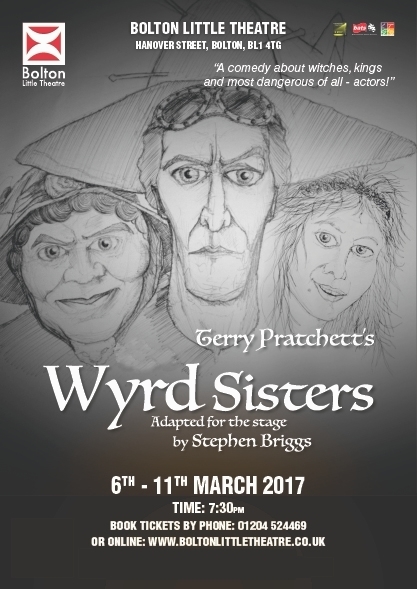
Wyrd Sisters Diary #1 – Setting out on the road to Lancre

Three witches with cauldron

I’m not trying to claim any snob value here but I discovered Terry Pratchett’s Discworld almost right at the beginning. Back in 1985 I read an interview with Terry Pratchett, promoting the paperback release of the first Discworld novel The Colour of Magic, thought it sounded funny and bought it soon after. Possibly as a birthday present for my sister Gail now I come to think about it. Turned out we both enjoyed this send up of fantasy novels and it set us, and eventually my whole family, on an enjoyable journey with Terry’s funny, ingenious books for many years.

Wyrd Sisters is the first proper Discworld Witches book, introducing us to the eccentric coven of the formidable, good but scary Granny Weatherwax, the cheerful, earthy, experienced Nanny Ogg, and the naïve, enthusiastic Magrat. As well as Witches, it has a ghost, a demon, lots of dim-witted guards, and a troupe of theatricals who stage a farcical play within the play.

It is in part a parody of Shakespeare, the Scottish Play in particular, but it is also a comedy about power, be it brute force, common sense or the subtler magic of storytelling. In fact I’m pretty sure it was Gail who bought me the script books of Wyrd Sisters and Guards! Guards! for my own birthday several years later. I had no idea they existed until then. By then I had become involved with amateur dramatics, and I loved Stephen Briggs’ adaptations and the idea of realising them on stage. So in time I persuaded my then current group of Mawdesley Amateur Dramatics to stage Wyrd Sisters. The photo at the top of the page is from that production.

Like many groups, a majority of MADS were women, so it was an advantage to have a play with four really good female roles, not to mention a fair amount of characters who could be played by either gender. That 2007 production was my first experience of directing theatre. It helped that we were already a group of friends, so that made it less intimidating that it could have been. We played it on a smallish village hall stage, with much less in the way of facilities at the time than Bolton Little Theatre has. For example the sound system consisted of my laptop computer and a guitar amp at the rear of the hall. I should add that the current hall has had something of an upgrade since. However the show was a success, and I think the local audience enjoyed the fact that we were trying something a bit different from the traditional amateur dramatic fare.

Now ten years later I am about to direct a new production in a fully equipped theatre with a specially designed set and a cast that is an interesting mix of experienced Bolton regulars and newer faces, some for whom this will be one of their first plays. I have Glenn Robinson, Francis Clemmitt, Jeff Lunt and Joylon Coombs providing invaluable advice and help. I have been doing my homework and pouring over the script, plotting out movements, assembling the music and sound effects. As I write this, the first rehearsal looms this Sunday afternoon and I’m hoping I’ll remember how to do this. It’s not just the Witches who are embarking on an adventure.

wyrd-sisters-bolton-little-theatre

For more information and to book tickets, please visit our theatre website

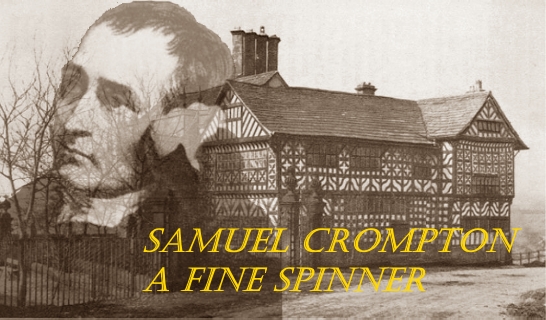
Samuel Crompton – A Fine Spinner

I am currently working with Bolton Little Theatre on an unusual one day theater piece called Samuel Crompton – A Fine Spinner.

Samuel Crompton is one Bolton’s most famous sons, a gifted engineer and inventor who created one of the key machines of the Industrial Revolution – the Spinning Mule. It changed the face of the cotton industry, enabling a worker to reliably spin yard upon yard of cotton thread without it breaking. It was also very scalable, leading to huge mills with rows of machines and much of Bolton’s wealth was built on it. But the man himself saw only a fraction of the wealth that he might have earned from his genius, due to not patenting his invention, but instead accepting payments from mill owners to come and view his designs.

A Fine Spinner by Donna A Hughes, is the story of Samuel Crompton, his invention and his troubled relationship with the new world that machine ushered in. A cast of five actors from Bolton Little Theatre will be performing this one act play at Crompton’s former home of Hall’ith Wood, on Tuesday 26 July 2016, as one of the events celebrating Manchester’s status as European City of Science 2016. Admission is to the house and the play is free, and we will be performing the play three times during the day.

You can find out more about the year long festival at http://www.manchestercityscience.com

European City of Science Logo_BLACK


It has been an interesting challenge so far to plan this production. The author originally intended the play for the theatre, with multiple sets, scenes and a larger cast. My first job was to sensitively edit her play to make it feasible for staging in one room and with the minimum of props. I also had to cut several characters to bring the cast down to a manageable level. First to go was the narrator, a fictional neighbour of the Crompton’s. He was purely a narrator, with no other role in the story, so it seemed sensible to take him out and give parts of his speeches to the characters to perform to the audience as asides. It also made the speeches a little more dynamic if the people involved were relating them. I chose to remove the first scene altogether, featuring Sam and his sister Ruth as children, since child actors bring their own complications and the scene mostly repeated information for elsewhere. My other main deletion was the Prime Minister, since he only appeared for about half a page. Instead the other characters will act as if he is there, while he remains off-camera as it were.

Hall’ith Wood is now a museum, dedicated to telling the story of the house, its role in the English civil war and its most famous tenant – Samuel Crompton. Open Tuesdays and Saturdays, free admission. You can find out more about the place by visiting its website.

I’ll be sharing some details about this production when we start rehearsal. But for now, if you are free during the day on Tuesday 26th July 2015, please mark your diaries!