Busy times for friends

Hope you are well. Apologies for it being a bit quiet around the blog this year, but I’ve been working on a few projects so that I can have a bit of a podcast event in the not too distant future. It’s a mini-season of Play for Tomorrow and I want all six episodes in the can, to guarantee I can release them weekly. In addition, I’ve recorded two further installments on Codename: Icarus and The Tomorrow People, which hopefully follow soon after. Meanwhile at work I’ve been working on my first authored VR projects, as opposed to just being a consumer of other people’s apps. And there’s some other activity that I can’t talk too much about yet. So there’s going to be more regular posting soon. I also thinking of releasing some old reviews which have never been in print before but which I think have some value. Speaking of reviews, I talk about Boris Karloff: The Man Behind the Monster in the latest episode of the Official Talking Pictures TV podcast.


Rik Hoskin is as busy as ever. Amongst his output are two short stories, one for an anthology and another for a fiction magazine.

Behind the Revolving Door: An Anthology of Choices is a forthcoming book from Celestial Echo Press.

Each of us makes a multitude of choices daily, some minor and some with major consequences. Do you eat cereal or oatmeal for breakfast? Skip it entirely? Do you or don’t you wear your lucky shirt to the sports event? What do you think the consequences would be if you didn’t wear your lucky shirt?

This anthology will be a collection of stories that will take you on a journey with the author’s protagonist as they make a decision. We will ask for stories that take them through a trial and force them to take an action, to make a choice. For example, the character comes to a fork in the road. Do they take the right path or do they take the left? Does the character find a wallet on the ground? Do they open it? Return it to the owner, or keep it? What are the consequences?  Do they encounter a second choice, going back through the revolving door? Do they find classified information, implicating a family member in a coup? What do they do with it?  What happens next? Is the character hiking through the woods, and finding a portal, not knowing where it will take them if they enter? What happens? Is it so bad that they try to return, hence going through the revolving door? There are many, many ways this theme can be interpreted.

They have invited five authors, some award-winning and some award-nominated, including Rik. The remainder of the stories will come via open submissions and they anticipate a September release.

Meanwhile the publishers of Cosmic Horror Magazine are launching a new title that promises to be a spiritual successor to Weird TalesGoblins & Galaxies Magazine. Rik will have a story in the premiere issue which is currently launching on Kickstarter: https://www.kickstarter.com/projects/crtyra/goblins-and-galaxies-magazine

We are passionate about turn-of-the-century pulp magazines like Weird Tales and have tried with each issue to pay homage while also amplifying modern story-telling techniques and diverse voices. We want to bring that same approach to a brand-new magazine emphasizing Sword & Sorcery, Dark Fantasy, and Science Fiction.


The marvellous Dylan Rees has guested on two episodes of Very British Futures and I’ve been a guest on three episodes of his Doctor Who Too Hot for TV podcast. A few years ago he published a book about the so-called “Wilderness Years” of Doctor Who called Downtime. Now he’s shortly to release a brand new book in a similar vein – Myths and Legends: The Reeltime Pictures Story.

This is the inside story of Reeltime Pictures, from the earliest days of its acclaimed Myth Makers VHS tapes, through the production of its ambitious dramas and documentaries. Boasting a wealth of quotes from many of those involved, the book tells the story of one man’s passion and dedication to develop a valuable archive of material chronicling the complete production history of classic Doctor Who.

You can pre-order the book now from Telos https://telos.co.uk/shop/doctor-who/myths-legends/


Chatri Art, the man behind the marvellous music for my podcast has been in a productive phase recently and releasing several new songs on bandcamp.com I can recommend the following:

THE VOLCANOS / SESSIONS 1972-3 by Chatri Ahpornsiri and Maybin Marwell and Tony Harris, check it out here.
“Unreleased and improved sound of the music from the early 70’s with added sound, until now. I hope you will enjoy the noise we make.”

SUMMER TO REMEMBER by Chatri Ahpornsiri, check it out here.

THE LIFE AND TIME OF WITCH DOCTOR GOY by Chatri Ahpornsiri, check it out here.

SO MANY TIMES / SINGLE by Chatri Ahpornsiri and Helen W Jackson, check it out here.
“2002 Single E.P. 2 songs 2 mixes each. Helen W Jackson : vocal”

Out of this World – Very British Futures

When I started the Very British Futures podcast I wanted to shine a light on programmes that didn’t have much of a following, that didn’t get talked about much online. Since then I’ve learnt that its good to mix up such programmes with well known titles because listeners like to hear discussions of shows they’ve seen as well as discover old series.

Listen to the Out of this World episode on Spotify

Out of this World is exactly the kind of series I designed this podcast for, and researching it myself I’ve come to be sorry that more it hasn’t survived. It was the first anthology of serious, adult orientated science fiction on UK television. Although both BBC and ITV companies had produced one-off adult dramas SF dramas, such as The Time Machine (1949) and The Ship That Couldn’t Stop (1961), a fully fledged evening series of upfront SF stories was a risky proposition. As it is, Out of this World was a well-received success and would have undoubtedly have had a second season if producer Sydney Newman and story editor Irene Shubik had not left ABC to work for the BBC. But the series was reborn on BBC2 as Out of the Unknown and you can find out more about that marvelous anthology in this podcast episode.

Most of the plots were based on existing stories from the golden age of science fiction, with a couple original scripts in the mix, including an early work about body snatching invaders from Terry Nation – “Botany Bay”. Each episode was introduced by cinema legend Boris Karloff, in the urbane uncle kind of role he often played in his later career. Tragically only one episode has survived – “Little Lost Robot” but that and the other surviving material suggests a very watchable series made with love and care.

See if you agree by listening to the latest episode, in which I am fortunate to be joined by Dylan Rees, host of the Doctor Who – Too Hot for TV podcast and writer Peter Grehen. They had the challenge of listening to me describing missing stories and then reacting to them, and they had some fun insights. You can get the episode on your favourite podcast app or on Youtube.


Whilst I’m here, I glad to tell you that my friend Chatri Art, who wrote the music for Very British Futures has a new album out – The Underdogs. To listen to it, try the player below or visit his Bandcamp page.

Cruise of the Gods – Very British Futures

SF conventions have been making appearances in comedy films for decades. It’s not hard to understand why, as the exotic fantasy worlds of science fiction meeting the mundanity and compromises of the present day and its fallible inhabitants creates a gap that is ripe for observation and storytelling. Then there’s the glamour of celebrity and the shared contract of delusion that exists between artists and their fans. Fandom is a place that build marvellous communities, but also be tawdry and hurtful.

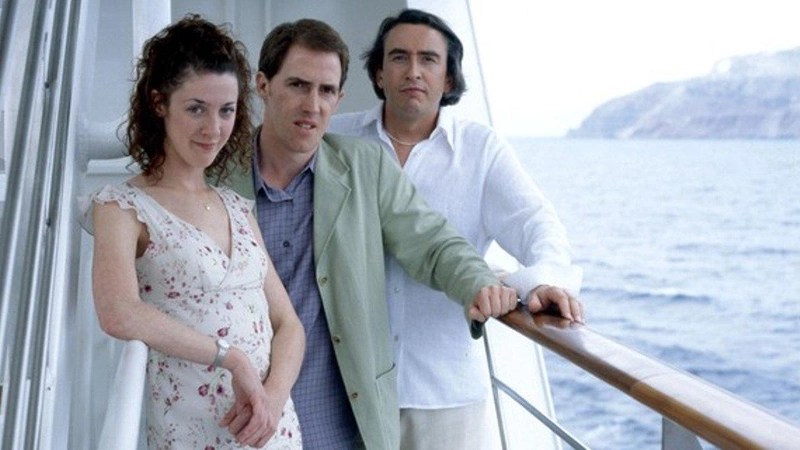
Amongst films and television that have depicted this are Staggered, G.B.H, Paul, Free Enterprise, Frasier, Community, The Big Bang Theory and most famously Galaxy Quest. Less well known but a marvelous example of this sub-genre is the 2002 TV movie Cruise of the Gods. Made by Baby Cow Productions for the BBC, it stars Rob Brydon and Steve Coogan as actors Andy Van Allen and Nick Lees. Both were the stars of an imaginary 80’s tv show Children of Castor. The show was set on a post-apocalyptic Earth, minus the USA (“America is Pollux!”) and featured a New Wave pop group who survived to become the inheritors of humanity. Now in 2002, Nick is globally famous for the US show Sherlock Holmes in Miami, whilst Andy is a barely working actor, supporting himself as a hotel porter. We learn that Andy has been a self-centred jerk most of his life. His lack of success and his resentful reliance on his cult fame has left him lonely and bitter. Most of the film takes place on a cruise ship taking holidaymakers, including a SF convention, around the Greek islands. Andy is the guest of honour, along with the show’s writer and a former actor who played a mutant in the opening credits. But his minor celebrity is overshadowed when Nick turns up completely by chance, filming the latest episode of his series. Andy is initially furious, but when Nick offers him a chance to appear in his programme, Andy sees an opportunity to finally become a star again.

SF conventions on cruise ships are regular events, but there is an extra nostalgia for me in seeing this manner of grassroots event, with guest panels, discussions and competitions, in an era where many conventions have largely become merchandise markets. The film features several actors who would become famous in the Noughties, including David Walliams and James Corden. As well as amusing guest appearances playing themselves from Jack Jones and Brian Conley. It’s a funny, feelgood drama that gently pokes fun at fans but without cruelty.

Cruise of the Gods is the subject of the latest episode of Very British Futures. You can listen to the podcast on Goodpods or any of the major podcast platforms. My guests, actor Cliff Chapman and podcaster Dani Wray, had originally recorded an entirely different episode about The Comic Strip Presents, but due to my clumsiness I lost the recording. So they very generously offered to record a new episode. I had toyed with the idea of covering Cruise of the Gods for a while. Whilst it is not science fiction, it is definitely about British cult television. Hope you enjoy it as much as we enjoyed recording it.

Exploring A for Andromeda and The Andromeda Breakthrough | Very British Futures Podcast

I am delighted to announce a new episode of my podcast Very British Futures. The first hopefully of a revived run of the show, after several months of concentrating my time on Bolton Little Theatre and my job at the university.

A for Andromeda and The Andromeda Breakthrough are fairly obscure today, compared to programmes like Quatermass or Doctor Who, but during 1961-62 they were popular successes for the BBC. It seems appropriate to talk about them now, at a time when Netflix has had a success with 3 Body Problem, another serious SF show about alien contact being conducted through radio communication. Written by noted astronomer Sir Fred Hoyle and TV producer John Elliot, the series begins with radio astronomers detected a message from an alien intelligence. That would be profound enough, but the message turns out to be a blueprint for a new kind of computer, more powerful than anything on Earth. Building the computer in turn creates new life, first an octopus like being, then a beautiful woman they christen Andromeda, based on the body of a murdered female technician. As politics, the military, and a ruthless tech company called Intel (no relation) become involved, maverick scientist John Fleming fights against the alien AI, whilst falling in love with Andromeda. The sequel takes the surviving characters to the Middle East, where a new computer has been built and Intel intend to dominate the world with its technology. But Earth’s weather is running out of control, thanks to Fleming’s interference and only the computer can save us, if it wants to.

Joined by Nigel Anderson and Brian Clark, friends I had worked with on the very first episode covering Pathfinders in Space, this has been a very interesting production to research and produce. After recently covering several high-profile shows, it was good to tackle something a bit more off the beaten track. You can listen to the results on all the major platforms, including YouTube, and find out more about the series, plus the BBC4 remake and the 70’s Italian version by visiting the podcast’s website at: https://westlakefilms.uk/verybritishfutures/


Rik Hoskin has been in touch to tell me about his involvement in a new PC computer game. He is the script editor and consultant on a live-action comedy dating game Forgetting Emily. To quote the blurb on its Steam store page: “When is it time to move on? Before your ex gets married to someone else… right? You play as Alex, a struggling musician invited to his ex-girlfriend Emily’s wedding. It’s in Turkey. It’s in one month. You said you’d bring a plus-one… so the countdown’s on, because you don’t have one.
Filmed in live action, you see through Alex’s eyes as he makes decisions that can land him just about anywhere as he tries to find his ideal date for the wedding. The trouble is, Alex doesn’t have much money, and it seems like everyone who offers to help is also conspiring against him … which is to say, YOU!”

Congratulations to Rik as he adds even more strings to his creative bow. If you would like to find out more, check out the game’s website https://www.forgettingemily.com/

Space: 1999 – Very British Futures

When I was growing up, Space: 1999 was one of the big SF shows. Although I never watched it religiously in the way I followed Doctor Who, nevertheless I had a Dinky die-cast Eagle toy, several annuals and I thought the uniforms looked really cool, especially the colourful jackets they wore in the second season. As a show it was always present in the background, in Look-In magazine, old issues of Starburst and Starlog, and in many of the other SF publications which filled the shops in the wake of Star Wars. Then for a while it seemed to lose its lustre with the fan community, at least in Britain. It became regarded as dull, or camp in the wrong way, an example of how television didn’t ‘get’ SF. But quality will out and in the wake of two serious-minded serial shows of the 90’s both set in one location: Babylon 5 and Deep Space Nine, ITC’s space opera was rediscovered and reappraised. Older fans even detected a story arc to Year One, a suggestion that the Moon’s journey was being controlled by some kind of cosmic higher power, that the Alphans were being prepared for a new destiny on another Earth.

I actually felt that Space: 1999 would already be well covered by podcasts so I avoided it at first. However I am glad I changed my mind because this twentieth episode of the podcast is proving to be one of the most popular episodes so far. Having good contributors helps, and I was delighted to have my friends and talented writers Kara Dennison and Ian Taylor along for the ride. Their contributions are fascinating and amusing.

You can listen to the episode now on Spotify and the other major podcast platforms, including Youtube. Hope you enjoy it and I intend to pick up the frequency of episodes for the remainder of the year. Coming next will be The Comic Strip Presents.

Stingray – Very British Futures

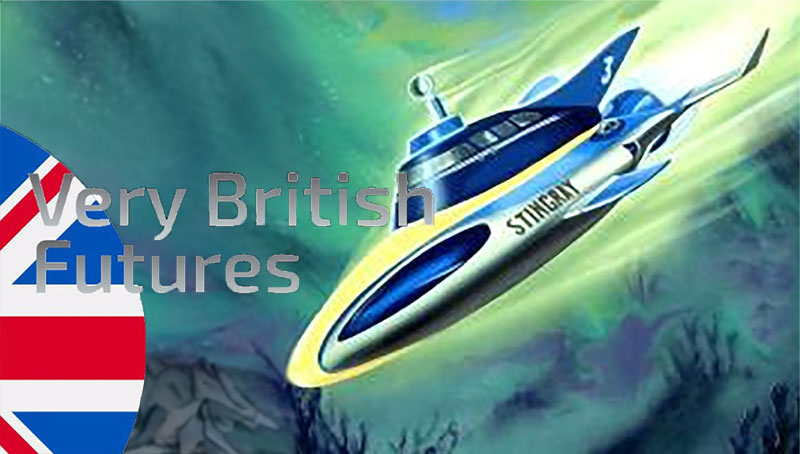
Just in time for Christmas, I’ve released a brand new episode of the Very British Futures podcast, with a seasonal flavour. There aren’t many British TV science fiction programmes that actually feature Christmas, apart from 21st century Doctor Who, but one welcome exception is the works of Gerry Anderson. Most of his puppet shows feature the Christmas holiday and for this special we took a look at Stingray and “A Christmas to Remember”.

Stingray is an odd fish. Although clearly a children’s show, it nevertheless features a largely adult cast of characters who have foibles, who socialise with alcoholic drinks and cigars, and have mature concerns beyond simply defeating the bad guy of the week. Most famously there is the romantic triangle between Troy Tempest, underwater-breathing glamourpuss Marina, and attractive Atlanta Shore, who works at Marineville most of the time. The stories were straightforward, but there was space for humour, and even a touch of satire. Meanwhile the excellent craftsmanship of the AIP team, created one of the glossiest junior shows on television, with memorable images like Stingray erupting from its undersea silo, or Marineville descending underground.

I was keen to get a younger viewer’s opinion for this episode, so invited John and his thirteen year old daughter Amber to be my guests for this mini-episode. It’s a slightly unusual episode as a result, but I hope listener’s enjoy the seasonal flavour and if it’s a success I’ll do another one next year.

YouTube version of the podcast

You can listen to Very British Futures on your favourite podcast app or at the official website

The Day After Tomorrow – Very British Futures

Plenty going on this month but the biggest news for this blog is that there is finally a new episode of my podcast Very British Futures out there – The Day After Tomorrow.

Nothing to do with the dreadful 2004 Roland Emmreich film but everything to do with Gerry Anderson’s continuing efforts to conquer America. UFO had come close but after a strong start in the ratings it had faltered. Space 1999 was doing reasonably well in syndication but the question of a second season was still up in the air. Then Gerry Anderson was approached by George Heinemann, producer of NBC’s new youth orientated anthology strand Special Treat. Special Treat was a series of documentaries and educational family dramas, and Heinemann was looking for a way to dramatise Albert Einstein’s famous theories for children. The result was the 50 minute special The Day After Tomorrow. Hoping it might act as a backdoor pilot for a TV series, Anderson and writer Johnny Byrne (Space 1999, Doctor Who) added the subtitle Into Infinity.

It’s an entertaining family SF adventure and something of an unintended callback to the pioneering Pathfinders in Space series with its young protagonists and parents and the emphasis on science and engineering. The short running time means it moves at a fair clip, and it enjoys the same high-quality production values as Space 1999. For this podcast I tried to reach out beyond my usual circle and recruited Felicia Baxter from the podcast guest site matchmaker.fm Felicia turned out to be a wonderful guest and her fresh perspective and presence make this an excellent episode. It’s also the first of what I intend to be an extra format for the podcast. As well as the traditional discussions with a group of guests, I’d like to more conversational two handers like this, looking at more targeted subjects and shorter form TV plays.

You can hear this episode on your favourite podcast app and also on the web here.


My friend Rik Hoskin has had a good month too. His comic strip adaptation of the second book in The Wheel of Time saga is out now and there’s a new trailer online.

Dynamite Comic’s The Great Hunt, written by Rik Hoskin

In addition he has published a marvellous creepy short story by a scuba diving holiday that takes a strange twist in The Dive, published by Cornice. You can enjoy for free and I recommend you give it a read.

Very British Futures – The Day of the Triffids

The Day of the Triffids aired on BBC1 in 1981 and became one of those SF television series that broke out of the genre ghetto and became part of popular culture, fondly remembered by many who saw it back then. Perhaps this shouldn’t be a surprise since the novel of the same name by John Wyndham had been a bestseller, remaining in print since it debuted in 1951. The series follows the story of a group of survivors living in a post-apocalyptic world after a meteor shower has rendered most of the population blind and given rise to deadly, venomous plants called Triffids. The main protagonist is Bill Masden, a young farmer who has ironically retained his sight due to being protected by bandages after a Triffid attack. As he navigates the dangers of post-apocalyptic England, he must also deal with the threat posed by the plants, which are able to move on their own and attack humans.

Like the book, the series explored themes of survival, adaptation, and morality. Produced by David Maloney, directed by Ken Hannam and adapted for television by Douglas Livingstone, it starred John Duttine, Emma Relph, and Maurice Colbourne.

I had an excellent time recording this episode with Rik Hoskin, and Chris and Ella Burton and we got unexpectedly deep in places when it came to the moral challenges faced by the characters. You listen to our debate by finding Very British Futures on YouTube, Spotify, Apple, and many more platforms. Or go to its page on the podcast website.

In other news, I am currently back on the sound desk at Bolton Little Theatre for the upcoming play Flamingoland which runs 20th to 27th May 2023. Written by ex-Coronation Street actor Deborah McAndrew, it’s the story of two sisters, their daughters, and a local pest control officer. Mari is terminally ill and spends her days organising her funeral and her will. Her sister Bridie wants her to focus on making the most of her remaining time. But the whole family is poisoned by a secret from their teenage years. Will bringing it out in the open help them to heal or is too late? Sound effects for this one are fairly domestic. Probably the biggest challenge was filming a video sequence at the open mic night at the Doffcocker Inn, Bolton, for the finale. But it gave me a chance to put a new 4K Canon XA50 camera and shotgun microphone through its paces.

You can book tickets online from Ticketsource.

Very British Futures now on YouTube – and other news

Following the good advice of my friend Kevin, producer of Tripodscast and I Don’t Do SciFi, my show Very British Futures is now available on YouTube, making it even more accessible to listeners all over the world.

Very British Futures as you’ll know if you read this blog regularly, is my discussion podcast about the rich library of science fiction television which has been produced by my native country. Moving to YouTube is a savvy addition, as the platform is already a go-to destination for people looking for content on a wide range of topics. The YouTube app already comes installed as standard on many smart TV’s and set top boxes. Therefore we have the possibility for more people to discover and engage with Very British Futures thanks to the platform’s massive global reach.

You can find the podcast by searching for “Very British Futures” on the YouTube app. Or you can follow this link to my channel. I am afraid I haven’t had time to add much visually to the episodes. Each has a new piece of artwork, but its still essentially an audio production. All the existing episodes are there and I’ll be adding each new show simultaneously alongside the standard podcast.

In other news, the final part of the comic strip prelude to Pierce Brown’s Red Rising trilogy, Sons of Ares, has been published. It’s written by my old friend Rik Hoskin and illustrated by Kewber Baal. The first two collections were superb and I’m looking forward to the conclusion. To quote its Amazon page: “The last two entries into the Sons of Ares had Fitchner on his heels. In the first, he was driven by love and desperation to save his wife Brynn before her execution at the hands of the Board of Quality Control. Then, in book two, Fitchner went head to head with both of his early allies — Arturius and Quicksilver. His wrath left Arturius dead and set back Quicksilver’s dream of expanding exploration and human habitation to other stars. In Forbidden Song, Ares may not always be in control. But he has a plan — and it’s a doozy. Forbidden Song is one part Ocean’s 11, one part Les Miserables, and it sets the fuse for the Rising that Darrow will inherit.”

And you’ll be hearing Rik soon as a guest in the next episode of Very British Futures, talking about The Day of the Triffids.

Finally, my long association the Official Talking Pictures TV podcast continues, and the latest edition is just out. It includes my review of the hilarious Laurel and Hardy short Twice Two, featuring the boys in the dual roles of their usual personas AND their sisters (and each other’s wife). You can hear it on all the major platforms or online here.

Thanks for reading.

The Chocky Trilogy – Very British Futures

Chocky was a science fiction novel by John Wyndham, the final one published in his lifetime (1968). It tells the story of an 11 year old boy named Matthew, who begins to exhibit strange behavior and abilities that concern his parents. They learn that Matthew has an imaginary friend named Chocky, who is actually a highly advanced alien being with a mission to help humanity. The novel was adapted for radio, but most famously into an ITV television series which led to two original sequels, all written by Anthony Read. In the first series, closely based on the novel, Chocky saves Matthew and his sister’s lives following a boating accident, This leads to press attention and Matthew being kidnapped by a mysterious secret organisation, who hypnotise him to contact Chocky directly. After Matthew is released, Chocky bids him goodbye, not wanting to endanger him more. Chocky’s Children reunites Matthew and Chocky when he discovers he has a psychic link with Albertine, a maths prodigy of similar age but a more fiery temperament. She too, has a connection to the alien and together they discover new powers, including telekenesis and a psychic attack. In the final series, Chocky’s Challenge, Matthew has moved to New York, but Albertine has joined forces with three more of Chocky’s human contacts to create the first cosmic energy generator. Once again the secret organisation tries to control them and even captures Chocky within a prison. This time it is the teenagers who must rescue their extra-terrestrial ally.

Although the novel is narrated from the viewpoint of Matthew’s father, the series are much more from the children’s perspective. Very popular at the time with CITV viewers, the series has been released on VHS and DVD several times and continues to gain new fans.

As part of the research for this episode, I spoke to producer Richard Bates (A Touch of FrostThe Tripods) who originally obtained the rights for a television adaptation of Chocky, and served as both creative consultant and producer of the third and final series. I had intended to include clips from our conversation in the final show but annoyingly I lost the file. Joining me for this edition is my regular guest Dr Rebecca Wray, and author, publisher and old friend Will Hadcroft. Both of them coincidentally have also talked with Richard Bates in the past. We had an excellent conversation and it was hard to edit it down to even the generous 90 minutes I have given this episode. There was also time to talk about Will’s writing career and Rebecca’s new podcast I Don’t Do Sci-Fi.

You can hear the podcast on all major podcast platforms, including YouTube, or you can find it here on the web.