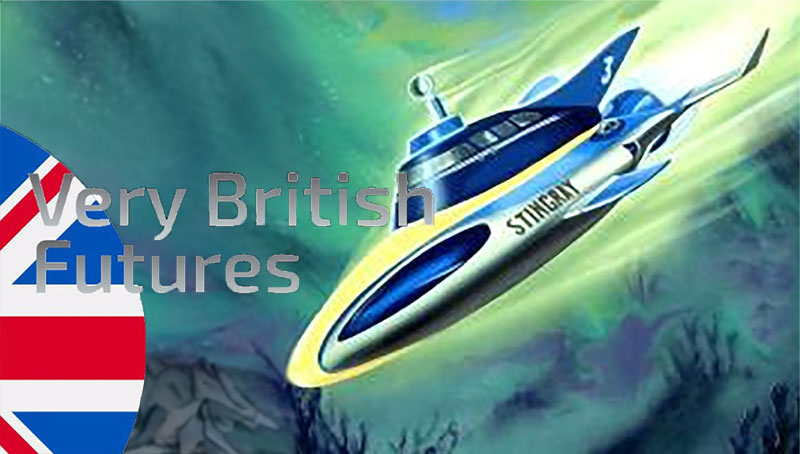
Just in time for Christmas, I’ve released a brand new episode of the Very British Futures podcast, with a seasonal flavour. There aren’t many British TV science fiction programmes that actually feature Christmas, apart from 21st century Doctor Who, but one welcome exception is the works of Gerry Anderson. Most of his puppet shows feature the Christmas holiday and for this special we took a look at Stingray and “A Christmas to Remember”.
Stingray is an odd fish. Although clearly a children’s show, it nevertheless features a largely adult cast of characters who have foibles, who socialise with alcoholic drinks and cigars, and have mature concerns beyond simply defeating the bad guy of the week. Most famously there is the romantic triangle between Troy Tempest, underwater-breathing glamourpuss Marina, and attractive Atlanta Shore, who works at Marineville most of the time. The stories were straightforward, but there was space for humour, and even a touch of satire. Meanwhile the excellent craftsmanship of the AIP team, created one of the glossiest junior shows on television, with memorable images like Stingray erupting from its undersea silo, or Marineville descending underground.
I was keen to get a younger viewer’s opinion for this episode, so invited John and his thirteen year old daughter Amber to be my guests for this mini-episode. It’s a slightly unusual episode as a result, but I hope listener’s enjoy the seasonal flavour and if it’s a success I’ll do another one next year.
YouTube version of the podcast
You can listen to Very British Futures on your favourite podcast app or at the official website
Plenty going on this month but the biggest news for this blog is that there is finally a new episode of my podcast Very British Futures out there – The Day After Tomorrow.
Nothing to do with the dreadful 2004 Roland Emmreich film but everything to do with Gerry Anderson’s continuing efforts to conquer America. UFO had come close but after a strong start in the ratings it had faltered. Space 1999 was doing reasonably well in syndication but the question of a second season was still up in the air. Then Gerry Anderson was approached by George Heinemann, producer of NBC’s new youth orientated anthology strand Special Treat. Special Treat was a series of documentaries and educational family dramas, and Heinemann was looking for a way to dramatise Albert Einstein’s famous theories for children. The result was the 50 minute special The Day After Tomorrow. Hoping it might act as a backdoor pilot for a TV series, Anderson and writer Johnny Byrne (Space 1999, Doctor Who) added the subtitle Into Infinity.
It’s an entertaining family SF adventure and something of an unintended callback to the pioneering Pathfinders in Space series with its young protagonists and parents and the emphasis on science and engineering. The short running time means it moves at a fair clip, and it enjoys the same high-quality production values as Space 1999. For this podcast I tried to reach out beyond my usual circle and recruited Felicia Baxter from the podcast guest site matchmaker.fm Felicia turned out to be a wonderful guest and her fresh perspective and presence make this an excellent episode. It’s also the first of what I intend to be an extra format for the podcast. As well as the traditional discussions with a group of guests, I’d like to more conversational two handers like this, looking at more targeted subjects and shorter form TV plays.
My friend Rik Hoskin has had a good month too. His comic strip adaptation of the second book in The Wheel of Time saga is out now and there’s a new trailer online.
Dynamite Comic’s The Great Hunt, written by Rik Hoskin
In addition he has published a marvellous creepy short story by a scuba diving holiday that takes a strange twist in The Dive, published by Cornice. You can enjoy for free and I recommend you give it a read.
The Day of the Triffids aired on BBC1 in 1981 and became one of those SF television series that broke out of the genre ghetto and became part of popular culture, fondly remembered by many who saw it back then. Perhaps this shouldn’t be a surprise since the novel of the same name by John Wyndham had been a bestseller, remaining in print since it debuted in 1951. The series follows the story of a group of survivors living in a post-apocalyptic world after a meteor shower has rendered most of the population blind and given rise to deadly, venomous plants called Triffids. The main protagonist is Bill Masden, a young farmer who has ironically retained his sight due to being protected by bandages after a Triffid attack. As he navigates the dangers of post-apocalyptic England, he must also deal with the threat posed by the plants, which are able to move on their own and attack humans.
Like the book, the series explored themes of survival, adaptation, and morality. Produced by David Maloney, directed by Ken Hannam and adapted for television by Douglas Livingstone, it starred John Duttine, Emma Relph, and Maurice Colbourne.
I had an excellent time recording this episode with Rik Hoskin, and Chris and Ella Burton and we got unexpectedly deep in places when it came to the moral challenges faced by the characters. You listen to our debate by finding Very British Futures on YouTube, Spotify, Apple, and many more platforms. Or go to its page on the podcast website.
In other news, I am currently back on the sound desk at Bolton Little Theatre for the upcoming play Flamingoland which runs 20th to 27th May 2023. Written by ex-Coronation Street actor Deborah McAndrew, it’s the story of two sisters, their daughters, and a local pest control officer. Mari is terminally ill and spends her days organising her funeral and her will. Her sister Bridie wants her to focus on making the most of her remaining time. But the whole family is poisoned by a secret from their teenage years. Will bringing it out in the open help them to heal or is too late? Sound effects for this one are fairly domestic. Probably the biggest challenge was filming a video sequence at the open mic night at the Doffcocker Inn, Bolton, for the finale. But it gave me a chance to put a new 4K Canon XA50 camera and shotgun microphone through its paces.
Following the good advice of my friend Kevin, producer of Tripodscast and I Don’t Do SciFi, my show Very British Futures is now available on YouTube, making it even more accessible to listeners all over the world.
Very British Futures as you’ll know if you read this blog regularly, is my discussion podcast about the rich library of science fiction television which has been produced by my native country. Moving to YouTube is a savvy addition, as the platform is already a go-to destination for people looking for content on a wide range of topics. The YouTube app already comes installed as standard on many smart TV’s and set top boxes. Therefore we have the possibility for more people to discover and engage with Very British Futures thanks to the platform’s massive global reach.
You can find the podcast by searching for “Very British Futures” on the YouTube app. Or you can follow this link to my channel. I am afraid I haven’t had time to add much visually to the episodes. Each has a new piece of artwork, but its still essentially an audio production. All the existing episodes are there and I’ll be adding each new show simultaneously alongside the standard podcast.
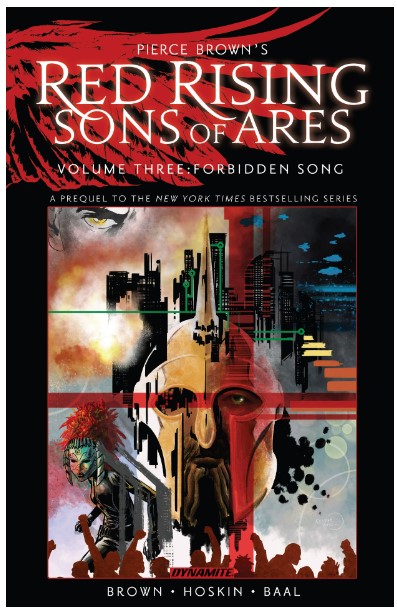
In other news, the final part of the comic strip prelude to Pierce Brown’s Red Rising trilogy, Sons of Ares, has been published. It’s written by my old friend Rik Hoskin and illustrated by Kewber Baal. The first two collections were superb and I’m looking forward to the conclusion. To quote its Amazon page: “The last two entries into the Sons of Ares had Fitchner on his heels. In the first, he was driven by love and desperation to save his wife Brynn before her execution at the hands of the Board of Quality Control. Then, in book two, Fitchner went head to head with both of his early allies — Arturius and Quicksilver. His wrath left Arturius dead and set back Quicksilver’s dream of expanding exploration and human habitation to other stars. In Forbidden Song, Ares may not always be in control. But he has a plan — and it’s a doozy. Forbidden Song is one part Ocean’s 11, one part Les Miserables, and it sets the fuse for the Rising that Darrow will inherit.”
And you’ll be hearing Rik soon as a guest in the next episode of Very British Futures, talking about The Day of the Triffids.
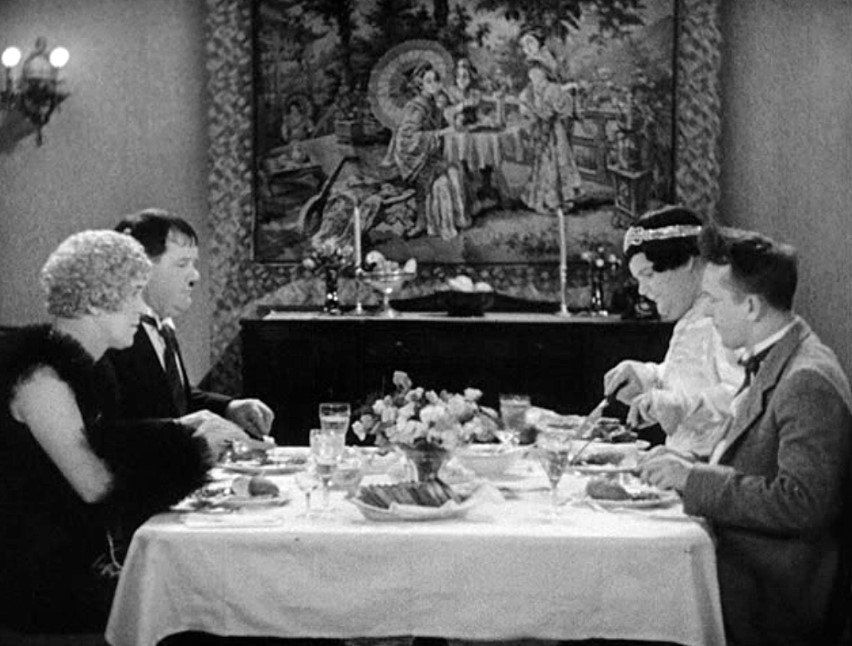
Finally, my long association the Official Talking Pictures TV podcast continues, and the latest edition is just out. It includes my review of the hilarious Laurel and Hardy short Twice Two, featuring the boys in the dual roles of their usual personas AND their sisters (and each other’s wife). You can hear it on all the major platforms or online here.
Chocky was a science fiction novel by John Wyndham, the final one published in his lifetime (1968). It tells the story of an 11 year old boy named Matthew, who begins to exhibit strange behavior and abilities that concern his parents. They learn that Matthew has an imaginary friend named Chocky, who is actually a highly advanced alien being with a mission to help humanity. The novel was adapted for radio, but most famously into an ITV television series which led to two original sequels, all written by Anthony Read. In the first series, closely based on the novel, Chocky saves Matthew and his sister’s lives following a boating accident, This leads to press attention and Matthew being kidnapped by a mysterious secret organisation, who hypnotise him to contact Chocky directly. After Matthew is released, Chocky bids him goodbye, not wanting to endanger him more. Chocky’s Children reunites Matthew and Chocky when he discovers he has a psychic link with Albertine, a maths prodigy of similar age but a more fiery temperament. She too, has a connection to the alien and together they discover new powers, including telekenesis and a psychic attack. In the final series, Chocky’s Challenge, Matthew has moved to New York, but Albertine has joined forces with three more of Chocky’s human contacts to create the first cosmic energy generator. Once again the secret organisation tries to control them and even captures Chocky within a prison. This time it is the teenagers who must rescue their extra-terrestrial ally.
Although the novel is narrated from the viewpoint of Matthew’s father, the series are much more from the children’s perspective. Very popular at the time with CITV viewers, the series has been released on VHS and DVD several times and continues to gain new fans.
As part of the research for this episode, I spoke to producer Richard Bates (A Touch of Frost, The Tripods) who originally obtained the rights for a television adaptation of Chocky, and served as both creative consultant and producer of the third and final series. I had intended to include clips from our conversation in the final show but annoyingly I lost the file. Joining me for this edition is my regular guest Dr Rebecca Wray, and author, publisher and old friend Will Hadcroft. Both of them coincidentally have also talked with Richard Bates in the past. We had an excellent conversation and it was hard to edit it down to even the generous 90 minutes I have given this episode. There was also time to talk about Will’s writing career and Rebecca’s new podcast I Don’t Do Sci-Fi.
I like to mix it up on the Very British Futures podcast. After the jolly, lightweight Dominick Hide plays we plunge into the pitch black dystopia of the BBC’s harrowing TV play Nineteen Eighty-Four. Based on George Orwell’s famous prophetic novel, this is ambitious drama brought more lustre to Nigel Kneale and Rudolph Cartier reputations, and remained a high point of Peter Cushing’s career.
The story is set in a futuristic austere Britain where the government is led by the IngSoc (English Socialism) party, headed by a man known as Big Brother. The Party seeks to control every aspect of people’s lives, including their thoughts, emotions, and behaviour. Winston Smith (Peter Cushing) is a low-ranking member of the Party who works in the Ministry of Truth, where he is responsible for altering historical records to conform to the Party’s version of reality. Despite being a loyal member of the Party, Winston is secretly unhappy with the oppressive regime and begins to rebel against it. He begins a secret affair with Julia (Yvonne Mitchell), a party member from the Fiction department. Together they become involved with a group known as the Brotherhood, which is rumoured to be a group of rebels who are plotting against the Party. However the Brotherhood is actually a myth created by the Party to lure out and eliminate any potential dissenters. Despite his efforts to rebel against the Party, Winston is captured and tortured until he fully conforms to their ideology. The novel ends with Winston being released back into society, fully loyal to the Party and completely brainwashed.
Writers Andrew Scott Roe-Crines and John Isles return to the show to join me in discussing the messages of the book and strengths of this television play. Find out about what the papers said, how the IngSoc party operates and the nightmare of Newspeak.
Now I am starting work on the next episode, about ITV’s Chocky trilogy.
Time travel is a dangerous business, not only for what effect changes in the past might affect, but the lure of nostalgia for a seemingly more exciting, more authentic world. A temptation which young Dominick Hide cannot resist any longer. He’s a time travelling historian from a future where life is peaceful and advanced, but most records of the past have been erased by an unknown catastrophe. His curiosity about the wild world of 1980 leads to an adventure which changes his life and that of Jane, a boutique shopowner with whom he falls in love, despite being married to Ava in his present.
Play for Today is generally remembered for its dramatic socially conscious dramas, yet over the years it has featured several notable comedies such as Mike Leigh’s Nuts in May and Jack Rosenthal’s Bar Mitzvah Boy. In fact one of its most successful and beloved installments was a science fiction romantic comedy The Flipside of Dominick Hide. In this episode, we analyse this play and its sequel, Another Flip for Dominick.
Making a welcome return visit for this episode are the warm and witty Tim Reid and Charles Auchterlonie, the hosts of The Randomiser, a podcast reviewing Doctor Who old and new, as well as other British cult TV. Hope you enjoy this one.
You can listen to Very British Futures on all the major podcast platforms, or online at Anchor.FM
It’s been longer arriving than I hoped but Season Two of my podcast Very British Futures is finally taking flight. I’ve found a better way of planning my time, and so I’ve been able to invest some energy into editing my recordings from the last few months.
So first released blinking into the online world is our discussion of The Aliens, E4’s 2016 drama with blackly comic moments, set in a world of human and alien drug dealers, ghettoised resentful alien immigrants and one hapless protagonist who keeps trying to do the right thing but generally just digs himself deeper into trouble.
It has a marvellous cast of people who were just getting recognised for their talent, including Michaela Cole (I Will Destroy You), Jim Howick (Ghosts) and Michael Socha (Being Human) and Michael Smiley (Kill List) and was produced by a lot of the same team responsible for Misfits.
This is also best produced episode so far, thanks to the technical brilliance of Kevin Hiley (Tripodscast) and being the first to be recorded in an actual room instead of online. I was joined by two guests from Tripodscast: Rebecca Wray and Dani Wray. Both of them were excellent and had plenty of fascinating observations about the show and its characters. Look out for their forthcoming new series with John Isles I Don’t Do SF in the new year.
You can listen to the episode at Anchor FM or on all the major podcast platforms. You can also check its dedicated page at my new website for the podcast which also has links for further reading, including the original E4 website which contains a lot more background information about the fictional history of the aliens’ arrival in Britain. For the first season I also put the episode up on this blog as a downloadable MP3. I’ve decided to stop that for season two, partly to cut down on housekeeping, and also to hopefully encourage more listeners to the podcast platforms and build up the podcast’s official stats. If you would like to download a file to listen to offline, may I suggest checking out the episode’s page at Spreaker, which has a download option.
Hope you enjoy this episode. More coming soon, continuing with The Flipside of Dominick Hyde.
It’s very flattering when someone credits you as an inspiration. John Isles and Rebecca Wray were inspired to create their own podcast, partially by my own Very British Futures podcast. Together with Dani Wray, the result is Tripodscast, a series discussing everything you could possibly want to know about John Christopher’s Tripods series. The books, the TV series, the comic strips and more. A good choice, because my episode on the BBC TV series is still my most downloaded instalment.
Episode one is out now and its excellent. A very entertaining 50+ minutes of conversation about the first novel The White Mountains, along with an charming interview with another friend of mine, author Will Hadcroft about his correspondence and eventual meeting with John Christopher, a pen-name of Samuel Youd. It is well produced too and reminds me that when I start season two of my podcast I want to do some in-person recordings as well as Skype chats.
When I started thinking about Outcasts, in my mind it was a series just a few years old, and I was shocked to find out it was actually broadcast in 2011. Nevertheless its striking how little impact this expensive primetime BBC1 science fiction series seems to have made. A quick google search reveals no dedicated fan sites, only a few reviews on newspapers and general purpose geek TV review sites. In the comments section underneath them, a mixture of short thoughts evenly divided between bouchets and brickbats. Creator Ben Richards tried to generate some excitement with teasing a few things which might have happened in season two but to no avail. No streaming company was rushing to Kudos’ door for more stories from Carpathia and it seemed there was no one campaigning for more. And revival campaigns are surely one of the defining factors of SF fandom?
Looking back there hasn’t been a really successful show about colonising a planet, despite the apparent strengths of such an idea. Neither Earth 2, or Terra Nova lasted more than a season and Outcasts continued the trend. Distant space colonies of explorers and farmers it seems, are more a place we like our heroes to visit, have an adventure, then blast off again to somewhere new. Post-apocalyptic survival tales seem to fare better. The Walking Dead and Survivors have both tackled themes about setting up a new society from the ground up and hooked us into the characters and their plight, yet both had more than their share of soapy storylines. Maybe when we go into space we’re always looking for new worlds to explore, preferably with interesting lifeforms to fight or fall in love with.
Perhaps another lesson to learn from Outcasts is that a great episode one is still important. Maybe a Netflix series can afford a slow burn when all the episodes are simultaneously online, although I wish they didn’t indulge in them quite so often, A weekly series however needs to grip from the first night. Most of the really negative, virulent reviews of Outcasts are based on the first episode. Watching the whole series I agree with some of my guests that the series does improve but the drag factor of the first two slow episodes sets a gloomy tone that later episodes never really shook off, even as the plot picks up momentum. At the same time some of the reviews themselves are weirdly hysterical. For example one newspaper asked if Ed Wood Jr (the notorious low-budget director) was in charge. Whatever else can be leveled at the programme, the production values are first class.
In this episode, I’m joined by Nicky Smalley, Dr Rebecca Wray and John Isles to talk about our rewatch of Outcasts and what we think worked and what didn’t. There’s some interesting discoveries along the way.
Essential facts
Cast Hermione Norris – Stella Isen Daniel Mays – Cass Cromwell Amy Manson – Fleur Morgan Ashley Walters – Jack Holt Eric Mabius – Julius Berger Michael Legge – Tipper Malone Liam Cunningham – Richard Tate Langley Kirkwood – Rudi Jeanné Kietzmann – Lily Isen
Production Created by Ben Richards
Written by Ben Richards, David Farr, Simon Block, Jimmy Gardner, Jack Lothian
Produced by Radford Neville Co-produced by Jörg Westerkamp, Thomas Becker, Vlokkie Gordon, David Wicht Executive Produced by Jane Featherstone, Faith Penhale, Matthew Read, Simon Crawford-Collins, Ben Richards Directed by Andy Goddard, Omar Madha, Bharat Nalluri, Jamie Payne
Production companies Kudos Film and Television ApolloMovie Beteiligungs BBC America BBC Wales Film Afrika Worldwide
You can now follow Very British Futures on Audible, as well as Spotify, Apple Podcasts, Google Podcasts and most other major platforms. If they don’t work for you, you can also listen or download it from here:
Very British Futures – Outcasts
As I explain at the end of the episode, this show marks the end of season one. The podcast will be taking a hiatus until Summer 2022, whilst I concentrate on other work. But it will be back. Thanks for reading.