Coincidence is rarely a factor in my podcast but this episode has been pushed to the front of the queue because its subject – Object Z. I had been planning to cover this series for a while, but when I learned that UK free to air channel Talking Pictures TV were going to be repeating it for the first time since its original transmission, starting Saturday 21st November at 9am, it was too good an opportunity to miss. So I brought forward the recording and thankfully my guest the marvellous Sarah Morgan, journalist and illustrator, was happy to cooperate.
First broadcast on ITV between 19 October and 23 November 1965, Object Z is a six-part British science-fiction thriller produced by Associated-Rediffusion. Written by Chris McMaster and produced and directed by Daphne Shadwell, this atmospheric and surprisingly dark serial explores humanity’s response to the threat of global annihilation
The story begins when Professor Ramsay and his team of scientists discover a mysterious astronomical object travelling through space on a collision course with Earth. Measuring several miles across, its impact threatens to bring about the destruction of civilisation and potentially wipe out most life on the planet. With time running out, the world’s governments face an unprecedented challenge as Britain, America and the Soviet Union put aside their political differences to devise a desperate plan to avert disaster.
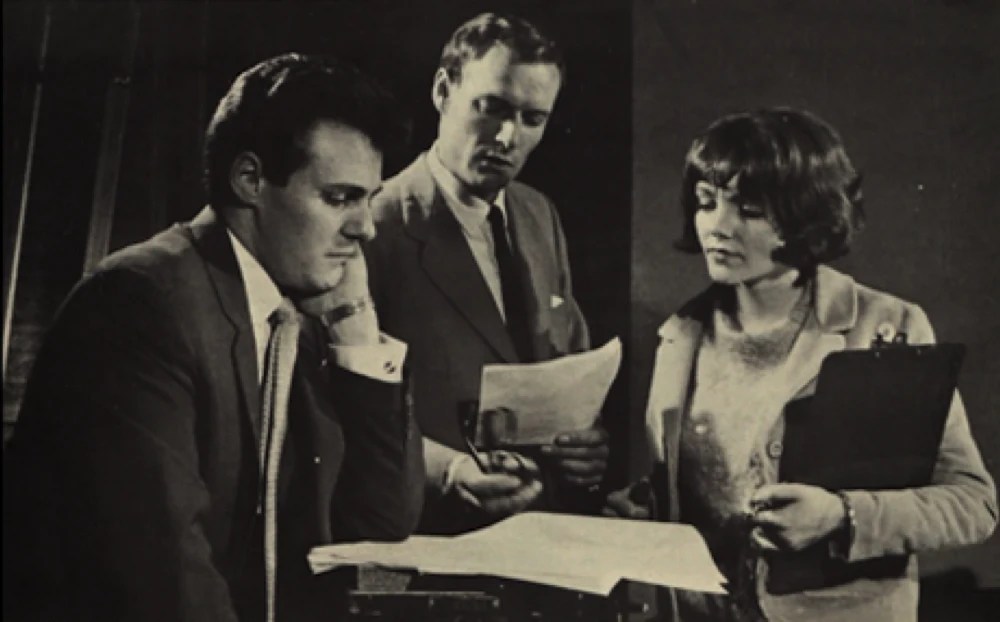
As the news spreads, public panic grows, governments introduce emergency measures and society begins to slide into chaos. Television journalist Peter Barry (Trevor Bannister) and his assistant Diana Winters (Celia Bannerman) find themselves caught up in the unfolding crisis, witnessing the political manoeuvring, scientific uncertainty and human drama surrounding the approaching menace.
Featuring Ralph Nossek as Professor Ramsay, alongside Margaret Neale, Denys Peek, Julian Somers and Arthur White, Object Z is an intriguing example of mid-1960s British television science fiction. Although originally intended for an adult audience, the serial was adapted for a teatime children’s television slot, resulting in a production whose serious themes, unsettling atmosphere and apocalyptic storyline were considerably more challenging than its scheduling might suggest.
Made on a modest budget, with shot-as-live studio-based drama complemented by stock footage, the series nevertheless creates a compelling sense of impending catastrophe. Its exploration of bravery in the face of the unknown, political extremism, and the fragility of civilisation gives it a relevance that extends well beyond its original 1965 transmission.
You can listen to the podcast now on your favourite app or follow this link. You can also listen to it on Youtube.


