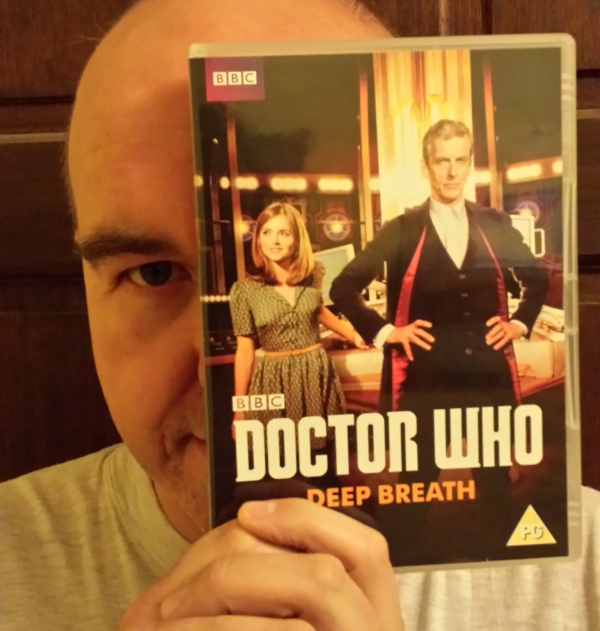
Doctor Who – Deep Breath reviewed

20150414_215848

One of my little side activities is writing reviews for the consumer site Ciao.co.uk, mostly on DVD’s. Unusually one my most recent submissions was rejected because the DVD in question “Doctor Who – Deep Breath” featured an episode I had previously reviewed as part of the Series 8 box set. Although as you’ll read the DVD also includes material not included in box set. Anyhow it seems a shame to waste the article, so my blog seemed an ideal home for it.

With the release of the complete Series 8 on DVD, is there any point buying a separate DVD of the first episode? Well it all depends on whether the chance to own its two exclusive extras is enough of an incentive.

    Feature

There’s a Tyrannosaurus Rex on the banks of the Thames, multiple cases of spontaneous combustion amongst Londoners, and a brand new Doctor for the Paternoster Gang to take care of. Clara thought she knew who the Doctor was, but she is finding it hard to relate to this strange older man. Can the regenerated Doctor stabilize himself in time to stop the terrifying Half Faced Man and his gruesome plans for London?
Matt Smith’s first adventure “The Eleventh Hour” felt wonderfully fresh and different. It was not just the lead actors who had changed, there was a new production team installed down in Wales, led by Steven Moffat, who wrote the story too. Aside from the TARDIS, everything else was original. By contrast in “Deep Breath” only Capaldi is new and he is surrounded by Matt Smith elements like Victorian London, the Paternoster Gang of Vastra, Jenny and Strax, a continuing companion in Clara and eventually an old enemy from even further back. Steven Moffat’s still in charge as well and writing again. So there is initially a sense of business as usual. Yet as the Twelth Doctor begins assert himself, a change can be felt.

For an obvious start there’s Capaldi’s less immediately appealing Doctor. He’s erratic, more vulnerable, wilder, more alien. It is too much of a cliché to say he is “darker” but his greater age and presence gives his Doctor much more gravitas once he has recovered. His final confrontation with the villain is laced with sadness and a grim determination. Not that he can’t be funny, but a lot of that humour is unintended on his part, it’s just in the way he sees the world and his casual rudeness toward Clara. Clara too is developing, becoming a more complicated and interesting person. However her difficulty in accepting a new older Doctor seems odd given all she has seen of other Doctors lately. It’s a thread that seems contrived and imposed on her by Moffat, who seems worried that the audience too won’t like having an older gnarly hero. This nervousness leads to an unexpected cameo by Matt Smith to give his “blessing” to the new Doctor, a moment that actually seems rather insulting to Capaldi’s efforts.

There’s plenty of good set pieces in this busy story. The tyrannosaurus opening, the Doctor’s conversation with it across the rooftops later, a restaurant filled with the living dead, Clara having to hold her breath whilst surrounded by monsters and the Doctor’s final confrontation with the Half Faced Man. Who incidentally is a great villain with a memorable look, and it’s a shame we do not see more of his than we do. Good jokes too, such as the cockney smugly telling his wife that the dinosaur is just a special effect, the Doctor’s reaction to his new face “Don’t look in the mirror, it’s furious!” or Strax’s examination of Clara. “You have an excellent spleen!”
“Deep Breath” has a few clunky moments but it’s definitely one of my favourites of Peter Capaldi’s first season. It benefits from it extra-long running time of seventy minutes to tell a rich story.

    Extras

There are three special features accompanying this story. “Behind the Scenes” is exactly what you think it would be, footage of the filming and interviews with some of the cast. It was originally shown on BBC iPlayer and the red button. This season’s behind the scenes series has been a lot better than the increasingly indulgent and samey Doctor Who Confidential of previous years, more focused, benefiting from its shortened running time of fifteen minutes.

I thought the exclusive prologue for “Deep Breath” rather disappointing. Hoping for more about the Doctor and Clara’s encounter with a tyrannosaur, or more of the Half-Faced Man mystery, instead we have Strax making a video log about the previous Doctors, whilst the gang are on a crashing spaceship that has nothing to do with the rest of the story. It’s essentially a remake of a previous Strax online video about the many Doctors filmed for the 50th anniversary. Dan Starkey is an entertaining as ever playing the Sontaran but the whole sequence feels superfluous compared to previous prologues.

There used to be a time when the announcement of a new Doctor was reserved for the “And finally…” spot on the evening news and perhaps an interview on “Blue Peter”. But it’s a sign of the importance of the show to the Beeb that Peter Capaldi’s unveiling qualified for a half hour live show on BBC1, which is available only on this DVD. Celebrity fan Zoe Ball hosted “Doctor Who Live: The Next Doctor” a shiny floor show and interviewed a few old cast members including ex-Doctor Colin Baker, introduced a video message from Matt Smith and finally ushered in Capaldi amongst a blaze of dry ice and lasers. It’s nice to have this bit of Doctor Who television preserved on DVD/Blu-ray for nostalgia but whether it is worth buying the DVD for depends a lot on how much you see this disc on sale for.

If you haven’t bought the Series Eight box set, which is already being reduced to a very reasonable price on some sites, I’d still say go for that. This disc is more of a novelty, designed for a moment in time in 2014. It has nostalgic appeal to fans but otherwise it’s an inessential release, despite the strengths of the story.

Live from Worktown poetry/comedy/music festival in Bolton

logo lfw

Whilst I’m not intending to spam the timeline with Live from Worktown notices, I’d be remiss if I didn’t put up links to both main webpage http://livefromworktown.org and the online box office http://livefromworktown.ticketsource.co.uk
Especially since I’ve just been putting a lot of work into the latter, listing all the events the organisers have planned for April and May. We’ve really got some big names coming to my home town of Bolton, UK, including one of the original Merseybeat poets – Brian Patten, and poet, comedian and singer John Hegley. Plus workshops, debates and a one-night revival of Dave Morgan’s play for voices “Hovis in Wonderland”, celebrating the work of poet Hovis Presley.

I’m currently editing a big launch trailer, so expect that to be posted here soon.

The weird thing about all this is, I couldn’t write a poem myself to save my life!

Doctor Who – The Lost Episodes – Taking Part in the debate

My good friend filmmaker Nigel J Anderson has been hosting some film tuition nights at Manchester Central Library. For one of these evenings he was demonstrating how to film and edit a debate, and he asked John Isles, Anne Louise Fortune and myself to appear in the exercise. We are all knowledgeable Doctor Who fans and the subject under discussion was the remaining lost episodes of from the Sixties. Many episodes of the BBC science fiction series were wiped in the early Seventies, along with a lot of other black and white television, because the BBC felt they had no lasting artistic or commercial value.

It was a fun evening and I hope our small audience enjoyed it too. I think Nigel did a great job putting it all together in a slick package too. I just wish I had worn a more colourful sweater so I didn’t risk fading into the white wall behind us 🙂

William Hartnell Era

Patrick Troughton Era

Hope you find them interesting.

Submissions wanted for the next Worktown poetry anthology

This year I am once again involved behind the scenes with our local poetry and related live performances festival. As part of it we are publishing an anthology with an open submissions opportunity for poets from the north of England:

logo lfw

As part of the Live from Worktown Festival 2015, we would like to invite poetry submissions from poets living in the north of England to appear in our festival anthology. The festival this year aims to showcase international performers and writers such as Brian Patten, John Hegley and Mandy Coe, alongside talented local artists.
But we also want to include you, so if you’re a poet living or working in the north of England then we want to see your work. Send us a maximum of two poems by the 13/04/15 to be considered by this year’s guest editor Anne Caldwell, head of poetry at Bolton University.
If accepted your words will be published in the festival anthology in April 2015 and may also appear on the festival website. All published poets will be invited to the anthology launch which will be held in Bolton during the Live from Worktown festival.
Please see below for submissions guidelines, and we look forward to reading your work.
The submission window is 23/03/15 to 13/04/15. Poems submitted outside this period will not be considered.
All submissions must be by e-mail.
Submissions must be sent as an attachment (doc, docx, pdf). Submissions sent in the body of an e-mail will not be read.
Submissions must be the original work of the entrant.
Any poems submitted that are not in English must be accompanied by an English translation.
Poems must be no longer than 30 lines.
Maximum submission of two poems per person.
Submissions should be made to: submissions@livefromworktown.org
Please include your name and postcode in your submission e-mail.
This opportunity is open to anyone aged 16 years or older who lives in the north of England.

logo arts council

Lear’s Daughters (or why is everyone so evil in King Lear?)

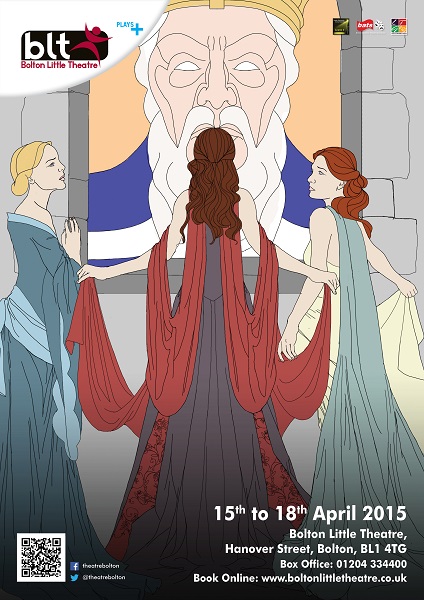
Hello again. One of the hats I wear is updating the Bolton Little Theatre website. I’m also on the marketing committee. At the last meeting I suggested filming some interviews with the creative souls at the theatre to promote up-coming plays and I’ve just completed the first one, which you can watch below.

It is centered on our forthcoming production in April of “Lear’s Daughters”, a prequel to “King Lear” looking into what made Goneril, Regan and Cordelia the women they are in Shakespeare’s tragedy. The play is written by Elaine Feinstein. But I’ll let director June Grice explain more…

Hope you find it interesting. Here is Ben Latham’s excellent poster for the production too.

BLT14156 Lears daughters

Exciting times ahead – Music, Poetry and Bolton

anthology2014cover
Live from Worktown was a 2014 festival of poetry and music based around the UK town of Bolton, my home. As well as the best local talents, it also featured sets from international names George Wallace and Anjum Malik. I was involved on the filming side and general gophering.

Tonight I’ve been at a meeting to discuss the forthcoming arts festival Live from Worktown and I’ve come away feeling very excited. There’s much to be done between now and May but already it looks as if our follow up to last year’s inaugeral event will be bigger and bolder. I’ll be posting up specifics about what I will be doing once they are confirmed but in the meantime, if you’ve not taken a look at the official website http://livefromworktown.org/ then please do. There is also a brand new archive site http://livefromworktown14.org.uk/ containing a permanent record of 2014’s events.

Thanks for reading. Stay tuned.

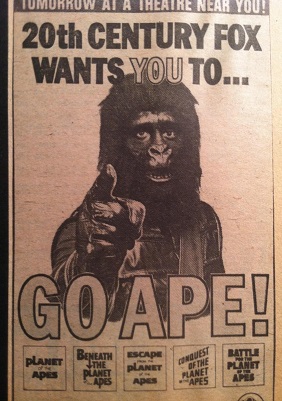
Go Ape! Or Get Your Stinking Paws Off My DVD Boxset

go_ape

I am a terrible hoarder of unwatched DVD boxsets. It’s a modern blight of our affluence. So this year I’ve been doing my best to reduce the clutter on my DVD shelves and that has led me to this six disc collection in an orange slipcase. Watching the five Apes movies in order for the first time I’m struck by how good the continuity is, especially considering that most of the films were not planned with sequels in mind. Little details like reusing the design of the spacecraft throughout the films mean a lot because I like my film series to fit together into one world.

Planet of the apes (1968)

The opening half hour is already visually striking, even before the apes appear. The spaceship crash is ingeniously created and because it is shot from the ship’s POV it hasn’t dated. Once the astronauts are on the surface there’s an emphasis on their tiny figures in a large unforgiving landscape. Taylor is a well-conceived protagonist who’s a bit more interesting than the average straight-arrow hero. He’s confrontational, cynical and self-reliant, but also intelligent, capable, passionate and ultimately concerned for the individuals around him, even if he doesn’t entirely respect them. I also approve of the way he doesn’t go “on a journey” to become a cuddlier, more sensitive man. He survives and achieves a kind of victory by the end.
Watching the film again, I’m impressed with how balanced its components are. It’s a satisfying action adventure, a witty satire on Western society, in particular race, class and religion, and it’s a meaty science fiction concept too. Seeing ape versions of environments like zoos and museums is unsettling. A definite droll highlight is the funeral service Taylor interrupts, with the priest eulogising that the deceased “never met an ape he didn’t like”, unconsciously quoting cowboy star Will Rogers. There’s a couple of terrific horror moments too, the gorillas posing for a photo over a pile of dead humans, and the later discovery of a stuffed Dodge in the museum.
The impact of John Chamber’s ape prosthetics cannot be under-estimated, a great melding of nature observation and theatricality. The apes are realistic enough to be convincing, whilst having faces that convey recognisable human qualities, such as the aristocratic orang-utans. Jerry Goldsmith’s marvellous and imaginative music score is another big factor, increasing the sense of Taylor’s alienation and the peril of the fight scenes.
Noticeably absent from this first film is the theme of gorilla militarism that becomes a much bigger motivation in the series later. Here the gorillas are simply straightforward blue collar workers.
Zira’s changing relationship with “Bright Eyes” as she names Taylor is cleverly written and played. Whilst always sympathetic, at first she treats him very much as an amusing pet. Later she has a moment when she’s resisting the idea of him being an equal, before accepting him as a person and in their last scene actually kissing him (clearly shown as a sign of affection rather than attraction take note).
Although its ending is a well-known part of pop culture, and in fact spoiled by the DVD box art, seeing it in context the moment is still chilling. I think it’s partly because of the lack of music, just the sound of the indifferent waves upon the beach, partly the way Charlton Heston sells it, and perhaps partly in the emotion of the glass painting itself, thanks to artist Emil Kosa.

Beneath the Planet of the Apes (1970)

It’s slightly irrational but with its mutants with psychic powers, an underground city, a more obvious antagonist in General Ursus and a new emphasis on action and militarism, this first sequel feels much more of a conventional science fiction movie than the original. To me is one of the main reasons why this sequel is inferior to the original. Another problem is that there is an inbuilt feel of repetition in the first half of the movie, as Brent undergoes the same series of discoveries that Taylor did, not to mention the fact that with the addition of a beard, James Franciscus has been cast as a knock-off Charlton Heston. That’s a shame really because Franciscus is fine in the lead and handles the action convincingly, but because of his cloned look, the film is continually reminding you that he isn’t Chuck.
There are some impressive scenes. The mass unmasking of the mutants is a great set piece. The gorilla army on the march and the mass hallucination they are attacked by is an unexpectedly vivid moment, especially the statue of the Lawgiver weeping blood. Ruined New York is not as poignant as the statue because the melted buildings give the whole place more of a fantastical atmosphere and thus less recognisable.
The film’s story may be darker but it also feels shallower. The first film touches on all kinds of modern concerns whilst this one is a cruder anti-war, anti-bomb parable. It also mostly misses the humour of its predecessor, aside from Cornelius and Zira pretending that he struck her, in order to deceive Zaius.
It’s quite brave move to seemingly finish the series so definitely but in the coming years that knowledge of the destruction of Earth does lend an extra frisson to the further sequels. That last line from some unknown omnipotent narrator is portentous yet I find it quite effective, a moment of very literary SF.

Escape from the Planet of the Apes (1971)

In retrospect it is such an obvious idea, reverse the journey of Taylor and make some intelligent apes the misunderstood strangers in an alien civilisation. That it works so well and makes this third sequel almost as much fun as the original owes a lot to Roddy McDowell and Kim Hunter and their strong performances. It also benefits from the return of much of the droll humour of the first film, making the fantasy seem much more believable. The sequence where they explore Seventies USA as celebrities is one of my favourite parts of the film and its loveliness only enhances the tragedy of the third act. The scene where they face a congressional enquiry and win the audience over with their wit is another highlight.
It’s a smart piece of continuity that the villainous scientist pursuing the couple is Dr Hasslein, the scientist Taylor was narrating to in the first film. The story is an excellent tragedy. We know from the beginning about Zira’s past as a human zoologist and that sooner or later that is going to catch up with them. Carrying on the mirroring of the first film, their very existence challenges the society they have landed in, and it is almost inevitable they will be imprisoned and killed.
The film’s sympathies are almost completely with the chimpanzee couple, although commendably human society is depicted not so much as actively evil, more misguided and short-sighted. Only Hasslein is unquestionably the bad guy for his hubris in trying to change future history.
Natalie Trundy gets the best of her four roles in the Apes series, as sympathetic zoologist Dr Branton, even though she basically in the role of supportive girlfriend of the human hero Dr Dixon.
I remember the final scene of the young Caesar beginning to talk being quite haunting. Watching it this time, not so much because the looping of the film to make the chimp appear to talk is more obvious to me this time. Nevertheless it is an effective end and the only film in the series to end on a cliffhanger they had already planned to resolve.

Conquest of the Planet of the Apes (1972)

Despite the fact that it often looks more like a made for television movie, thanks to an even lower budget, this is an entertaining if downbeat seventies SF parable. The metaphor about black slavery may be anything but subtle, especially compared to the first film, but it does create some striking scenes in Ape Control as human guards herd crowds of frightened apes about, moving them with cattle prods and whips. Making MacDonald, the apes’ chief supporter amongst the government a black man is also rather obvious, even if Hari Rhodes plays him well.
Roddy McDowell impresses once again by making Caesar noticeably different to Cornelius. Much more aggressive and less humorous. Once a slave he quickly takes on the mantle of the alpha male in a prison block, with a wide streak of cynicism. As a result the studio re-edit of the final scene to make him a peacemaker, rather than a revenger, doesn’t really work. Those final words about treating the conquered humans with justice and fairness ring hollow, especially against a city on fire.
Using the Irvine Campus of California University was a good decision, since the place certainly looks futuristic without the need for too much set dressing. Dressing nearly all the apes in jumpsuits however does lend an air of cheapness to the enterprise and it was no surprise to read that a lot of the futuristic props and sets were recycled from Irwin Allen television productions. It seemed in keeping with the TV feel of much of the film. But the story is brisk and benefits from no gratuitous romantic sub-plot being shoehorned in. If the series had ended here it would have been a satisfying conclusion.

Battle for the Planet of the Apes (1973)

The final film in the original series is not great but it’s not a turkey either, thanks to the care taken to keep the continuity links with the previous films, and the performances, especially Roddy McDowell and more interestingly singer/actor Paul Williams as the optimistic, curiosity-driven orang-utan Virgil. It’s a more hopeful conclusion to the saga, although there remains a shadow that the promised human and ape equality will fail and humanity will devolve into mute hunter gatherers again.
As with the previous film there is something of television movie feel about it all, with lots of recycled props and masks from older films. Aside from the debate about whether the future can be changed or not, after Caesar hears the voice of his father describing it, the plot in this one is shallowest yet. It is essentially a western, with the good ranchers facing gorilla black hats and mutant enforcers from the railroad company. It’s not about themes of racism and nuclear war anymore, it is about captures, escapes and a chimpanzee having to do what a chimpanzee must do.

Planet of the apes (2001)

A misfire on several levels, director Tim Burton’s “reimagining” suffers from not really being about anything more than a nostalgic desire to do an Apes movie with modern technology. The film’s highlight is undoubtedly Taylor’s arrival in Ape City, watching in amazement along with Mark Wahlberg at a culture that is simultaneously non-human but with echoes of our own. The detail in the costumes and implements, drawing on Asian and African influences is beguiling. I feel this is where Burton’s real interest lies, just realising a simian-centric culture.
However neither he nor writers William Broyles Jr, Lawrence Konner and Mark Rosenthal have an idea what story to set in that world. So we get a script that tries to be different for difference’s sake, making the planet definitively alien for example and bringing in genetic engineering, neither of which really adds to the interest. As for the ending, it just doesn’t make any sense tagged on to the end of the story we’ve just watched, let alone having a huge statue of Thade on Earth without any more justification than it’s a surprise.
Performance wise it’s largely a disappointment too. In the role of Taylor, Wahlberg is his usual dull frowning self, whilst Helena Bonham-Carter gives one of her worst performances as Ari, failing to convey any sense of being a non-human and perfunctorily running through her admittedly trite dialogue. In fact only Tim Roth really comes out with any credit, putting in the energy and conveying Thade’s personality with his whole body and movement.
Rather than telling a good adventure tale whilst holding a mirror up to our current culture, this remake is just a succession of sub-plots about characters we don’t really care about, leading to an underwhelming time travel revelation. And it’s a tribute to John Chamber’s original make-up that the ape prosthetics of thirty plus years later do not look significantly better.

I’m going to leave the recent two CGI movies for another time, especially since I haven’t seen Dawn yet. Watching these movies again has been an entertaining experience. Strange to think the Apes movies were the biggest SF movie franchise until Star Wars came along four years later. They were very much films of the restless Seventies, when pre-Star Wars, USA cinematic SF tended to be gloomy and message driven rather than just escapism. The best of the Planet of the Apes series combined that intelligence with good characters and a sense of adventure and Saturday matinee peril.
Santa Claus Conquers the Mayans

For the past few years, my friends and I, under the guise of Westlake Films, have made some kind of comedy video to tie in with Christmas. This year’s production, made despite all kinds of problems and completed against the clock by director/editor Kevin Hiley, is Santa Claus Conquers the Mayans. Written by John Isles, it features a Mancunian Santa and his Chief Elf in a race against time to stop a deadly boardgame from destroying the world. A plan that involves robbery and Mexican wrestling.

As well as helping to make the film in general assistant category, I also make a couple of onscreen contributions, playing a dubious Australian TV historian and providing the opening narration.

You can find out more about Westlake Films and our past work at our website: http://www.westlakefilms.co.uk

Merry Christmas everyone!

Arsenic and Old Lace

arsenic

I’m shamelessly plugging my upcoming appearance in “Arsenic and Old Lace”, the classic American black comedy by Joseph Kesselring. I’m playing Dr Herman Einstein, the plastic surgeon and cringing henchman of the fiendish Jonathan Brewster. Armed with a comic German accent, I’ve been part of a hard working cast of actors and technicians at Bolton Little Theater and the rehearsals have been busy but rewarding.

The play is on for seven nights between 6th to 13th of December, tickets are £10 and if you are interested in watching then find out more from: http://boltonlittletheatre.co.uk/whats/arsenic-and-old-lace/

Written in 1939, this brilliantly constructed comedy, has impressively stood the test of time. As a writer I love the script, not just for its tightly designed plot and atmosphere of matter of fact madness, but for some jokes about writers which are still bang on target. Take Office O’Hara, the would-be playwright for whom his policeman job is “just a temporary thing”. “How long have you been a policeman?”, asks Mortimer, “Twelve years”, replies O’Hara blithely. Later on, after boring the room senseless with his hours long pitch, the cop protests, “I know the first two acts are a bit long, but I can’t see what we can leave out!”

It’s a play that combines slapstick of hiding dead bodies with some sharp satire on the hypocrisies of the monied establishment. The Brewster sister are hailed for the good works, but they are shown to be rather prejudiced as well as murderers. Their money and position means that the police treat them with rather too much respect. Although we are a British theater troupe, we are playing with American accents, because somehow the comedy just doesn’t work without them. This play is both timeless, yet fixed to a specific place and time.

Expect some production photos in a little while.